
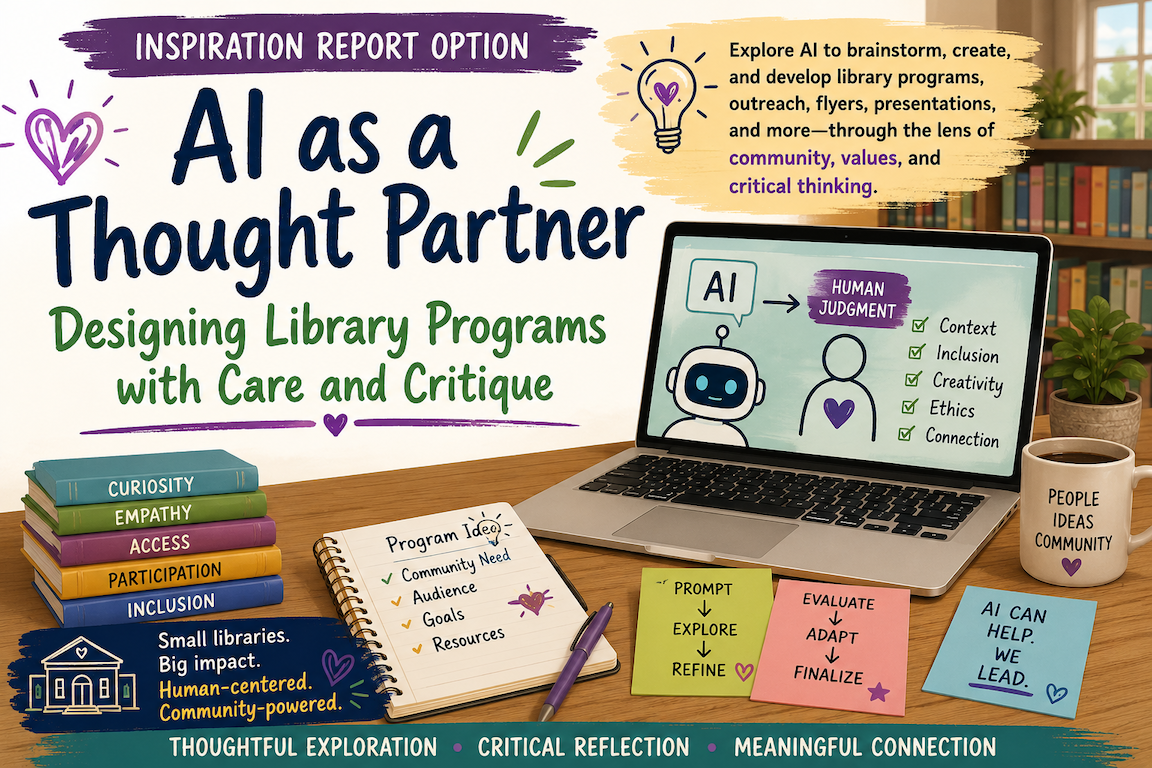
For this Inspiration Report option, you will explore how artificial intelligence might support the early stages of creating a library program, service idea, flyer, outreach message, display, presentation, or community engagement activity. This is not an assignment where you ask AI to create something and simply turn it in. Instead, you will use AI as a brainstorming and creation partner, then critically examine, revise, and humanize what it produces.
This option may be especially useful when thinking about small libraries, rural libraries, school libraries, branch libraries, or any library setting where staff time, funding, and capacity are limited. How might AI help generate a starting point, expand possibilities, or create useful draft materials? Where might it fall short? What human knowledge, care, local context, and professional judgment are still essential?
Your work should be rooted in the foundations of the class: participatory service, community needs, curiosity, empathy, creativity, inclusion, transparency, and the evolving role of libraries as human-centered spaces.
AI may help you create a finished or near-finished product, such as a flyer, program outline, presentation, outreach message, or planning document. Your task is to show how you prompted, evaluated, revised, and contextualized that product so it reflects the needs of a specific library community and the values of this course.
What You Might Explore
You may use an AI tool to help brainstorm, design, draft, or develop one of the following:
- A library program idea
- A program outline or agenda
- A flyer, social media post, or outreach blurb
- A presentation or slide deck
- A passive program or display concept
- A community engagement activity
- A staff training idea
- A teen, adult, children’s, family, or intergenerational program
- A low-cost program for a small or understaffed library
- A welcoming or inclusive service idea
- A “hyperlinked” library experience that connects people, stories, technology, and community
Required Elements
Your Inspiration Report should include the following:
1. Context and Purpose
Briefly describe the library setting or community you are imagining. This may be a real library, a library you work in, or a realistic hypothetical setting.
Explain the need, opportunity, or community interest your program or idea is responding to. Consider questions such as:
- Who is this for?
- What community need or interest does it address?
- Why might this matter in a library setting?
- How does this connect to the human-centered values of the course?
2. AI Exploration Process
Describe how you used AI as part of the brainstorming, planning, or creation process. Include examples of prompts you tried, how you revised them, and what kinds of responses the AI produced.
You might reflect on:
- What did AI help you think through or create?
- What did it suggest that was useful?
- What felt generic, unrealistic, biased, inaccessible, or disconnected from local community needs?
- How did your own knowledge of libraries improve, challenge, or reshape the AI’s output?
You should include selected examples of your prompts and AI responses, but the focus of the report should be your thinking, analysis, and revision process.
3. Human Revision and Professional Judgment
Explain how you changed, improved, rejected, or reimagined the AI-generated ideas or products.
This is the heart of the assignment.
Consider:
- What did you add that AI could not know?
- How did you make the idea more inclusive, practical, ethical, welcoming, or community-specific?
- What would a library worker need to consider before implementing this?
- What would need to be adapted for a small library with limited staff, time, or budget?
- How does the final idea reflect the principles of this course?
4. Critical Reflection on AI in Library Work
Reflect critically on the role of AI in this process. Your response should move beyond whether AI was “good” or “bad.”
Consider questions such as:
- Where can AI support library workers?
- Where might it create risks or blind spots?
- How might AI reinforce generic programming, stereotypes, inaccessible design, privacy concerns, or assumptions about communities?
- How can library workers use AI without outsourcing creativity, care, ethics, or professional responsibility?
- What does this exploration reveal about the continuing importance of human connection in libraries?
5. Final Concept or Product
Share your revised final idea or product. This may be a program outline, flyer draft, presentation, event description, outreach plan, display concept, staff training idea, or other library-related creation.
Your final concept or product may be polished, practical, and ready to share, or it may still be an early-stage prototype. Either is acceptable. What matters is that you clearly show how AI contributed to the process and how your own critical, human-centered thinking shaped the result.
Suggested Student Deliverable
Students may submit a written reflection of approximately the same length as the other Inspiration Report options. The report should include:
- A brief description of the imagined library/community context
- The AI prompts used and selected AI responses
- A discussion of what was useful, problematic, or missing
- A revised program, flyer, presentation, outline, outreach idea, or other final product
- A critical reflection connecting the experience to course themes
Students should not submit AI output alone as the report. The emphasis is on process, critique, revision, context, and connection to course learning.
Summary:
For this Inspiration Report option, you will explore how artificial intelligence might support the early stages of creating a library program, service idea, flyer, outreach message, display, presentation, or community engagement activity. This is not an assignment where you ask AI to create something and simply turn it in. Instead, you will use AI as a brainstorming and creation partner, then critically examine, revise, and humanize what it produces.
AI may help you create a finished or near-finished product, such as a flyer, program outline, presentation, outreach message, or planning document. Your task is to show how you prompted, evaluated, revised, and contextualized that product so it reflects the needs of a specific library community and the values of this course.
Your report should include the library/community context, the prompts you used, selected AI responses, your critique of the AI-generated material, your revised final concept or product, and a reflection connecting the experience to course themes such as participation, creativity, inclusion, empathy, access, transparency, and human-centered library service.
 This page was developed with support from Hyperlinked Library Insights, an AI-enhanced course partner that has been trained on the full content of INFO 287: The Hyperlinked Library, including modules, assignments, and grading criteria.