
Going through the Pew research and AI readings in the Hyperlinked Environments module, I kept thinking back to one line from danah boyd’s “What World Are We Building?” from the previous module:
“[T]oday’s technology is valued — culturally and financially — based on how much it’s used by the most privileged members of our society.”
This is the case with AI, as it has been used by employers to screen applicants, by large tech companies to serve as the new reference desk, and, perhaps most egregiously, by the government to identify and arrest suspects. This is problematic because AI hiring tools can perpetuate racism (Bommasani et al., 2026), Google’s AI overview provides inaccurate content and sources that don’t corroborate the information (Mickle et al., 2026), and people of racial minorities have been incorrectly identified and wrongly arrested because of facial recognition technology (Liang, 2026).
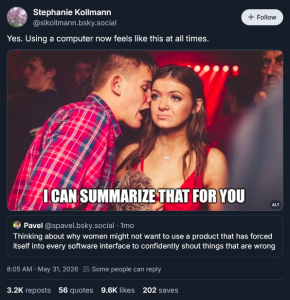
AI also affects women and men differently. In a 2025 report, the UN estimated that women are 2–3 times as likely to be in the jobs at greatest risk of being replaced by AI, especially in high-income countries (Gmyrek et al., 2025, p. 43–44). Research has also shown that women are less likely to use AI, not necessarily due to lack of access, however, but due to other factors such as perceived usefulness, institutional support, social legitimacy, and trust/privacy/risk concerns (Cranney et al., 2025).
Some argue that the fix is to ensure equal access to AI. After all, awareness of AI in everyday activities correlates to levels of education, income, and internet use, per Pew research (Kennedy et al., 2023). Cranney et al.’s conclusion was most concerned with increasing women’s usage of AI so they don’t fall behind in their careers and so that they can participate more in AI development. When asked about AI during the Fall 2025 “Ask Me Anything,” then-director of the SJSU iSchool Anthony Chow also said, “It’s our job to really debunk any fears about AI,” though the fears he emphasized were more about not knowing how to use new tools (Winslow, 2025, 00:24:25–00:27:08).
The issue is much more complex, especially when public attitudes toward AI in the U.S. have become increasingly negative throughout the years despite increased usage: data privacy is a major concern; majorities of Americans have low confidence in both government regulation and corporate responsibility (Tyson & Kikuchi, 2023; Kennedy et al., 2025; Gottfried et al., 2026). Though these are just sentiments, we’ve already seen concrete ways AI has perpetuated systemic oppression, in the first paragraph. These issues will not go away once everyone uses AI. These issues are not for librarians to “debunk.”
Honestly, I don’t know what role libraries can play beyond fostering community and literacy. But I do know that literacy goes beyond simply knowing how to use a tool. In the meantime, I hope that we can help the public think more critically amidst all the misinformation and slop that AI has helped proliferate (PBS, 2025) and find ways to decentralize our technological needs.
References (click to expand)
Bommasani, R., Bana, S. H., Creel, K. A., Jurafsky, D., Liang, P. (2026, May 26). AI hiring tools can yield racial bias and systemic rejection. Stanford Institute for Human-Centered AI. https://hai.stanford.edu/news/ai-hiring-tools-can-yield-racial-bias-and-systemic-rejection
boyd, d. (2016, January 25). What world are we building? Data & Society: Points. https://medium.com/datasociety-points/what-world-are-we-building-9978495dd9ad
Cranney, K., Delecourt, S., & Konin, R. (2026, May). Global evidence on gender gaps and generative AI over time [working paper]. Harvard Business School. https://www.hbs.edu/ris/Publication%20Files/25-023_be8fb517-3dd5-40aa-97f9-4e42e1c8e6ff.pdf
Gmyrek, P., Berg, J., Kamiński, K., Konopczyński, F., Ładna, A., Nafradi, B., Rosłaniec, K., Troszyński, M. (2025, May). Generative AI and jobs: A refined global index of occupational exposure [working paper]. International Labour Organization. https://www.ilo.org/sites/default/files/2025-05/WP140_web.pdf
Gottfried, J., Bishop, W., Anderson, M., Faverio, M., Park, E., & McClain, C. (2026, June 17). Americans and AI 2026: Chatbots, smart devices and views on impact. Pew Research Center. https://www.pewresearch.org/internet/2026/06/17/americans-and-ai-2026-chatbots-smart-devices-and-views-on-impact
Kennedy, B., Tyson, A., & Saks, E. (2023, February 15). Public awareness of artificial intelligence in everyday activities. Pew Research Center. https://www.pewresearch.org/science/2023/02/15/public-awareness-of-artificial-intelligence-in-everyday-activities
Kennedy, B., Yam, E., Kikuchi, E., Pula, I., & Fuentes, J. (2025, September 17). How Americans view AI and its impact on people and society. Pew Research Center. https://www.pewresearch.org/science/2025/09/17/how-americans-view-ai-and-its-impact-on-people-and-society
Liang, G. (2026, May 30). In the image of injustice: A critical examination of AI, surveillance, and systemic racism in the United States. Race and Justice. https://doi.org/10.1177/21533687261455743
Mickle, T., Metz, C., Freedman, D., Terol, T. M., & Collins, K. (2026, April 7). How accurate are Google’s A.I. Overviews? New York Times. https://www.nytimes.com/2026/04/07/technology/google-ai-overviews-accuracy.html
PBS. (2025, October 23). What is ‘AI slop’ and how does it affect users? https://www.pbs.org/newshour/classroom/daily-news-lessons/2025/10/critics-warn-of-ai-misinformation
Tyson, A., & Kikuchi, E. (2023, August 28). Growing public concern about the role of artificial intelligence in daily life. Pew Research Center. https://www.pewresearch.org/short-reads/2023/08/28/growing-public-concern-about-the-role-of-artificial-intelligence-in-daily-life
Winslow, B. (2025, September 3). FA25 Director’s Ask Me Anything [YouTube video]. https://youtu.be/b9w1yBe7PsU
Hi @anitayjc ! It’s funny, I also wrote about AI this week, just really from a line I read in one of our readings: “Microsoft believes that if they build it, we will come -and buy their product. Google’s approach is different: if they built it, we will integrate it into our lives”. And I think that’s what Google has done with Gemini, and just what AI has been doing the past several years: just integrating into our lives. In my blog, I talked more about how it affects our social environment. The video you linked about “AI slop” (which I had not watched yet) is really interesting and does also mention the human connection this “slop” can steal from us.
You’re bringing up a really relevant point when you say that despite the increasingly negative view that the public has towards AI, the number of its users also increases. I think that part of it is maybe due to the productivity chase. We are asked for more and more, and the time saving that AI can sometimes offer for some tasks can easily lure many users in. AS for the actual slop, I’m not sure. Maybe part of the appeal is the easier creation of videos/images/music/etc, which used to be accessible to people who were trained. I personally do not enjoy watching videos that are fake, even if they seem cute or funny., but clearly I may not be in the majority! As much as I used to believe that the internet was the most impactful technological change that ever happened, I think we’re riding the early stages of a newer, bigger one, that will have many more ramifications.
Thanks for the comment, @jenniferw! I also find that line about Google’s approach interesting in the case of AI. Many people recently switched to other search engines like DuckDuckGo once Google’s AI Overview started displaying conversational replies (https://www.cnet.com/tech/services-and-software/duckduckgo-installs-increase-after-google-io). I actually made the same move on my phone because I was bothered by how much space the AI responses took up on my screen. I’ve also seen tips on disabling AI overviews and even hiding the AI buttons. That said, I still use Google Search on my computer and the Google Workspace is pretty much fully integrated into my life, as has been the case for the past 15+ years at this point—it’s hard to escape!
As for AI-generated entertainment, I am with you. As someone who loves the arts and is grateful for parents who also cared for the arts, I do wonder if there’s a correlation between how much art one was encouraged to engage with in their youth and how inclined they are to use AI to generate stories, videos, images, music, etc. To me, the arts are about experimenting and making deliberate choices to make ourselves seen/heard, so that component of human connection is missing when we “create” and consume content that had minimal thought/effort put into it. To deliberately, manually remix or reference other artists is one thing, but to scrape their work to approximate it is something else entirely.
@anitayjc You present a strong and grounded exploration of current issues with AI here. I would venture to say that libraries, especially public libraries, are still finding their way into how to effectively educate the public. I’m very impressed with what Toronto Public Library is doing as one example with various learning opportunities for AI as well as the AI Innovator in Residence program and their AI Summit. https://tpl.ca/programs-and-classes/featured/learnai/2025-ai-summit/
Thank you for the link @michael, I’ll have to check that out!
@anitayjc 😃👍