
Trust. Be Curious. Transform. And Don’t Do it Alone

In some of the stories Michael has shared it’s apparent that some libraries and staff still struggle with viewing users almost as adversaries or challenges. When we find ourselves asking something like ‘how do we protect the library from users?’ that signifies a fundamentally flawed relationship to our user-base. To break out of that way of thinking we have to (1) understand what it means for the library to belong to its users, and (2) respond with curiosity and compassion.

At least some of the pressure libraries feel comes from trying to do everything, all at once, and trying to do it alone. We live in a society where we view abundance as coming from the top of the social-economic hierarchy and flowing downward. Large companies “create jobs and opportunities” for workers, billionaires engage in philanthropy, charities provide for the ‘needy’. Therefore we see the library as a provider and therefore — unfortunately — as being above our most vulnerable users. Then we run into issues with trying to pour from an empty cup. That view is false. Workers create value for companies through their labor and it’s the people on the ground that make the biggest difference. Value flows UP in our society regardless of what the CEOs and billionaires say, which means the abundance actually lies at the bottom.

When we see our users and our community as allies and partners we open up new possibilities for both our users and for the library itself. Instead of trying to be every solution, be the vehicle for the solutions the community has to offer. Ask people what they need, what would make their lives better. Then ask people what solutions they have for the issues their community faces. Bring services to them where they are. Make it easier for them to come to you. Ask them for help and partner with groups in the community to expand services. The library doesn’t have to do it all or be the only answer, but it plays an important role in making these things happen.

I was really moved by the Wash & Learn program because not only was it bringing library services and supports to people when it would be convenient for them, it was also run by young volunteers who no doubt gained skills and insights about what their community needs. Libraries belong to users, so they should be tools that help users and communities help themselves.
Photo by Matt Seymour on Unsplash

I think part of the solution displayed here is thinking about users as more than library users. They are also teachers, parents, singers, hosts, designers, and so much more. They are also drivers, eaters, shoppers, and just people who need to do laundry so they have clean clothes to wear next week.

For my own work, I was really excited to learn about Commons in a Box created by CUNY. It is exactly the kind of tool that I’ve been looking for or thinking about building to help communities connect and create together. I have two projects where I would like to try to implement this and I am so excited to learn more about how to create and support communities through platforms like this through experimentation.

Assignment X: Participation and Community Empowerment

The theme within the concept of the Hyperlinked Library that has most captured my attention is that of user participation. I love that the Hyperlinked Library takes this concept beyond participation in programming or even providing feedback to help design library services, instead it asks how libraries can support users actively participate in all areas of their lives and as members of their communities.

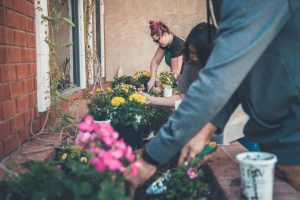
photo of three people planting flowers
Photo by Quilia on Unsplash

Participation in this way is about agency and empowerment. Libraries exist to connect their communities to information and resources (including people!) that enable them to take action, to create, and to make an impact on their own lives and on the world around them. For libraries to do this work, they must break down the barriers that make information and people inaccessible.

Libraries are already doing versions of this: creating zine collections featuring local zine-makers; supporting civic literacy by educating users on their rights and on issues that affect them so they can make informed decisions;“exchanging knowledge without curriculum and administrators” (Stephens,2016); and offering seed libraries for home and community gardens. Even outside the library itself, Little Free Libraries have expanded who can contribute to their communities through literary resources; and when established libraries join in, these little libraries can become a powerful expansion of the library’s mission and reach. (Cottrell, n.d.)

The capitalist framework once promised that competition would drive innovation and push our societies to new heights. Instead, we have witnessed that same competitiveness hold individuals, businesses, and organizations back from real innovation and service. A competitor is a threat that we must either attack or defend against. But when we stop seeing everything as a threat — including Little Free Libraries — we instead have the opportunity to better serve our communities by meeting them where they are, answering their needs, and pivoting to work with them using the tools they’re already holding. (Schneider, 2006) Sometimes the library will act as a leader, educating and aiding users. Other times the library will find itself jumping on a bandwagon that users started. A successful library need not predict their users needs at every turn. A library that truly belongs to its users will accept being helped and led by its community instead.

Libraries must belong to its users and its community in all ways. Not only in the literal but indirect way of taxpayer funding but also emotionally. When we participate in building something with our own hands, when someone relies on us, and when we are allowed to contribute something substantial to a project or cause, we develop a sense of ownership. Libraries cannot be charities, they cannot be top-down resource provision for the “needy,” they must be spaces where people come to provide to the library, to help themselves, and to support each other. This is the kind of ‘buy-in’ that will generate true participation and empowerment. (Casey, 2011) This is how users and communities learn to practice agency and solve problems themselves.

Photo of an older asian man helping a young brown-skinned woman fill out paperwork
Photo by Monica Melton on Unsplash

The average person in the Global North is alienated from labor and expertise. We are experts in our own fields or our own roles, but lack understanding about other kinds of work and other kinds of knowledge. Worse, we assume that these things are inaccessible and far away. We are taught that engaging expertise means outsourcing, literally bringing in professionals from outside our circles to solve our problems for us (and usually with the exchange of money). But what if the expertise — the experience — we need is already local? What if we could learn to tap into the wisdom of our neighbors? What if we could learn to build more resilient and self-sufficient communities, not through isolation but through connection? What if our users are themselves the answers they seek? and the answers we seek?

Some of the questions I am most interested in exploring throughout this course include:

    • What are ways that people working at any level or role in a library can help build participatory culture?
    • What might it look like to build this kind of participatory culture in other organizations, especially in smaller and less formal ones?
    • How can library users exercise their agency as users and community members, to take ownership of their libraries as spaces for active participation?

References

Casey, M. (2011). Revisiting participatory service in trying times. Tame the Web. https://tametheweb.com/2011/10/20/revisiting-participatory-service-in-trying-times-a-ttw-guest-post-by-michael-casey/ 

Cottrell, M. (2018). The question of little free libraries: Are they a boon or bane to communities? American Libraries Magazine. https://americanlibrariesmagazine.org/2018/01/02/question-little-free-libraries/

Schneider, K (2006). The user is not broken. Free Range Librarian. http://freerangelibrarian.com/2006/06/03/the-user-is-not-broken-a-meme-masquerading-as-a-manifesto/ 

Stephens, M. (2016). “The age of participation” in The Heart of Librarianship, p. 79. ALA Editions.