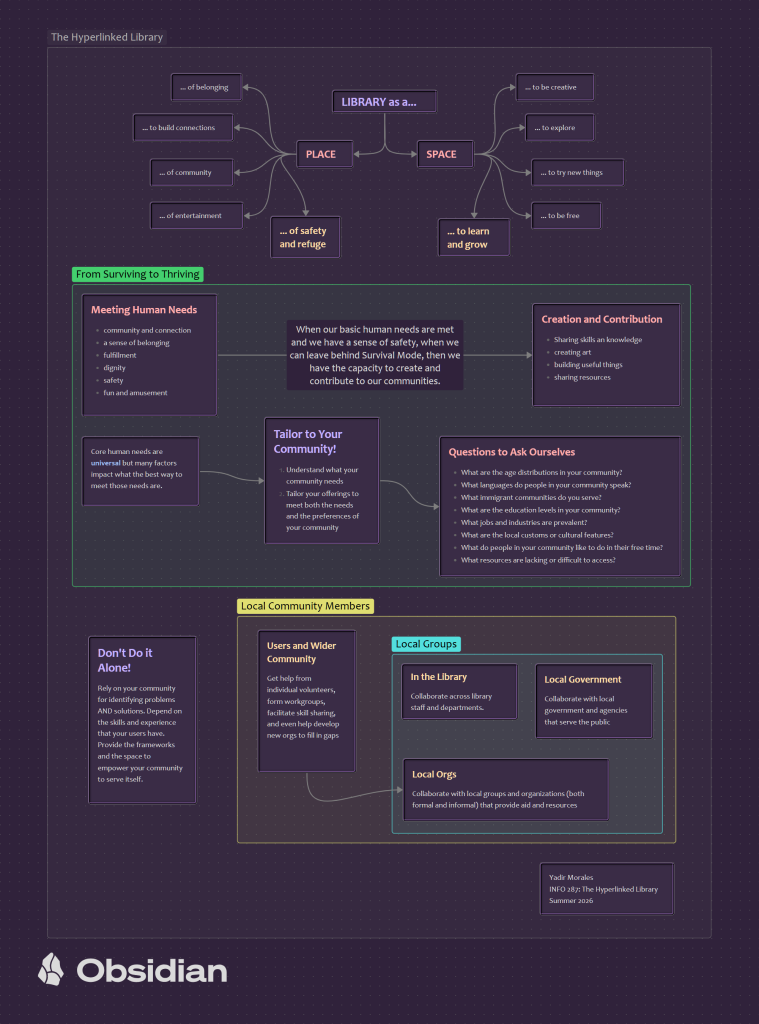
As I reflected upon this semester I found a couple of themes that really stood out to me. One major theme was this dual purpose and pathway of supporting members of our community From Surviving to Thriving. Libraries serve as a place of safety and refuge. I see this often in my own community in how my libraries serve my unhoused neighbors, providing them with space, resources, and a place for them to relax in dignity. Libraries also serve as places to create and explore: STEAM activities for kids, conversation and social activities for adults, makerspaces for people of all ages. It provides users the opportunity to expand their understanding of the world, their skills, and even their sense of self. It is a place of dreaming and a space of possibility.
While all of us need things like shelter, food and water, safety, connection, and fulfillment, every community will have different specific obstacles and resources to actually meeting those needs. Our job is to be curious and flexible. We must understand what our community lacks, and also what strengths it has. If our community lacks public transportation but has many families with mini-vans, could we coordinate carpooling efforts for community events or voting to expand access? If we have a large immigrant population, can we build programs of mutual culture and language sharing? If we have a large population of seniors can we create programming where they can share their stories, get help digitizing their memories (oral histories, photographs, etc.) and contribute to our local historical archives for future generations?
There are so many opportunities to collaborate with our library users and local groups and organizations to benefit many in our community. I think we have to look beyond traditional problem-solving and service providers to see just what our users themselves can do.
This has been such a wonderful journey. Through this class I feel like my mind is bursting with ideas and possibilities. More than ever I want to dive in and help build these kinds of collaborations in my community.
Thank you all for your generous sharing and ideas this semester!