
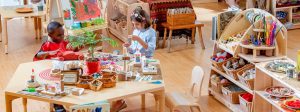
There were many nuggets of wisdom and inspiration once again with this Choose Your Own Adventure module. I decided to pursue the School Libraries route, as I currently work in a high school library and although I would be open to various routes of librarianship, my current dream role would be a school librarian. I loved witnessing the amazing examples of school libraries adapting, innovating, and evolving to keep up with our rapidly changing digitized society. I especially marveled at the astute examples of these environments pushing the envelope by transforming their traditional school book warehouses into malleable, imaginative, and creative makerspaces and learning commons. If you cannot infer by now I adore this trend and the participatory nature that is associated with these community hubs. One article that especially resonated with me was the article; “Reinvented School Libraries Unleash Student Creativity” by Sara Luster from 2018. This subtitle of the article caught my attention immediately; “No longer zones of silence, school libraries are now bustling hubs of student social activity that enhance learning and nurture imaginations.” I am enamored with this statement and idea.
It made me once again ponder upon my current work atmosphere and reflect upon what kind of library I would love to envision myself in for the future. I know it would be difficult to pull off revamping our library completely into having a designated learning commons space, especially since unfortunately the higher ups in our organization tend to have the “we don’t have time for that” and “we’ve always done it this way” mentalities, but it did have me wondering if we could snippet some of these integral concepts and incorporate them into our current program? What if we transformed our central space within our own library to host more frequent, engaging, and creative events? Could we host craft nights, poetry slams, concerts, a plethora of workshops, STEM experiments, robotics challenges, author talks, game nights, seed trading…etc?
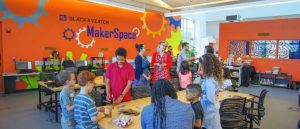 In addition, I would love to gain direct patron feedback. Where can we put a suggestion board or box in our school library? What would the students want their library to be transformed into? What things would they keep vs. discard, what things would they change? What local organizations could we partner with to put on educational and appealing communal events? Could we partner with an animal rescue and have service animals come in to read with our kids? Should we have the kids design and install a trinket trade box in our library, to encourage whimsy? The possibilities are endless, yet it would be illuminating and impactful to see what the users wanted to see within these special and dedicated learning spaces. Even better would be trying to implement and dabble with some of these ideas if feasible. This is the kind of library I want to work in, where curiosity, ideas, and imagination are rampant. I want the users to feel empowered, heard, and valued, where all walks of life along with their ideas are welcome. After all, our main mission is to serve them and our communities. As their needs change, libraries ought to do the same, especially if they want to stay relevant within our rapidly changing informational landscape.
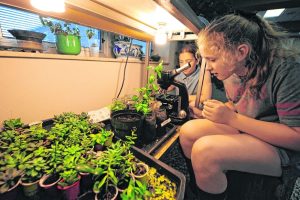 I believe more than ever we need to capitalize on opportunities for social connection and engagement amongst our peers whilst simultaneously pursuing hands-on learning through these creative ventures. With the inundation and overwhelm of information we experience daily, these creative hubs can serve as a form of reprieve for our minds. There is an inexplicable joy and therapeutic benefit that comes with cultivating curiosity and creativity with your hands with these types of experiences (in my humble opinion). This is such a novel and alternative way for students to learn within our modern society. With the advances in technology, I have been able to witness firsthand that students, regardless of walk of life or age, can tend to have a hard time focusing or sitting too long within a classroom setting these days. As someone who has never been officially diagnosed but recognizes that I have ADHD tendencies, this type of learning is a breath of fresh air for people like me. This participatory trend helps alleviate some of this pressure, in allowing students to move, connect, experiment, and learn hands-on material through this creative and engaging process. This also further heightens students’ abilities for problem solving skills.
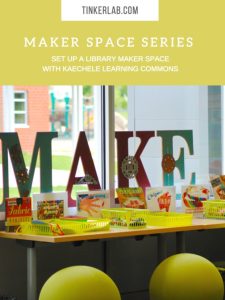
Another excellent library example mentioned within our course that excels in this maker space genre is The Bubbler in Madison, Wisconsin. I currently work in Wisconsin, and I hope to go there in person one day to see this incredible learning space firsthand. I dream of working in a library where we have a dedicated carved out area employed for various means of tinkering, creativity, collaboration, learning, and imagination such as this. I have been an artist for quite some time and have participated in myriad workshops throughout my lifetime and hope to continue to do so as they inevitably bring me tremendous amounts of joy and personal growth. I wish I had more chances such as this to engage with as a learner when I was growing up in school in my own library. I am thankful for my experiences that I had, especially being surrounded by books, but it is fascinating to see the massive amounts of innovation and exploration that libraries have achieved in veering in this direction. I look forward to seeing greater possibilities that blossom from this movement. I will leave you with some of my favorite quotes from the article below;
“ ‘Back in the day, people were information seekers and consumers,’ explains Priscille Dando, coordinator of library information services in Fairfax County, Virginia. ‘Now, information is easier to come by so people want to create something.’
‘Librarians are a change agent,’ says Dando. ‘Certified librarians get the chance to work with everyone in the school and make a difference in the way people operate, teach, and learn.’
Jones believes librarians should take this unique opportunity to shape and influence their school, staying up to date with changing times and innovative ways to teach. ‘Being a teacher is about adapting,’ says Jones, ‘and education is a practice.’”
Hi Sophie,
Great post! I can tell you are very passionate about your current work in the libraires and envisioning all the possibilities of what it could be. Service animals reading with kids is a great idea. It will also probably help them stay calm and focused (my dog helps me focus when I’m studying).
At the University of Minnesota, where I work, they have the PAWS (Pet Away Worry & Stress) program (https://swhp.umn.edu/PAWS) where they bring animals to different locations on campus including the libraires so students can visit them.
Hi Bella,
Thank you so much for your comment! I am incredibly passionate where I currently work and am so excited to be in this field. That’s amazing you work at the University of Minnesota, are you in the Cities? We just moved to Duluth this past August and absolutely love it here. That PAWS program sounds so great, I would love to do something similar in our library. I appreciate you taking the time to read my post and share your thoughts. I hope you have a delightful rest of your weekend and semester ahead! 🙂