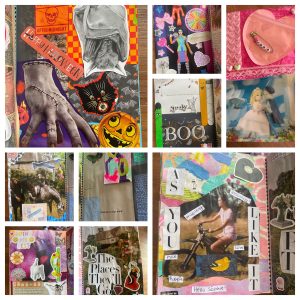
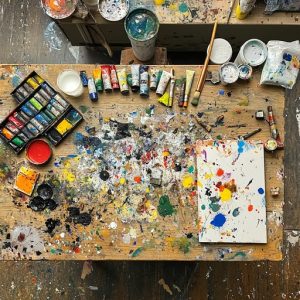
(Left: A collage of some of my junk journaling products, where I embraced the art of letting go and messiness in pursuit of artistic creation. Right: A gorgeously messy artistic workspace.)
After marinating on the wondrous materials provided these past couple of weeks showcasing the infinite possibilities that unfurl within the library as classroom, there is much to be inspired by and ideas to be appreciative of. A couple of articles in particular drew my attention and heightened my reflective abilities in what I want to take with me amidst my information professional career. The first article that I greatly resonated with was this one here about embracing messy learning. I adore the first sentence relayed within this article; “Learning is a messy process– and authentic, project-based learning immerses us in unique parts of this mess” (Block, 2014). They do a great job at showing the creative process and the areas of discomfort that typically arise with authentic work. This point is succinctly stated here; “I am slowly learning to embrace the struggles that students experience as they engage with authentic work. If I don’t allow learning to be messy, I eliminate authentic experiences for students as thinkers and creators. I find it is important to regularly remind myself that frustration leads to insights and that learning is not necessarily the equivalent of master” (Block, 2014).
This steers me toward my own mindfulness and concepts I have well-engrained within my own approach towards life, especially when it comes to teaching both myself and others. This brings up two specific areas in my life that I would regularly employ similar sentiments. The first being in my yoga practice, my teachers would often say “find comfort in your discomfort,” not only as a means to literally melt into a pose more to broaden my body in ways I may not push myself towards without this mantra. It also equips myself mentally in having to inevitably face and embrace suffering, as this fact is an undeniable part of life. In my yoga teacher training, we spoke often about how life is filled with suffering at times, no matter what, everyone must face this notion, yet we learn immensely how we grapple with this pain, and learn much about ourselves and how we react in growing through these experiences.
My second life experience that is relevant to this idea is possessing and modeling the importance of the growth mindset vs. fixed mindset mentality when it comes to teaching and learning. The growth mindset approaches learning in a much more open, positive, and circular process. It capitalizes on the attitude that through hard work, dedication, and persistence that one’s intelligence, talents, and abilities can be harnessed and increased through continued efforts, trials and tribulations, that we learn and grow through our mistakes along the way. Whereas a fixed mindset takes the perspective that one’s intelligence and talents merely are innate, fixed, and unchangeable. Fixed is linear and growth is circular. I love the growth mindset because it embraces this very idea that we learn immensely through exploring both play and mistakes. In fact, I am a firm believer in that one typically learns more from their “failures” than one does through their “wins.” Thus, I am fond of this concept of embracing messiness when it comes to learning. This idea also coincides with what Dr. Stephens said when introducing the hyperlinked library model, that there will inevitably be some sort of chaos when it comes to trying something new, therefore it is best to embrace it.
I am an artist for fun in my free time and have learned this hands on many times when I am creating. As someone who is a bit of a control freak when it comes to work, I had to learn to relish this art of letting go when it comes to creating a while ago. When I let my guard down, ceding this idea of control, that is when I truly created such amazing things. It is almost like a flow state if you will, you let that monkey part of your mind that overthinks go and the creativity truly shines during those moments of surrender. This makes me ponder how I can illustrate this important concept to my students in their learning. It is easier said than done, but this is such a pivotal idea for students not only when it comes to learning and creating, but having in their toolkit in facing many difficult experiences in life. Lastly, for this article, I especially admired the last section in which they prominently give voice to Frederick Douglass and how he declared that struggling is essential in order to progress. The article writes; “The abolitionist Frederick Douglass provides us with a poignant historic reminder that, ‘If there is no struggle, there is no progress.’ Struggle is necessary for growth but facing discomfort is not easy for people of any age. In classrooms where students engage with authentic, rigorous work, strategic support and modeling enable learners to progress past discomfort. As teachers we must be willing to accept messy days and remind ourselves that struggle and frustration are inherent parts of the process of creation” (Block, 2014). This conclusion also further instills my beliefs aforementioned in this post.
In addition, I thoroughly enjoyed perusing the article about 8 Awesome Ways Libraries Are Making Learning Fun. It is fantastic to continue to witness the fun and creative ways libraries carry on in showing up with a diverse range of innovative and appealing programming and events for folks of all ages. It is important for libraries to persevere, to push the envelope in this way, in staying relevant and proving to be a viable place for people of all walks of life to learn, connect, and spark joy in the process. These events all look so fun and interesting to me, but especially the fairy hunt for myself! This proves that creativity truly is such a gift and librarian superpower, and with this power libraries have the ability to serve as safe places for communities to learn and grow together.
Lastly, I wanted to depart this post by sharing some of my favorite quotes from reading Dr. Stephens chapter on infinite learning this week from The Heart of Librarianship;
“My thoughts turn again to the concept of librarians as facilitators of learning. It becomes clear to me that as learning goes on the move, we not only must keep up with the significant changes in education environments but aim to become connector and collaborators within our users’ learning spaces.
It was a fun, chaotic, and messy experience. In our weekly group chats online, the mantra has become ‘Learn by doing.’ Real-world messiness offers a level of experience unmatched by classroom activities.
These include themes I write about often: innovation management; learning by play, exploration, and creation; emotional intelligence; meaningful activities; and networking with the real world.
In A New Culture of Learning, authors Douglas Thomas and John Seely Brown write, ‘Where imaginations play, learning happens.’ This could and should define our services for now and in the future. The library as creative classroom means we approach the learning opportunities we create with thought, user-directed planning, and insights from research. This classroom may include physical spaces for instruction and discovery as well as online, multiscale platforms aimed at social learning and participation” (Stephens, 2016).
Thanks for reading and happy infinite learning, teaching, and creating everyone (now and always) !
References:
Block, J. (2014, January 7). Embracing messy learning. George Lucas Educational Foundation. Edutopia. https://www.edutopia.org/blog/embracing-messy-learning-joshua-block
Bookey, J. L. (2015, April 29). 8 Awesome ways libraries are making learning fun. HuffPost. https://www.huffpost.com/entry/8-awesome-ways-libraries-_b_7157462
Stephens, M. (2016). The Heart of Librarianship: Attentive, Positive, and Purposeful Change. American Library Association.