Extra! Extra! Read all about my hyperlinked journey in my reflection newspaper. The link is below. Thanks to all for a great semester! Hope everyone enjoys the rest of their summer!
Author: Rachel Leverenz
Inspiration Report – Room for the Future: Creating a Digital Learning Lab
Here is a link to my Inspiration Report about creating a digital literacy lab at the library where I work. This is something our college administration has suggested. So, it was great to take a deeper dive into the topic, knowing this could happen one day!
Infinitive Learning Reflection – Supporting Digital Literacy in Adult Basic Education Program
“Cartoon Computer With Access To Social Media Sites” by Free Clip Art is licensed under CC BY-SA 4.0

The library can be a center for lifelong learning. It is a space for people to try out new technologies and ideas, and librarians should seek out opportunities to be teachers to support patrons in different learning environments (Stephens, 2014). In reading this module, the phrase “lifelong learning” was not new to me. The last two academic libraries I worked at have included “lifelong learning” in their mission statements. In the context of an academic library, I understand this means we are not just preparing our students to be successful at school. We are also preparing them to be successful in life. We need to help them develop critical thinking and literacy skills. Yes, they will need these skills to pass their class right now, but they will also need these skills in the future to be responsible and fulfilled employees and citizens. While I understood this lifelong leaning concept in the broadest sense, it seemed more like a buzzword to me than something that I could actively incorporate into my daily work. However, this module’s readings got me thinking about things I could initiate in my own work.
The Digital Promise (2016) article was really inspiring to me. It talked about the Chicago Public Library’s Digital Literacy Hub, which offers online classes about basic digital literacy lessons. The library knows that helping patrons improve their technology skills will also be beneficial for their academic endeavors. I think there is a real opportunity to use digital literacy hub type lessons in my library, specifically to do more outreach and instruction with our adult basic education (ABE) students. I work in a small technical college library. ABE classes cover essential skills (reading, writing, math). Most of our ABE students are working towards a GED diploma or are English as a second language students, and there is a great age range among students. My college’s ABE program was moved to the main campus last year after their satellite office was closed. Since this move, the library has made efforts to better support these programs. We recently added two new collections to our physical books—an Adult Ed/ELL collection and an Emerging Readers collection (easier reading level fiction books). These book additions are a great step, but this module has helped me realize there is more we can do to engage with these students.
For example, we have a large circulating laptop collection (about 250 laptops). When we checkout laptops to students, we tell them if they have any problems or questions about the laptops to go to see the IT Helpdesk. This is probably adequate for our traditional college-aged students who have grown up using laptops in their classrooms. However, a lot of the ABE students are older and might benefit from more intentional instruction related to using a laptop and all the great opportunities that entails. I’m not sure what that instruction would look like. I like Chicago Public Library’s Digital Literacy Hub. However, if a student is unfamiliar and uncomfortable with using a computer, I don’t want to just push them toward an online course. Hands-on programming or instruction sessions could be beneficial, and I think this would also be a great opportunity to collaborate with the ABE faculty as well.
I have never done targeted digital literacy instruction, and I really liked the Park (2016) article that named eight areas of digital intelligence that everyone should be prepared for: digital identity, digital use, digital safety, digital security, digital emotional intelligence, digital communication, digital literacy, digital right. I think this would be a great outline to follow to prepare an info lit session. These competencies go beyond just helping someone complete basic computer tasks and would help set someone up for success in their academic journey and in life.
References
Digital Promise. (2016, January 28). The library as a gateway to 21st century skills. https://digitalpromise.org/2016/01/28/chicago-public-library-the-library-as-a-gateway-to-21st-century-skills/
Park, Y. (2016, June 14). 8 digital skills we must teach our children. Medium. https://medium.com/world-economic-forum/8-digital-skills-we-must-teach-our-children-f37853d7221e#.789qtaw64
Stephens, M. (2014). YLibrary: Making the case for the library as space for infinite learning [White paper].
The Power of Storytelling Reflection – Storytelling in the Academic Library
The thought that has most stuck with me from the storytelling module is this quote from the Wentz (2013) article: the “library shares the community with itself.” I love this idea! We have read throughout this class that the library is a place of community and connection. If the library can use storytelling to further facilitate community connections, then storytelling is great tool to add to our library tool belt. I appreciated how the Stephens (2019) chapter succinctly broke down library storytelling examples to fit into three categories: keeping stories, sharing stories, and making stories. The following are examples from the small technical college library where I work that fall into each category.
Keeping Stories: Library and Archival Collections
Librarians build collections of books that are inclusive of diverse topics and voices (Stephens, 2019). Representation matters. It is important to see yourself in a story, and I think local history collections are great ways to help people connect with local stories and people in their own communities. At my library, we have several books in our local history collection that are written by former students and staff. These books are mainly self-published and not available in other libraries. We include them in our collection because they are of local interest, and it is valuable for our students to see what their peers have done. When I catalog these books, I add a marc field note that indicates it is an alumni or faculty authored book. This enhances discoverability and helps to amplify these authors’ voices.
My library also houses our college’s archival collections. Again, the work library staff do here to preserve college history and make it easily accessible helps to connect the community to its own stories. I love to help with genealogy research requests and connect people to their own stories through their relatives who have worked or attended school at our college. In our digital archival collections, the yearbooks are usually the most viewed artifacts. People like searching for and finding personal connections.
Sharing Stories: Library Programs and Displays
My college library also has several initiatives that help to share stories within the community. For example, we have a virtual bilingual story time. Children’s stories representing diverse voices from community populations are selected. The library also provides students with a bag containing supplies for a craft and a snack related to the culture in the story. Students watch the story time and do the activities at home with their children. We also create several archival displays every year to put in the library or at various campus-wide events. These archival displays help the campus community learn about its own stories and history.
One new initiative is to record testimonials from our former Justice Involved students. (Justice Involved students are students who are incarcerated at the time they are taking classes.) Feedback we heard from several of these students was that it is hard for them to imagine themselves having a life and being successful outside of incarceration. So, by having former students share their stories, the Justice Involved students can see this is possible.
Making Stories: Library Equipment and Spaces
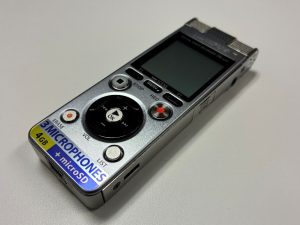
Voice recorder (own photo)
The library circulates equipment that can be used to record oral histories or podcasts. We check out voice recorders, microphones, and camcorders. The library also has soundproof study rooms that can be used as a place to make and record stories. Admittedly, this equipment is not often used. This module has got me thinking about programming ideas that would promote the recording and sharing of stores for the benefit of the whole campus community. (An oral history archive project would be lots of fun!)
References
Stephens, M. (2019). Telling Stories. In Wholehearted librarianship: Finding hope, inspiration, and balance (pp. 91-93). ALA Editions.
Wentz, E. (2013, April 26). The human library: Sharing the community with itself. Public Libraries Online. https://publiclibrariesonline.org/2013/04/human_librar/
New Models Reflection Blog: Hygge in the Academic Library
Hygge is a Danish term related to coziness. It is a state of mind that focuses on building comfort, connections, community, and well-being (Stephens, 2019). When we apply the hygge concept to our work in the library, this means creating inclusive welcoming spaces in the library that bring people together, and it is a resounding focus on people, not books (Stephens, 2025).
Hygge in a Technical College Library
I work in a small technical college library that has seen declining use of the physical library space in the past few years, and library staff have been tasked with making the library a more welcoming space where students will want to hang out. As I learned about hygge in this module, I was very surprised and happy to see that several plans we have started already align with this comfort and community philosophy. One big change we made was getting rid of about a dozen desktop computers. These computers took up a lot of space and were largely unused. To fill the space, we ordered two large soft couches. (See the photograph below.) Students love the couches! I have seen everything from groups meeting there to students studying while their kids slept on the couches. Other campus departments are also impressed with the couches and are looking to purchase the same ones for their own spaces.
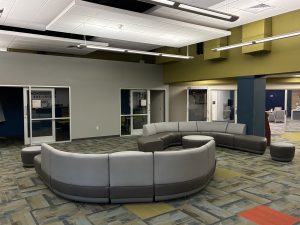
New couches in Lakeshore Library (own photo)
We also recently purchased a cart and a Keurig coffee machine. We are going to offer free snacks and hot beverages to students, and brand this the snack cart. It will be strategically placed by the library desk. Once students have been lured in with free food, library staff will be conveniently located to engage students in conversation. Another goal is to create a space where student parents can study and their kids can be safely entertained. Right now, the general idea is to create a comfy study room with toys and an early literacy kit.
The hygge state of mind can also apply to library programming. Again, it was great to see that some of the programs we have run fall under this category. For example, we put out a Finals Relaxation Station at the end of every semester. (See below photograph.) It is just a table with some relaxing activities (origami, coloring, wordsearches, crosswords puzzles, etc.) and some snacks. It is a nice restful place for students (and staff!) to sit down and take a break during a busy and stressful time of the school year.
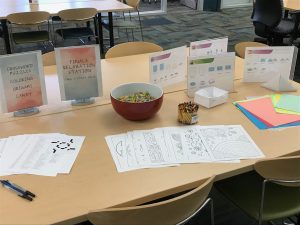
Finals Relaxation Station display (own photo)
Ideas for Expansion
This module’s readings and explorations got me thinking about other ideas for things we could be doing in my library to create hygge’s tenants of coziness, well-being, and community. Specifically, the Lauersen (2024) article recommended thinking about how the library brings value and impacts the community, with considerations for four dimensions of culture: emotional, intellectual, creative, and social. Inherently, the library brings much intellectual value to the campus community, and some of our recent space upgrades have created a more conductive social space. I think there is the greatest opportunity for us to consider how the library can impact the emotional and creative campus environment. One idea I’m excited about is playing ambiance music in the library. We could collaboratively create playlists with students, and we could also have designated quiet hours to be cognizant of people who have sensory considerations. I think this could benefit students’ emotional well-being. My Innovation Strategy and Roadmap project also highlighted encouraging student creativity through photography that would be donated to the college archive to document student life. Finally, I really liked the idea presented in the Stephens (2019) chapter about the library acknowledging important life moments. As an academic library, we already play a part in important life events (graduation, job offers, passing an important test, et.), and I am excited to consider how our library might encourage our students and celebrate their success better.
References
Lauersen, C. (2024, August 25). The value of libraries from Roskilde to Toronto. The Library Lab. https://christianlauersen.net/2024/08/25/the-value-of-libraries-from-roskilde-to-toronto/
Stephens, M. (2019). Hygge state of mind. In Wholehearted librarianship: Finding hope, inspiration, and balance (pp. 63-65). ALA Editions.
Stephens, M. (2025). The hyperlinked library: New models [Video]. The Hyperlinked Library. https://287.hyperlib.sjsu.edu/
Innovation Roadmap: Archiving Student Life
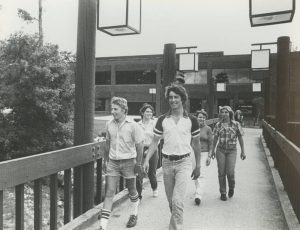
Students walk over bridge at Lakeshore Technical Institute [Photograph]. (1985). Lakeshore College Archives. https://content.mpl.org/digital/collection/lakeshore/id/2890/rec/9
What is the idea?
Idea Overview
This is an initiative to engage Lakeshore College students in preserving and sharing their own college experiences and history. This program will be run by the Lakeshore College Archives. The archive will provide students with a camera (either a digital camera or an instant camera with film) and a worksheet to fill out basic metadata information. The archive will partner with student organizations, and individual students can also participate. The students will donate the images to the archive, and archive staff will process the images for preservation and addition to the archive collection. The images will be made publicly available through the college’s digital archive, with the student photographer listed as the material’s creator. The archive will then print and frame student images to hang in the archive photo gallery located inside the college library. In collaboration with the student photographers, the archive will host a small exhibit opening party where the students can talk about their photographs. Additionally, throughout the course of the initiative, archive staff will present information literacy sessions related to researching in the college archive and managing personal digital files.
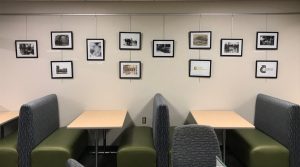
Archive photo gallery located in Lakeshore Library (own photo)
Project Goals
- Give students opportunities to experiment with different photography technologies
- Engage students in the sharing of their own stories and amplify their voices
- Teach archival research skills and digital literacy skills
- Expand the historical record in the college archive to be inclusive of student voices and experiences
- Promote the college archive and increase student use of archives
Description of Community
Lakeshore College is a rural technical college with a yearly enrollment of about 1,500 FTE (Lakeshore College, 2026). The college offers technical and associate degree programs. BIPOC students represent 22.86% of the student body (Lakeshore Technical College, 2022). This is a commuter college, and many students are adults balancing work, family, and school.
Who We Are Helping
Students will be the focus of this project, but the whole campus community will benefit from a more diverse representation in the archives.
How We Are Helping
- Promoting a sense of belonging and strengthening community
- Encouraging students’ creativity through photography
- Providing camera technology and giving students opportunities to play with old-school film medium
- Preserving current history and creating a more accurate and diverse historical record in the archives
- Promoting digital literacy skills
Mission & Institutional Context
The archive’s mission is “to collect, preserve, and make accessible materials that document the history of Lakeshore College and to serve as an educational resource to support research and learning” (Lakeshore College Library, 2026). The archive serves Lakeshore students, staff, alumni, and external community members. The college archive is managed by library staff and is physically very small. All archival materials are stored on a few shelves within the library. The archive is relatively new. Historical materials that had been housed throughout campus were brought to the library and organized in 2022. A small digital archive was launched in 2023. Almost all the archival materials were produced and donated by college employees, particularly the marketing department, and there is very little representation of student created materials. Now that the archive has been set up, work is focused on collecting and preserving current materials that record college history. Due to the collection gap related to student produced materials, priority has been placed on student life related materials. The Archiving Student Life project will bring these missing voices to the archive and will allow students to share and document their own experiences.
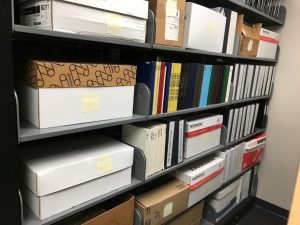
Lakeshore College Archives (own photo)
Action Brief Statement
Convince Lakeshore College students that by preserving and sharing records of their experiences at Lakeshore College they will contribute to a more complete and diverse college historical record which will create opportunities for research, engagement, and strengthening the campus community because the archive’s mission is rooted in sharing college history and supporting learning.
Inspiration
The literature shows there is a growing movement to acknowledge that “student experience has long been poorly and selectively captured by university archives” (Becker, 2017) and that only “a small portion of archival holdings represent student-generated material” (Buchanan & Richardson, 2012). These articles and case studies highlight efforts institutions have done to remedy this.
- Washington State University Vancouver Library Student Organization Documentation Initiative (Becker, 2017)
- University of California, Los Angeles’s Collaborative Bruin Archives Project (Buchanan & Richardson, 2012)
- University of Virginia’s Archiving Student Life for the Third Century Project and Workshop (Shaw, 2019)
- Archiving Student Life at Iowa State University (Wells, 2025)
Guidelines & Policies
- Lakeshore College Archives (2026) has a collection development policy that guides all archive acquisition decisions. This addresses what type of material may be added to the collection. This means the content of the materials must be related to Lakeshore College. The collection development policy also maintains that the copyright of all donated materials must be transferred to the archive. This will allow the archive to include the material in the publicly accessible digital archive.
- Copyright touches ethical and access issues. Lakeshore College Archives (n.d.) has a gift agreement form that will be used to formally transfer copyright to the archives.
- Privacy concerns will be considered if a student wishes to submit materials but remain anonymous. They would need to sign a gift agreement form but would not be identified in the metadata in the publicly accessible digital archive. A student could also choose not to have their pictures exhibited in the photo gallery or to have their name be anonymous.
- Technostress—feeling overwhelmed by the amount of new technology getting thrown as you—is very real problem (Stephens, 2008). This could certainly affect students. If students would rather elect to use their own device (like a smartphone) to take pictures instead of using a library issued digital camera or instant camera, they can choose to do that. This flexibility offers opportunities for a more inclusive program and student learning experience (Stephens, 2008).
- Libraries and archives need to be transparent with their stakeholders. Program ideas and policies should be made public (Stephens, 2025). Project guidelines should be shared with participants. Especially with matters of transferring copyright, we want to make sure that participants are informed and consent to archive policies.
- A participatory service mindset means that the user is involved in planning (Stephens, 2025). Students should be consulted about the project’s guidelines in the planning phase.
Timeline for Implementation
Planning is important when rolling out a new library service. The service should align with the library’s mission, and all planning should be done with the user in mind. Communication is important as the plan needs to be promoted to stakeholders, and staff must buy into the plan. The plan also needs to be flexible to accommodate surprise challenges (Stephens, 2004).
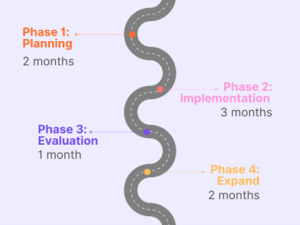
Note. Infographic template created by Pitstud using Canva.
- Phase 1: Planning (2 months) – create project proposal and obtain funding, collaborate with student life staff and student organization groups, purchase equipment, catalog new equipment, create metadata worksheet, staff training, prepare information literacy sessions
- Phase 2: Implementation (3 months) – marketing efforts, check out camera equipment, check in with participants, obtained signed gift agreement forms, process donated student photographs for addition to the archive collection and for ingestion into the publicly accessible digital archive, print and hang student photographs in the archive gallery, collaboratively work with student photographers to plan exhibit gallery party, lead information literacy sessions
- Phase 3: Evaluation (1 month) – create and send out participant survey, obtain collection statistics, compile statistics from information literacy sessions and exhibit gallery party, identify problems and make improvements
- Phase 4: Expand (2 months) – adjust project plan for improvements learned in last cycle, collaborate with digital photography faculty to have students from the photography class participate in the program, build stronger partnerships with student life organizations and offer assistance with records management
Marketing & Promotion
- The program will be branded “Lenny’s Lens.” (Note: Lenny the snow leopard is the college’s mascot.)
- Phase 2 (implementation) will be launched in October to celebrate National American Archives Month.
- The marketing message to students will emphasize that their story matters and this is an opportunity for them to share and preserve their story.
- Internal Promotion: mass email messages, short article in the student e-newsletter, post fliers in the library and on campus bulletin boards, social media post, announcement on library website, attend and speak at student organization meetings
- External Promotion: Reaching alumni could be valuable for this project. They might have materials from their time as a student they want to donate. Alumni might also have an interest in viewing this collection when completed and attending the photo gallery launch party. Social media would be used to promote to this alumni group.
- Note: Separate communication will be used to promote the information literacy sessions. This message would focus on learning how to preserve your own digital history.
Staff Training & Readiness
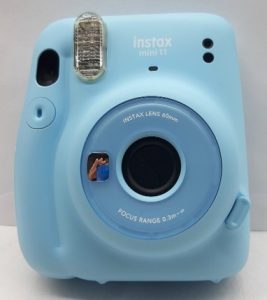
“FUJIFILM INSTAX MINI” by ORANIT DORON is licensed under CC BY-SA 4.0

- One library staff person has archives responsibilities and will be putting on this program. That would be me! The only new process or technology I would need to learn is the instant camera. I will need to educate myself about how to operate and care for the camera and film. I will also need to research how to preserve instant pictures as this might be different than other types of photographs that are currently in the archive.
- Other library staff will be updated about all aspects of the project so they can answer any patron questions that might come up. I will handle the updates and any training requests that come from other staff. I will also create a short reference document for other library staff that briefly explains the different stages in this program.
Evaluation
- Archive collection statistics: number of student life materials, number of student creators
- Student participant feedback gathered through surveys
- Attendance statistics: information literacy sessions, photo gallery launch party
- Success stories: hope to share many stories of student engagement and excitement for the archive
Future Expansion
- Faculty partnerships: possibility to collaborate with faculty of digital photography class to have their students participate in the archive initiative. This would ensure a larger number of student participants, and the project could be run more frequently to align with class offerings.
- Further develop partnerships with student life organizations: possibility for archives to offer records management assistance. Digital records are fragile, and the archives can help the students maintain and preserve their own history (Beccera-Licha, 2017). The archives could also produce a LibGuide specifically for student organizations that would help simplify the records management process.
References
Becerra-Licha, S. (2017). Participatory and post-custodial archives as community practice. Educause Review. https://er.educause.edu/articles/2017/10/participatory-and-post-custodial-archives-as-community-practice
Becker, J. (2017). Bringing student voices into the university archives: A student organization documentation initiative case study. In The Library With The Lead Pipe, 205-24. https://www.inthelibrarywiththeleadpipe.org/2017/bringing-student-voices/
Buchanan, S., & Richardson, K. (2012). Representation through documentation: Acquiring student and campus life records through the Bruin Archives Project. The American Archivist, 75(1), 205-224. https://doi.org/10.17723/aarc.75.1.e61061ul8701076u
Lakeshore College. (n.d.). Lakeshore College strategic plan scorecard. https://lakeshore.edu/sites/default/files/2026-04/Lakeshore%20College%20Scorecard%20Worksheet%20-%202025-30.pdf
Lakeshore College Archives. (n.d.). Lakeshore College Archives gift agreement. https://lakeshore.libguides.com/ld.php?content_id=75163184
Lakeshore College Archives. (2026). Lakeshore College Archives collection development policy. https://lakeshore.libguides.com/ld.php?content_id=83764268
Lakeshore College Library. (2026). Lakeshore College Archives. https://lakeshore.libguides.com/archives
Lakeshore Technical College. (2022, June). Equity report. https://lakeshore.edu/sites/default/files/pdf/hr/LTC-Equity-Report-2022-Final.pdf
Shaw, J. (2019, April 22). Introducing the archiving student life for the third century project and workshop. University of Virginia Library. https://smallnotes.library.virginia.edu/2019/04/22/archiving_student_life/
Stephens, M. (2004). Technoplans vs. technolust. Tame the Web. https://tametheweb.com/2004/11/01/technoplans-vs-technolust/
Stephens, M. (2008). Taming technolust: Ten steps for planning in a 2.0 world. Tame the Web. https://tametheweb.com/2012/05/30/taming-technolust-ten-steps-for-planning-in-a-2-0-world-full-text/
Stephens, M. (2025). The hyperlinked library: Participatory service & transparency [Video]. The Hyperlinked Library. https://287.hyperlib.sjsu.edu/
Wells, R. (2025). Archiving student life at Iowa State University. Iowa State University Library. https://instr.iastate.libguides.com/c.php?g=1274598&p=9355624
Hyperlinked Environments Reflection: Hybrid Environments in the Academic Library

“Student” by EFF-Graphics is licensed under CC BY 3.0 US

Hybrid learning environments have become the norm in higher education. Some students attend class fully online, some in a physical classroom, and others in a blended mix of both environments. The flexibility offered to students through these different delivery models makes higher education accessible to more students, and research has shown there is not a significant difference in academic success across these models (Educause, 2016).
Libraries evolve with their communities, and academic libraries have also become hybrid environments—regarding collections, services, and spaces. Our services, like reference and instruction, can be delivered both in person and online using multiple different tools. Our collections are now a mix of print and digital resources, and our library spaces need to be both collaborative and conductive to quiet study (Webster, 2017). Beyond homes for stacks of books, many academic libraries now contain academic support and writing centers, technology filled classrooms, makerspaces, and other critical resources for teaching and learning. Far from being obsolete in an ever-changing technology driven world, the academic library “has never been more important…[and] is central in the sense that it is the tool which connects our students wherever they are” (Straumsheim, 2017).
Hybrid Technical College Library
Different patrons and stakeholders have different needs, and the idea of a hybrid library will look different to different groups. I work in a small technical college library. We have one college vice president who constantly advocates for us to move all the books out of our library space. (Library staff are very opposed to this!) On the other hand, there is one college board member who exclaims there are no books whenever he walks through the library. It is hard to make everyone happy, but we do have to try to serve all our populations. I think this all comes down to knowing your patrons and consulting them on what kind of library support they need. For example, our welding department on campus really values our physical course reserves collection, while our writing instructors heavily utilize citation LibGuides and in-person library instructional sessions. Our humanities classes can’t get enough of our Kanopy streaming videos, and our collaborative study rooms are popular with nursing students in study groups. You must observe, keep statistics, and communicate with your stakeholders when looking to make decisions for the future of the lilbrary.
While it might feel like the library is being pulled in different directions, it also means that we can serve more students and faculty. Flexible services and collections mean more accessibility. Yes, it may seem like the library is constantly pivoting, but these adjustments help us stay relevant and connected to student and faculty needs. These Module 6 readings got me excited! I am well positioned as both an online student and a library practitioner to consider how to best enhance the hybrid nature of my library’s resources.
References
Educause. (2016, February). 7 things you should know about….The 2016 key issues in teaching and learning. Educause Learning Initiative. https://library.educause.edu/~/media/files/library/2016/2/eli7129pdf.pdf
Straumsheim, C. (2017, March 23). Arizona State University Library reorganization plan moves ahead. Inside Higher Ed. https://www.insidehighered.com/news/2017/03/24/arizona-state-u-library-reorganization-plan-moves-ahead
Webster, K. (2017, February 15). Reimagining the role of the library in the digital age: Changing the use of space and navigating the information landscape. London School of Economics and Political Science. https://blogs.lse.ac.uk/impactofsocialsciences/2017/02/15/reimagining-the-role-of-the-library-in-the-digital-age-changing-the-use-of-space-and-navigating-the-information-landscape/?platform=hootsuite
Self-Care While Serving Communities
This post is not for any of the official assignments as I feel like I need to be upbeat and positive about serving our communities and patrons when I write those. However, I just wanted to share that some of the readings in Module 5 were hard for me to read. Specifically, the ones focusing on how patrons are always right and about needing to get to know your patrons on an intimate personal level to best serve their needs. I understand the logic behind this. However, it also makes me anxious. Last year, I had a bad experience with patron-perpetrated sexual harassment. At the time, while dealing with that, I could barely staff the service desk, let alone have any kind of personal conversation with a patron for fear it might happen again.
When we talk about serving our communities, I sometimes forget that I am also a part of my own community, and I deserve to feel safe in the library as well. A year out, I feel much better about patron interactions, and I realize most patrons don’t have bad intentions. I can be personable without being personal. I don’t owe anything to patrons beyond what I am comfortable sharing. This has been a shift in mindset for me. I am better about standing up for myself, and I can still be helpful without it being a detriment to myself. So, folks, use your employee assistance program to talk to counselors. Know your rights. Advocate for yourself, and document things that don’t feel okay. Also, share your struggles with your coworkers because they might be experiencing them too, and you don’t need to struggle alone. Module 5 was all about creating a community that supports all the needs of our patrons. Don’t forget to include staff in this as well!
Hyperlinked Communities Reflection Blog: Holistic Support for Patron Needs
Modern libraries support their patrons’ social, mental, and physical wellbeing, in addition to their information needs (Greenwood, 2022). As numerous readings in Module 5 attested, this support means libraries, in addition to books, also provide access to technology, the internet, employment resources, food and clothing, mental health resources, and the list goes on and on to include a truly holistic view of patron needs. Libraries are uniquely positioned to do this work. They are considered safe spaces and trusted institutions by many community members (Dixon, 2017). This is important because it means patrons—especially the most vulnerable patrons—feel comfortable coming to libraries to seek help. Libraries are also places of connection. Patrons can connect with each other through library programs like book clubs or craft groups (Hasan, 2022). The library also connects with other community networks (private and governmental) to provide funding for these resources (Williams, 2021).
Example: Summer Lunches

“20210810-FNS-UNC-0015” by U.S. Department of Agriculture is in the public domain
My local public library runs a summer meal program that is a great example of holistic support. During the summer, the library prepares and serves free lunch on weekdays. The goal is to ensure children get fed during the summer. However, these meals are open to anyone. The library serves about 35 – 70 meals a day. This program is funded through donations from local businesses and individuals. One library staff member prepares and serves all the meals, with the help of volunteers. (One of the volunteers is my mom, who was my source for this information.) When I heard about this program, my first thought was this seemed like a waste of staff time. This library only has two full-time staff, and the meal preparation and clean up takes most of the workday for one. This person oversees most of the technical service functions of the library. When I heard she had to do all this cooking, I wondered how she would have time to do her actual job. This module has shown me that meal service is her actual job. The library is doing important work to support the physical well-being of vulnerable children in the community. Allotting library staff time arranging funding sources and cooking meals is absolutely appropriate. They are supporting the holistic needs of their community.
Implications for My Work
I don’t know why I was surprised by this meal program at the public library because the college where I work also focuses on holistic student support. After all, students cannot be successful in their classes if their basic needs are not met. For me in the library, this holistic support mainly means referring students to other departments for help. Other departments on campus offer great services that we in the library do not need replicate. This includes a food pantry, free clothing, transportation vouchers, financial coaching, employment help, etc. Right now, the library mainly contributes to holistic support by providing internet hotspots and technology to students. However, this module has me thinking about how the library is well-positioned as a partner with many campus and community organizations, and we can do more to be a better support for holistic community needs.
References
Dixon, J. (2017, October 23). Convening community conversation. Library Journal. https://www.libraryjournal.com/story/convening-community-conversations-programming
Greenwood, C. (2022). Healthy library, healthy life. INCITE, 43(6), 24.
Hasan, T.N. (2022, October 20). ‘Free, non-judgemental, accessible’: How your local library is a sanctuary of health and wellness. SBS Bangla. https://www.sbs.com.au/language/bangla/en/article/free-nonjudgmental-and-accessible-how-your-local-library-is-a-sanctuary-of-health-and-wellness/t15blzsi9
Williams, A. (2021, March 17). How libraries are bridging the digital divide. Internet Society. https://www.internetsociety.org/blog/2021/03/libraries-are-bridging-the-digital-divide/
Assignment X: The Library is Everywhere (So Meet Patrons Where They Are!)
“Everywhere” by Joe Lencioni is licensed under CC BY-NC-SA 2.0
One of the tenants of the Hyperlinked Library model is the idea that the library is everywhere and collections need to be available outside the confines of the physical library building (Stephens, 2011). This idea is beneficial for both the library and the patron. Patrons receive convenient access to library materials, and the library stays relevant in a world where information can be accessed immediately online.
What does this mean?
My initial response to the “library is everywhere” idea was that most libraries already do this. For decades, bookmobiles have travelled to patrons who cannot come to physical library buildings, and, nowadays, most libraries have some web presence where patrons can easily access digital content remotely. However, as I read more about this idea, I became increasingly excited thinking about how we as libraries could expand this to meet ever evolving patron needs.
At its core, this is a question of customer service and user experience. In a blog post, Schneider (2006) said, “Meet people where they are–not where you want them to be. The user is not ‘remote.’ You, the librarian, are remote, and it is your job to close that gap.” I absolutely love this! One of the reasons this “library is everywhere” idea calls to me is because I work at a technical college library where our administration tells us we need to get more students into the library space. We have been given funding to purchase furniture and technology in hopes of luring students in. I will not complain about the money. Updating library space is a good thing. However, just because students are not using the library space, does not mean they are not using the library. We have database statistics and digital circulations to prove that. As the Schneider quote points out, if your patrons are not in your space, your focus should be on figuring out how to get your services to them and not on how to get them to come to your services. The library is everywhere. Think outside your space!
Connecting with Patrons
To reach our patrons, we need to know them. Casey and Savastinuk (2007) suggested ways to do this. They recommended driving around your neighborhood to learn about your user demographics and see what users do when not in the library. They noted you also need to think about who in your community is not currently using your library and why that might be. These types of community analyses are opportunities to learn how your library can better fill needs for your users and potential users. Casey and Savastinuk (2007) also recommended asking library patrons about their experience in the library as feedback surveys can be helpful in analyzing current library services. This research is just the first step! Once you have a better understanding of your users and their needs, you need to reassess your library’s offerings. You might need to adjust your services, create new ones, or market your offerings differently. Remember, the goal is to meet people where they are.
Putting Into Practice
I am excited about this “library is everywhere” idea and have been thinking of ways to put this “meet patrons where they are” mantra into practice at the library where I work. To start, I took a walk around campus to observe where and how students spent time. I then tried to see if there were parts of the library we could bring to them. First, I noticed student lounges in the academic buildings were usually the busiest places. Currently in the library, we have a display about our summer reading challenge. (See the below image.) We are going to work with the student life department to see if we can put displays like this in the student lounges to possibly get more students involved in the summer reading challenge. As another example, I noticed the police academy students spent much time exercising alone, and many of them wore earbuds. This inspired me to do targeted marketing in the public safety division related to the library’s digital subscriptions.
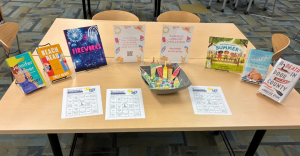
Summer reading passive programming display (own photo)
There are several larger ideas that I am developing. (Like putting vending machines in academic buildings containing course reserve books for those specific departments.) I had not realized how limiting it is to only consider the library to be confined within its building. When you expand your vision to include your whole community (and not just the ones who normally visit you), everyone wins.
References
Casey, M.E., & Savastinuk, L.C. (2007). Finding the road to the library. In Library 2.0: A guide to participatory library service (pp. 19-36). Information Today, Inc.
Schneider, K.G. (2006, June 3). The user is not broken: A meme masquerading as a manifesto. Free Range Librarian. https://freerangelibrarian.com/2006/06/03/the-user-is-not-broken-a-meme-masquerading-as-a-manifesto/
Stephens, M. (2011). The hyperlinked library [White paper]. Tame the Web. https://tametheweb.com/2011/02/21/hyperlinkedlibrary2011/