
“Everywhere” by Joe Lencioni is licensed under CC BY-NC-SA 2.0
One of the tenants of the Hyperlinked Library model is the idea that the library is everywhere and collections need to be available outside the confines of the physical library building (Stephens, 2011). This idea is beneficial for both the library and the patron. Patrons receive convenient access to library materials, and the library stays relevant in a world where information can be accessed immediately online.
What does this mean?
My initial response to the “library is everywhere” idea was that most libraries already do this. For decades, bookmobiles have travelled to patrons who cannot come to physical library buildings, and, nowadays, most libraries have some web presence where patrons can easily access digital content remotely. However, as I read more about this idea, I became increasingly excited thinking about how we as libraries could expand this to meet ever evolving patron needs.
At its core, this is a question of customer service and user experience. In a blog post, Schneider (2006) said, “Meet people where they are–not where you want them to be. The user is not ‘remote.’ You, the librarian, are remote, and it is your job to close that gap.” I absolutely love this! One of the reasons this “library is everywhere” idea calls to me is because I work at a technical college library where our administration tells us we need to get more students into the library space. We have been given funding to purchase furniture and technology in hopes of luring students in. I will not complain about the money. Updating library space is a good thing. However, just because students are not using the library space, does not mean they are not using the library. We have database statistics and digital circulations to prove that. As the Schneider quote points out, if your patrons are not in your space, your focus should be on figuring out how to get your services to them and not on how to get them to come to your services. The library is everywhere. Think outside your space!
Connecting with Patrons
To reach our patrons, we need to know them. Casey and Savastinuk (2007) suggested ways to do this. They recommended driving around your neighborhood to learn about your user demographics and see what users do when not in the library. They noted you also need to think about who in your community is not currently using your library and why that might be. These types of community analyses are opportunities to learn how your library can better fill needs for your users and potential users. Casey and Savastinuk (2007) also recommended asking library patrons about their experience in the library as feedback surveys can be helpful in analyzing current library services. This research is just the first step! Once you have a better understanding of your users and their needs, you need to reassess your library’s offerings. You might need to adjust your services, create new ones, or market your offerings differently. Remember, the goal is to meet people where they are.
Putting Into Practice
I am excited about this “library is everywhere” idea and have been thinking of ways to put this “meet patrons where they are” mantra into practice at the library where I work. To start, I took a walk around campus to observe where and how students spent time. I then tried to see if there were parts of the library we could bring to them. First, I noticed student lounges in the academic buildings were usually the busiest places. Currently in the library, we have a display about our summer reading challenge. (See the below image.) We are going to work with the student life department to see if we can put displays like this in the student lounges to possibly get more students involved in the summer reading challenge. As another example, I noticed the police academy students spent much time exercising alone, and many of them wore earbuds. This inspired me to do targeted marketing in the public safety division related to the library’s digital subscriptions.
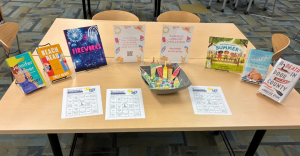
Summer reading passive programming display (own photo)
There are several larger ideas that I am developing. (Like putting vending machines in academic buildings containing course reserve books for those specific departments.) I had not realized how limiting it is to only consider the library to be confined within its building. When you expand your vision to include your whole community (and not just the ones who normally visit you), everyone wins.
References
Casey, M.E., & Savastinuk, L.C. (2007). Finding the road to the library. In Library 2.0: A guide to participatory library service (pp. 19-36). Information Today, Inc.
Schneider, K.G. (2006, June 3). The user is not broken: A meme masquerading as a manifesto. Free Range Librarian. https://freerangelibrarian.com/2006/06/03/the-user-is-not-broken-a-meme-masquerading-as-a-manifesto/
Stephens, M. (2011). The hyperlinked library [White paper]. Tame the Web. https://tametheweb.com/2011/02/21/hyperlinkedlibrary2011/