The thought that has most stuck with me from the storytelling module is this quote from the Wentz (2013) article: the “library shares the community with itself.” I love this idea! We have read throughout this class that the library is a place of community and connection. If the library can use storytelling to further facilitate community connections, then storytelling is great tool to add to our library tool belt. I appreciated how the Stephens (2019) chapter succinctly broke down library storytelling examples to fit into three categories: keeping stories, sharing stories, and making stories. The following are examples from the small technical college library where I work that fall into each category.
Keeping Stories: Library and Archival Collections
Librarians build collections of books that are inclusive of diverse topics and voices (Stephens, 2019). Representation matters. It is important to see yourself in a story, and I think local history collections are great ways to help people connect with local stories and people in their own communities. At my library, we have several books in our local history collection that are written by former students and staff. These books are mainly self-published and not available in other libraries. We include them in our collection because they are of local interest, and it is valuable for our students to see what their peers have done. When I catalog these books, I add a marc field note that indicates it is an alumni or faculty authored book. This enhances discoverability and helps to amplify these authors’ voices.
My library also houses our college’s archival collections. Again, the work library staff do here to preserve college history and make it easily accessible helps to connect the community to its own stories. I love to help with genealogy research requests and connect people to their own stories through their relatives who have worked or attended school at our college. In our digital archival collections, the yearbooks are usually the most viewed artifacts. People like searching for and finding personal connections.
Sharing Stories: Library Programs and Displays
My college library also has several initiatives that help to share stories within the community. For example, we have a virtual bilingual story time. Children’s stories representing diverse voices from community populations are selected. The library also provides students with a bag containing supplies for a craft and a snack related to the culture in the story. Students watch the story time and do the activities at home with their children. We also create several archival displays every year to put in the library or at various campus-wide events. These archival displays help the campus community learn about its own stories and history.
One new initiative is to record testimonials from our former Justice Involved students. (Justice Involved students are students who are incarcerated at the time they are taking classes.) Feedback we heard from several of these students was that it is hard for them to imagine themselves having a life and being successful outside of incarceration. So, by having former students share their stories, the Justice Involved students can see this is possible.
Making Stories: Library Equipment and Spaces
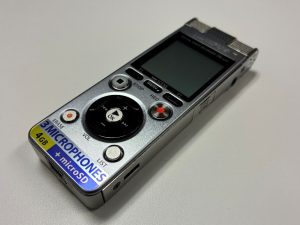
Voice recorder (own photo)
The library circulates equipment that can be used to record oral histories or podcasts. We check out voice recorders, microphones, and camcorders. The library also has soundproof study rooms that can be used as a place to make and record stories. Admittedly, this equipment is not often used. This module has got me thinking about programming ideas that would promote the recording and sharing of stores for the benefit of the whole campus community. (An oral history archive project would be lots of fun!)
References
Stephens, M. (2019). Telling Stories. In Wholehearted librarianship: Finding hope, inspiration, and balance (pp. 91-93). ALA Editions.
Wentz, E. (2013, April 26). The human library: Sharing the community with itself. Public Libraries Online. https://publiclibrariesonline.org/2013/04/human_librar/
Hi Rachel,
I really enjoyed reading your post on how your library helps keep, share, and make stories. I love the idea of providing patrons with recording devices so they can record their stories. I resonate with curating a collection that represents the many and having archives in which patrons can see their ancestors reflected back. Thank you for sharing how your library helps share, keep, and make stories.
@chicanasteamlibrarian Hi, Maria! Thank you for reading my post. There are so many different ways for libraries to tell stories. It has been great to read all the thoughts and experiences everyone is sharing.
Hey Rachel,
I enjoyed reading your post on the Power of Stories module. As I plan to prepare the Inspiration Report, I have chosen the “Power of Storytelling” option. What I realized in the process of preparing for my idea was that the community in which the library is placed needs to be the main priority since stories differ in each community so much. The best stories are always those from one’s backyard, the stories of the people whom these libraries serve.
On the other hand, I should add that although I want to become a Young Adult Librarian, I would like to gain experience elsewhere too. Therefore, this fall I will be doing my archival internship at an academic library. What I particularly appreciated from your post was the statement that no matter where you go and what type of institution you end up working with, ideas and projects always need to relate to the community which it serves, and in this case, students and professors at the college.
@aniellafields Hi, Aniella! Thank you for reading my post. Yes! Libraries definitely need to be responsive to their patron base. I have worked in several different academic libraries. Even between the same types of libraries, the environments and the people you serve will be very different. Best of luck with your internship with fall!