Hygge is a Danish term related to coziness. It is a state of mind that focuses on building comfort, connections, community, and well-being (Stephens, 2019). When we apply the hygge concept to our work in the library, this means creating inclusive welcoming spaces in the library that bring people together, and it is a resounding focus on people, not books (Stephens, 2025).
Hygge in a Technical College Library
I work in a small technical college library that has seen declining use of the physical library space in the past few years, and library staff have been tasked with making the library a more welcoming space where students will want to hang out. As I learned about hygge in this module, I was very surprised and happy to see that several plans we have started already align with this comfort and community philosophy. One big change we made was getting rid of about a dozen desktop computers. These computers took up a lot of space and were largely unused. To fill the space, we ordered two large soft couches. (See the photograph below.) Students love the couches! I have seen everything from groups meeting there to students studying while their kids slept on the couches. Other campus departments are also impressed with the couches and are looking to purchase the same ones for their own spaces.

New couches in Lakeshore Library (own photo)
We also recently purchased a cart and a Keurig coffee machine. We are going to offer free snacks and hot beverages to students, and brand this the snack cart. It will be strategically placed by the library desk. Once students have been lured in with free food, library staff will be conveniently located to engage students in conversation. Another goal is to create a space where student parents can study and their kids can be safely entertained. Right now, the general idea is to create a comfy study room with toys and an early literacy kit.
The hygge state of mind can also apply to library programming. Again, it was great to see that some of the programs we have run fall under this category. For example, we put out a Finals Relaxation Station at the end of every semester. (See below photograph.) It is just a table with some relaxing activities (origami, coloring, wordsearches, crosswords puzzles, etc.) and some snacks. It is a nice restful place for students (and staff!) to sit down and take a break during a busy and stressful time of the school year.
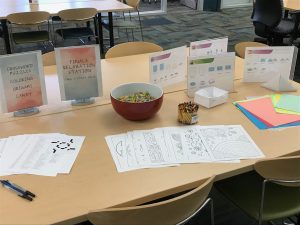
Finals Relaxation Station display (own photo)
Ideas for Expansion
This module’s readings and explorations got me thinking about other ideas for things we could be doing in my library to create hygge’s tenants of coziness, well-being, and community. Specifically, the Lauersen (2024) article recommended thinking about how the library brings value and impacts the community, with considerations for four dimensions of culture: emotional, intellectual, creative, and social. Inherently, the library brings much intellectual value to the campus community, and some of our recent space upgrades have created a more conductive social space. I think there is the greatest opportunity for us to consider how the library can impact the emotional and creative campus environment. One idea I’m excited about is playing ambiance music in the library. We could collaboratively create playlists with students, and we could also have designated quiet hours to be cognizant of people who have sensory considerations. I think this could benefit students’ emotional well-being. My Innovation Strategy and Roadmap project also highlighted encouraging student creativity through photography that would be donated to the college archive to document student life. Finally, I really liked the idea presented in the Stephens (2019) chapter about the library acknowledging important life moments. As an academic library, we already play a part in important life events (graduation, job offers, passing an important test, et.), and I am excited to consider how our library might encourage our students and celebrate their success better.
References
Lauersen, C. (2024, August 25). The value of libraries from Roskilde to Toronto. The Library Lab. https://christianlauersen.net/2024/08/25/the-value-of-libraries-from-roskilde-to-toronto/
Stephens, M. (2019). Hygge state of mind. In Wholehearted librarianship: Finding hope, inspiration, and balance (pp. 63-65). ALA Editions.
Stephens, M. (2025). The hyperlinked library: New models [Video]. The Hyperlinked Library. https://287.hyperlib.sjsu.edu/
@rachelll I ❤️ this: “Once students have been lured in with free food, library staff will be conveniently located to engage students in conversation.”
The idea of the snack cart is right on target in my mind, and it does lead to maybe conversation striking up when students are grabbing a snack or a cup of coffee There’s something to be said about luring them in. 😀