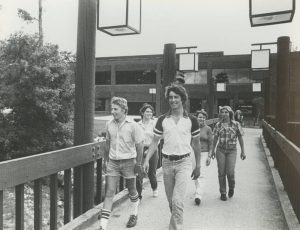
Students walk over bridge at Lakeshore Technical Institute [Photograph]. (1985). Lakeshore College Archives. https://content.mpl.org/digital/collection/lakeshore/id/2890/rec/9
What is the idea?
Idea Overview
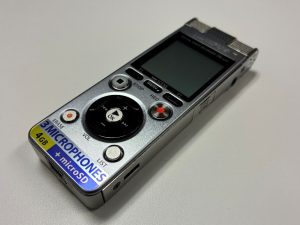
This is an initiative to engage Lakeshore College students in preserving and sharing their own college experiences and history. This program will be run by the Lakeshore College Archives. The archive will provide students with a camera (either a digital camera or an instant camera with film) and a worksheet to fill out basic metadata information. The archive will partner with student organizations, and individual students can also participate. The students will donate the images to the archive, and archive staff will process the images for preservation and addition to the archive collection. The images will be made publicly available through the college’s digital archive, with the student photographer listed as the material’s creator. The archive will then print and frame student images to hang in the archive photo gallery located inside the college library. In collaboration with the student photographers, the archive will host a small exhibit opening party where the students can talk about their photographs. Additionally, throughout the course of the initiative, archive staff will present information literacy sessions related to researching in the college archive and managing personal digital files.
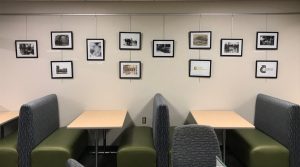
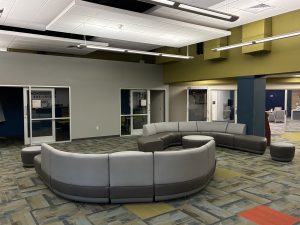
Archive photo gallery located in Lakeshore Library (own photo)
Project Goals
- Give students opportunities to experiment with different photography technologies
- Engage students in the sharing of their own stories and amplify their voices
- Teach archival research skills and digital literacy skills
- Expand the historical record in the college archive to be inclusive of student voices and experiences
- Promote the college archive and increase student use of archives
Description of Community
Lakeshore College is a rural technical college with a yearly enrollment of about 1,500 FTE (Lakeshore College, 2026). The college offers technical and associate degree programs. BIPOC students represent 22.86% of the student body (Lakeshore Technical College, 2022). This is a commuter college, and many students are adults balancing work, family, and school.
Who We Are Helping
Students will be the focus of this project, but the whole campus community will benefit from a more diverse representation in the archives.
How We Are Helping
- Promoting a sense of belonging and strengthening community
- Encouraging students’ creativity through photography
- Providing camera technology and giving students opportunities to play with old-school film medium
- Preserving current history and creating a more accurate and diverse historical record in the archives
- Promoting digital literacy skills
Mission & Institutional Context
The archive’s mission is “to collect, preserve, and make accessible materials that document the history of Lakeshore College and to serve as an educational resource to support research and learning” (Lakeshore College Library, 2026). The archive serves Lakeshore students, staff, alumni, and external community members. The college archive is managed by library staff and is physically very small. All archival materials are stored on a few shelves within the library. The archive is relatively new. Historical materials that had been housed throughout campus were brought to the library and organized in 2022. A small digital archive was launched in 2023. Almost all the archival materials were produced and donated by college employees, particularly the marketing department, and there is very little representation of student created materials. Now that the archive has been set up, work is focused on collecting and preserving current materials that record college history. Due to the collection gap related to student produced materials, priority has been placed on student life related materials. The Archiving Student Life project will bring these missing voices to the archive and will allow students to share and document their own experiences.
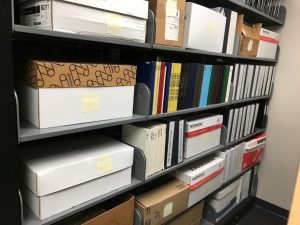
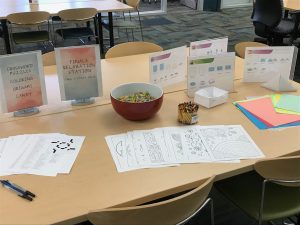
Lakeshore College Archives (own photo)
Action Brief Statement
Convince Lakeshore College students that by preserving and sharing records of their experiences at Lakeshore College they will contribute to a more complete and diverse college historical record which will create opportunities for research, engagement, and strengthening the campus community because the archive’s mission is rooted in sharing college history and supporting learning.
Inspiration
The literature shows there is a growing movement to acknowledge that “student experience has long been poorly and selectively captured by university archives” (Becker, 2017) and that only “a small portion of archival holdings represent student-generated material” (Buchanan & Richardson, 2012). These articles and case studies highlight efforts institutions have done to remedy this.
Guidelines & Policies
- Lakeshore College Archives (2026) has a collection development policy that guides all archive acquisition decisions. This addresses what type of material may be added to the collection. This means the content of the materials must be related to Lakeshore College. The collection development policy also maintains that the copyright of all donated materials must be transferred to the archive. This will allow the archive to include the material in the publicly accessible digital archive.
- Copyright touches ethical and access issues. Lakeshore College Archives (n.d.) has a gift agreement form that will be used to formally transfer copyright to the archives.
- Privacy concerns will be considered if a student wishes to submit materials but remain anonymous. They would need to sign a gift agreement form but would not be identified in the metadata in the publicly accessible digital archive. A student could also choose not to have their pictures exhibited in the photo gallery or to have their name be anonymous.
- Technostress—feeling overwhelmed by the amount of new technology getting thrown as you—is very real problem (Stephens, 2008). This could certainly affect students. If students would rather elect to use their own device (like a smartphone) to take pictures instead of using a library issued digital camera or instant camera, they can choose to do that. This flexibility offers opportunities for a more inclusive program and student learning experience (Stephens, 2008).
- Libraries and archives need to be transparent with their stakeholders. Program ideas and policies should be made public (Stephens, 2025). Project guidelines should be shared with participants. Especially with matters of transferring copyright, we want to make sure that participants are informed and consent to archive policies.
- A participatory service mindset means that the user is involved in planning (Stephens, 2025). Students should be consulted about the project’s guidelines in the planning phase.
Timeline for Implementation
Planning is important when rolling out a new library service. The service should align with the library’s mission, and all planning should be done with the user in mind. Communication is important as the plan needs to be promoted to stakeholders, and staff must buy into the plan. The plan also needs to be flexible to accommodate surprise challenges (Stephens, 2004).
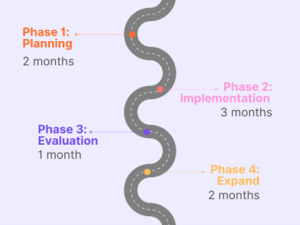
Note. Infographic template created by Pitstud using Canva.
- Phase 1: Planning (2 months) – create project proposal and obtain funding, collaborate with student life staff and student organization groups, purchase equipment, catalog new equipment, create metadata worksheet, staff training, prepare information literacy sessions
- Phase 2: Implementation (3 months) – marketing efforts, check out camera equipment, check in with participants, obtained signed gift agreement forms, process donated student photographs for addition to the archive collection and for ingestion into the publicly accessible digital archive, print and hang student photographs in the archive gallery, collaboratively work with student photographers to plan exhibit gallery party, lead information literacy sessions
- Phase 3: Evaluation (1 month) – create and send out participant survey, obtain collection statistics, compile statistics from information literacy sessions and exhibit gallery party, identify problems and make improvements
- Phase 4: Expand (2 months) – adjust project plan for improvements learned in last cycle, collaborate with digital photography faculty to have students from the photography class participate in the program, build stronger partnerships with student life organizations and offer assistance with records management
Marketing & Promotion
- The program will be branded “Lenny’s Lens.” (Note: Lenny the snow leopard is the college’s mascot.)
- Phase 2 (implementation) will be launched in October to celebrate National American Archives Month.
- The marketing message to students will emphasize that their story matters and this is an opportunity for them to share and preserve their story.
- Internal Promotion: mass email messages, short article in the student e-newsletter, post fliers in the library and on campus bulletin boards, social media post, announcement on library website, attend and speak at student organization meetings
- External Promotion: Reaching alumni could be valuable for this project. They might have materials from their time as a student they want to donate. Alumni might also have an interest in viewing this collection when completed and attending the photo gallery launch party. Social media would be used to promote to this alumni group.
- Note: Separate communication will be used to promote the information literacy sessions. This message would focus on learning how to preserve your own digital history.
Staff Training & Readiness
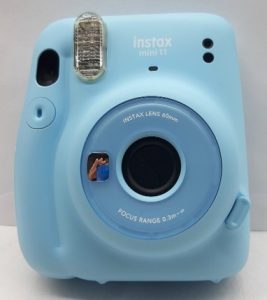
“FUJIFILM INSTAX MINI” by ORANIT DORON is licensed under CC BY-SA 4.0
- One library staff person has archives responsibilities and will be putting on this program. That would be me! The only new process or technology I would need to learn is the instant camera. I will need to educate myself about how to operate and care for the camera and film. I will also need to research how to preserve instant pictures as this might be different than other types of photographs that are currently in the archive.
- Other library staff will be updated about all aspects of the project so they can answer any patron questions that might come up. I will handle the updates and any training requests that come from other staff. I will also create a short reference document for other library staff that briefly explains the different stages in this program.
Evaluation
- Archive collection statistics: number of student life materials, number of student creators
- Student participant feedback gathered through surveys
- Attendance statistics: information literacy sessions, photo gallery launch party
- Success stories: hope to share many stories of student engagement and excitement for the archive
Future Expansion
- Faculty partnerships: possibility to collaborate with faculty of digital photography class to have their students participate in the archive initiative. This would ensure a larger number of student participants, and the project could be run more frequently to align with class offerings.
- Further develop partnerships with student life organizations: possibility for archives to offer records management assistance. Digital records are fragile, and the archives can help the students maintain and preserve their own history (Beccera-Licha, 2017). The archives could also produce a LibGuide specifically for student organizations that would help simplify the records management process.
References
Becerra-Licha, S. (2017). Participatory and post-custodial archives as community practice. Educause Review. https://er.educause.edu/articles/2017/10/participatory-and-post-custodial-archives-as-community-practice
Becker, J. (2017). Bringing student voices into the university archives: A student organization documentation initiative case study. In The Library With The Lead Pipe, 205-24. https://www.inthelibrarywiththeleadpipe.org/2017/bringing-student-voices/
Buchanan, S., & Richardson, K. (2012). Representation through documentation: Acquiring student and campus life records through the Bruin Archives Project. The American Archivist, 75(1), 205-224. https://doi.org/10.17723/aarc.75.1.e61061ul8701076u
Lakeshore College. (n.d.). Lakeshore College strategic plan scorecard. https://lakeshore.edu/sites/default/files/2026-04/Lakeshore%20College%20Scorecard%20Worksheet%20-%202025-30.pdf
Lakeshore College Archives. (n.d.). Lakeshore College Archives gift agreement. https://lakeshore.libguides.com/ld.php?content_id=75163184
Lakeshore College Archives. (2026). Lakeshore College Archives collection development policy. https://lakeshore.libguides.com/ld.php?content_id=83764268
Lakeshore College Library. (2026). Lakeshore College Archives. https://lakeshore.libguides.com/archives
Lakeshore Technical College. (2022, June). Equity report. https://lakeshore.edu/sites/default/files/pdf/hr/LTC-Equity-Report-2022-Final.pdf
Shaw, J. (2019, April 22). Introducing the archiving student life for the third century project and workshop. University of Virginia Library. https://smallnotes.library.virginia.edu/2019/04/22/archiving_student_life/
Stephens, M. (2004). Technoplans vs. technolust. Tame the Web. https://tametheweb.com/2004/11/01/technoplans-vs-technolust/
Stephens, M. (2008). Taming technolust: Ten steps for planning in a 2.0 world. Tame the Web. https://tametheweb.com/2012/05/30/taming-technolust-ten-steps-for-planning-in-a-2-0-world-full-text/
Stephens, M. (2025). The hyperlinked library: Participatory service & transparency [Video]. The Hyperlinked Library. https://287.hyperlib.sjsu.edu/
Wells, R. (2025). Archiving student life at Iowa State University. Iowa State University Library. https://instr.iastate.libguides.com/c.php?g=1274598&p=9355624