All posts by staciwright

Reflection Blogging: Hyperlinked Environments

In exploring the concept of hyperlinked environments, the user research from Pew section caught my attention. There is something so enticing about concrete statistics and the clear, bolded statements that accompany a Pew Research study. Whenever I see statistics in a study, article, or news clip, I am reminded of taking the required statistics class for my psychology degree – the bane of nearly every psychology major’s existence. I cannot, for the life of me, remember how to calculate p-values, but I do remember the professor challenging us to be mindful of how statistical information is presented. What was the sample size like? What are the demographics or characteristics of the participants? The context greatly influences the actual meaning of the results. Unlike headlines written to be punchy and attract views, the results of scientific inquiry can often be less black and white. Whenever I see information presented in this way, I try to think critically about what story is being told, and who benefits from that version of the story.

These research studies can help library staff, especially, to stay aware of general trends and patterns regarding information-related attitudes and behaviors. With AI coming to the forefront of people’s consciousness, “The Public Awareness of Artificial Intelligence in Everyday Activities” report (Pew Research, 2023) caught my attention. This study, a few years old, helps to illustrate that today’s AI technologies did not pop out of the ether to destroy the world, but did, in fact, evolve from AI technologies that already existed in the day-to-day life of many people.

I am in the same boat at 38% percent of Americans that could only correctly identify 3-5 of the 6 uses of AI in the study. For me- it was the “e-mail categorizing things as spam” that caught me off-guard. Perhaps this is a feature of e-mail (a technology I have used and had access to since I was a child) that I simply took for granted.

The section on concern/excitement about AI technologies hits close to home, as I have been forced to reckon with my own opinions and experiences with this technology in both an academic and professional context. Even understanding that generative AI has evolved from technologies that I happily engage with every day… for the first time I am experiencing the concern and fear that comes with rapid technological changes. I am also with the 39% of medium-awareness of AI folks that are more concerned than excited about these changes.

The content of this class and especially the lectures given by @michael help me to challenge my perspective. It certainly is not comfortable, but at the same time, I appreciate how that helps me grow as an information professional. AI tools are a part of the current hyperlinked environment that library professionals operate in. Though I have my concerns, I do agree that playing with these tools will help me better assist patrons moving forward. To that end, see below for my first ever conversation with Google’s Gemini:

Early Milestones in Artificial Intelligence: AKA Staci’s Attempt to Get Gemini To Make A Timeline of Historical Events

Pew Research Center. (2023, February 15). Public awareness of artificial intelligence in everyday activities. https://www.pewresearch.org/science/2023/02/15/public-awareness-of-artificial-intelligence-in-everyday-activities

@staciwright

Reflection Blogging: Hyperlinked Communities

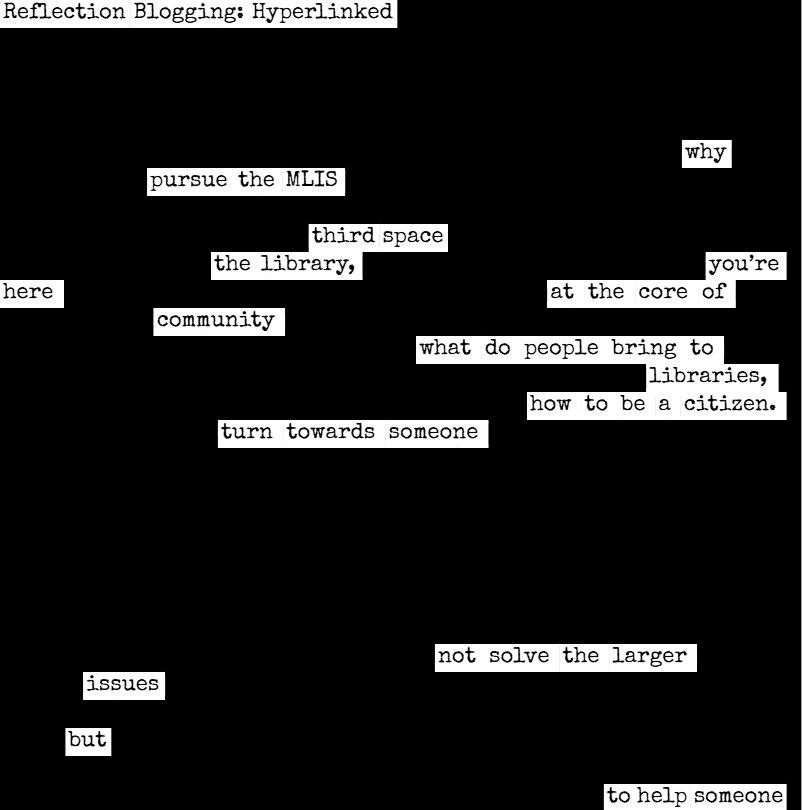
In this moment I am extremely grateful for the flexible due dates in this course, as life has taken more than one unexpected turn for me in the past few weeks. It’s a bit daunting to catch up on weeks’ worth of educational content, but watching Ciara’s Eastell’s TED Talk: “How Libraries Change Lives” helped to calm my thoughts and reminded me why I am choosing to pursue the MLIS and this career path. While donning possibly the coolest necklace I have seen in sometime, Eastell describes the library as a third space is the most succinct of ways: when you come to the library, you “cease to be a consumer, you’re here as a citizen”. I think this concept is at the core of the hyperlinked community concept. When there is no capital to be produced, money to be exchanged, what do people bring to this environment? When people scoff at the relevance of libraries, sometimes I wonder if they have forgotten how to be a citizen. Forgotten how to turn towards someone when they ask the hard questions like Eastell was asked: “when will my grief end?”

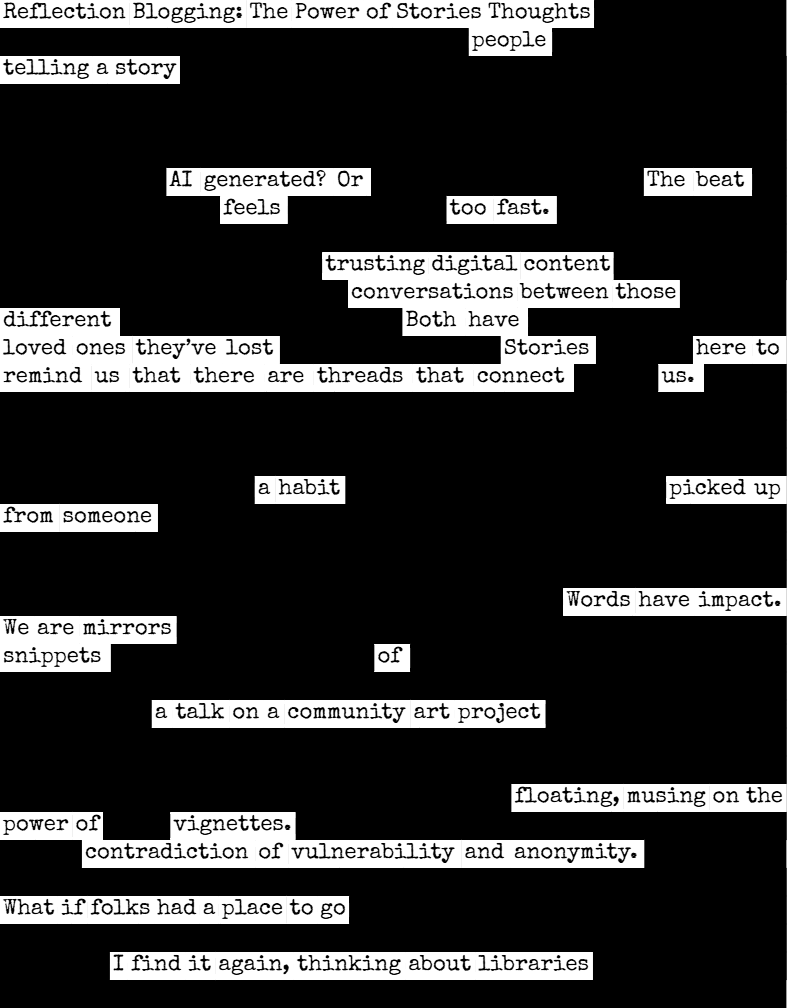
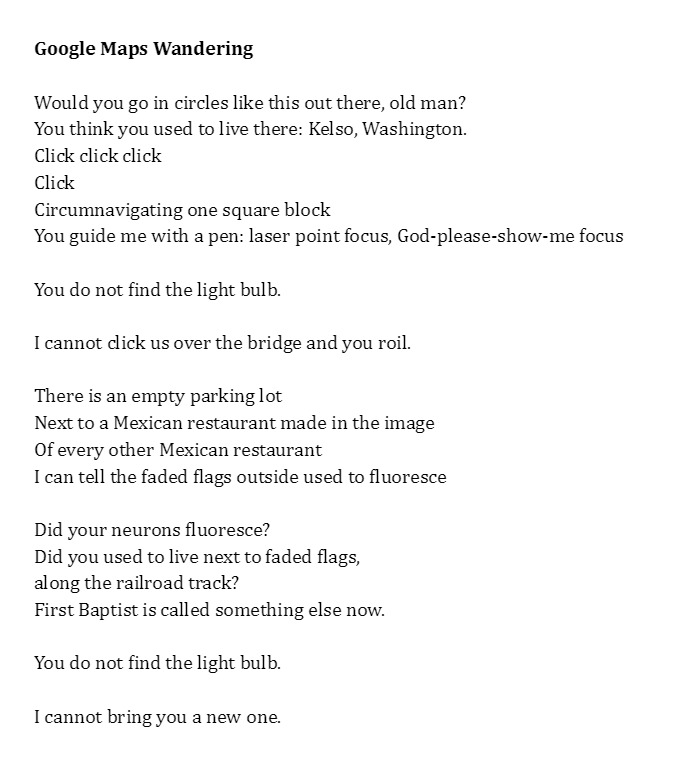
The work that I have been able to do in libraries (that I personally find to be the most meaningful) echo that interaction that Eastell describes. Helping a regular user with dementia use Google Maps to try and remember where they used to live, for example, was something I did on a semi-regular basis. At the time, I wrote the following poem while reflecting on the interaction:

7.13.24

This module’s content has reminded me that although I could not solve the larger mental health issues that this patron faced, I could share that time with them. The brooding tone of the poem was true to my feelings at the time; but now I can see the dual sides of the experience, too. There was no charge for internet access, no tip required for my services. Acting as a fellow citizen, I used my computer skills to help someone try to find what they were looking for.

TEDx Talks. (2019, June 13). How Libraries Change Lives | Ciara Eastell | TedxExeter [Video]. YouTube. https://youtu.be/Tvt-lHZBUwU?si=GmH1yglASVKI7Few

Author’s Note:

Creative detours were taken in the making of this blog post. Screenshots of Eastell’s glorious jewlery were subjected to my (unimpressive) photo editing skills. Apologies to all graphic designers everywhere, but I had fun doing it:

7.14.26

@staciwright

Assignment X: Reflecting on Intersections in The Four Spaces Library Model

Of all the material covered so far in this course, the model depicted here by Jochumsen et al. (2012) has stayed floating around in my mind:
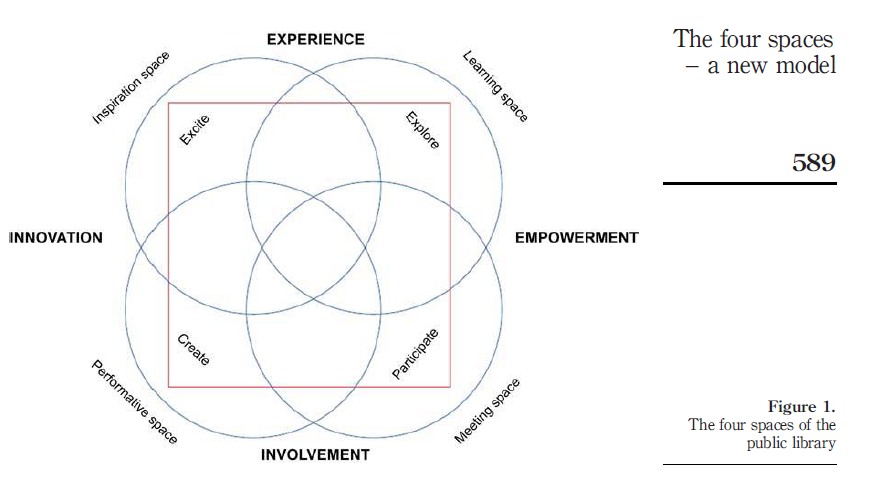
Flashed only briefly in the lecture on participatory service, I thought back immediately to the first public library job I held as a circulation assistant in a small suburban library in Oregon. Hunting down the original article to see what information was written alongside this visual, I found that the authors asked the following question: “… would a small library also be able to mirror itself in all the four spaces listed, or would it seem too ambitious and unrealistic to size and resources?” (Jochumsen et al., 2012, pp. 594). Pulling from my experiences, I would give this a resounding yes, yes it can! with an appropriate amount of scaling to the library’s size and resources.

While it may not have been possible with available funds to do serious construction on the (rented) suite in the strip mall where the library was located, or to hire, say, a makerspace librarian – I witnessed the staff and patrons of this library work together to create and foster all four of the spaces illustrated by this model in some capacity. For this assignment, I will be mapping examples of the library’s design, programs, and partnerships to the four spaces depicted by Jochumsen et al.’s (2012) four spaces library model.

Inspiration Space

On a rainy, cold evening in October, the library hosted a local theater company to perform A Year of Magical Thinking, the play based off of Joan Didion’s book of the same name. Staff reorganized tables and chairs that typically occupied the front of the library to create a wide-open stage, or at least as wide open as possible in the twenty-foot by thirty-foot space in front of the circulation desk. Patrons sat a mere few feet away, as the actress playing Didion performed the one-woman show, monologuing for ninety minutes.

Learning Space

Loyal patrons returned week after week on Friday mornings to attend the Tech Help program hosted by our adult service’s librarian. All hands were on deck to continue to hold the program even in the face of staffing issues. On one fateful day, I was asked to step in even as a Circulation Assistant. Working at the front desk most of the time, I frequently observed this program taking place. Folks from all backgrounds took on the challenge of working with library staff to solve a wide array of problems: anything from changing Libby account settings to rectifying e-mail inbox issues.

Meeting Space

Monthly, the passionate and vocal members of the local Community Participation Organization would use the library as a meeting space. Open to all in the community, the library re-organized the space and furniture to accommodate the groups, project equipment for presentation, and staff to be available after regular business hours to ensure the building could be operational for this meeting. Community members discussed construction projects and shared concerns about issues affecting the area.

Performative Space

Partnering with a local art supply store that focused on recycling and reusing art/craft supplies of all kinds, the library hosted programs with staff members from the organization to create various STEAM projects for kids and tweens. Sifting through scrap bits of cardboard, spare dice, newspaper, a trail of smiling faces would parade bird houses or UFO’s after a bit of guidance from the DIY experts. No two creations would be exactly the same, but the joy of hands-on creation glowed in each child’s face.

Further Reflection

The most interesting part of this model is the interconnected nature of it; it reminds me of the other course materials that intend to illustrate what “hyperlinked” means for a library. While on the surface the programs and services described above may seem pretty typical for a library, I felt a bit of pride, a bit of joy looking at this model. A small, scrappity library that began as a completely volunteer-run organization in an unincorporated area became a library that, unknowingly, embodies the four quintessential goals described by LIS scholars. I currently work in an academic library, serving a very different purpose and a very different patron base. As I continue to explore the hyperlinked library concept, I hope to find the connections between this model or others that bring the same flavor heart to the academic library sphere.

References

Jochumsen, H., Rasmussen, C.H. & Skot-Hansen, D. (2012). The four spaces: A new model for the public library. New Library World, 113(11/12), 586-597.

@staciwright
Howdy: Hyperlinked Edition

Hi, Everyone! I’m going to take a rapid-fire, fun-fact style approach to this one. Here it goes:

Name: Staci

Current Job: Circulation Assistant at an Academic Law Library

College Major: Psychology

Home Base: Orange County, CA

Current Hair Color: Pink and Red (Think: Strawberry Shortcake)

Currently Reading: House of Spirits by Isabel Allende

Last Piece of Art To Move Me: Nopal en la frente (con Dos Equis Ambar), 2021 by Alejandro Macias

Currently Playing: Legend of Zelda: Echoes of Wisdom

Hill That I Am Willing to Die On: Mint ice cream does not taste like toothpaste. (A lifelong argument between my brothers and I).

Go-To Coffee Order: Iced Lavender Oat Milk Latte

Additional Excitement Blurb: I am looking forward to getting to know everyone throughout the course of this summer session, and am already enjoying experimenting with this blog. This course was recommended to me by my INFO 203 professor, and the syllabus captured a lot of what I find most interesting and exciting about library and information science work! My first library assistant position (before my current one) really solidified my passion for user-centered library work, and being able to help patrons at the circulation desk for the past few years has been both challenging and rewarding.