Of all the material covered so far in this course, the model depicted here by Jochumsen et al. (2012) has stayed floating around in my mind:
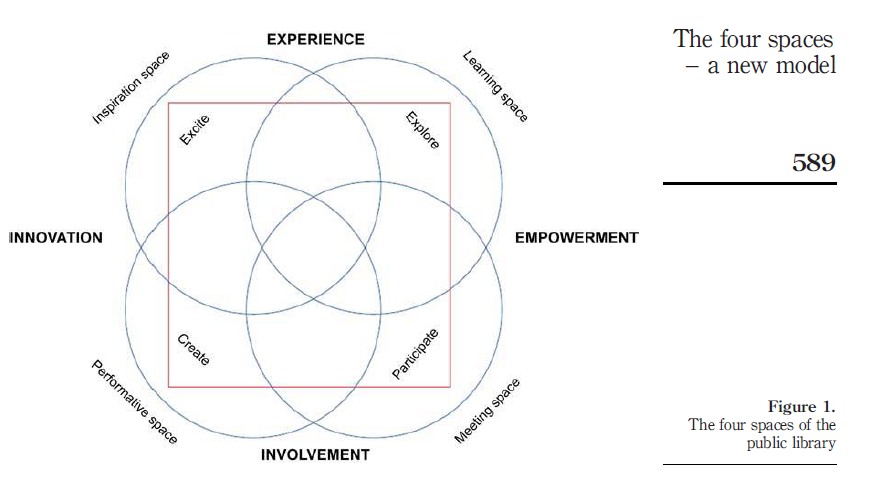
Flashed only briefly in the lecture on participatory service, I thought back immediately to the first public library job I held as a circulation assistant in a small suburban library in Oregon. Hunting down the original article to see what information was written alongside this visual, I found that the authors asked the following question: “… would a small library also be able to mirror itself in all the four spaces listed, or would it seem too ambitious and unrealistic to size and resources?” (Jochumsen et al., 2012, pp. 594). Pulling from my experiences, I would give this a resounding yes, yes it can! with an appropriate amount of scaling to the library’s size and resources.
While it may not have been possible with available funds to do serious construction on the (rented) suite in the strip mall where the library was located, or to hire, say, a makerspace librarian – I witnessed the staff and patrons of this library work together to create and foster all four of the spaces illustrated by this model in some capacity. For this assignment, I will be mapping examples of the library’s design, programs, and partnerships to the four spaces depicted by Jochumsen et al.’s (2012) four spaces library model.
Inspiration Space
On a rainy, cold evening in October, the library hosted a local theater company to perform A Year of Magical Thinking, the play based off of Joan Didion’s book of the same name. Staff reorganized tables and chairs that typically occupied the front of the library to create a wide-open stage, or at least as wide open as possible in the twenty-foot by thirty-foot space in front of the circulation desk. Patrons sat a mere few feet away, as the actress playing Didion performed the one-woman show, monologuing for ninety minutes.
Learning Space
Loyal patrons returned week after week on Friday mornings to attend the Tech Help program hosted by our adult service’s librarian. All hands were on deck to continue to hold the program even in the face of staffing issues. On one fateful day, I was asked to step in even as a Circulation Assistant. Working at the front desk most of the time, I frequently observed this program taking place. Folks from all backgrounds took on the challenge of working with library staff to solve a wide array of problems: anything from changing Libby account settings to rectifying e-mail inbox issues.
Meeting Space
Monthly, the passionate and vocal members of the local Community Participation Organization would use the library as a meeting space. Open to all in the community, the library re-organized the space and furniture to accommodate the groups, project equipment for presentation, and staff to be available after regular business hours to ensure the building could be operational for this meeting. Community members discussed construction projects and shared concerns about issues affecting the area.
Performative Space
Partnering with a local art supply store that focused on recycling and reusing art/craft supplies of all kinds, the library hosted programs with staff members from the organization to create various STEAM projects for kids and tweens. Sifting through scrap bits of cardboard, spare dice, newspaper, a trail of smiling faces would parade bird houses or UFO’s after a bit of guidance from the DIY experts. No two creations would be exactly the same, but the joy of hands-on creation glowed in each child’s face.
Further Reflection
The most interesting part of this model is the interconnected nature of it; it reminds me of the other course materials that intend to illustrate what “hyperlinked” means for a library. While on the surface the programs and services described above may seem pretty typical for a library, I felt a bit of pride, a bit of joy looking at this model. A small, scrappity library that began as a completely volunteer-run organization in an unincorporated area became a library that, unknowingly, embodies the four quintessential goals described by LIS scholars. I currently work in an academic library, serving a very different purpose and a very different patron base. As I continue to explore the hyperlinked library concept, I hope to find the connections between this model or others that bring the same flavor heart to the academic library sphere.
References
Jochumsen, H., Rasmussen, C.H. & Skot-Hansen, D. (2012). The four spaces: A new model for the public library. New Library World, 113(11/12), 586-597.
@staciwright