Category Archives: Reflection Blogging

Reflection Blogging: Hyperlinked Environments

In exploring the concept of hyperlinked environments, the user research from Pew section caught my attention. There is something so enticing about concrete statistics and the clear, bolded statements that accompany a Pew Research study. Whenever I see statistics in a study, article, or news clip, I am reminded of taking the required statistics class for my psychology degree – the bane of nearly every psychology major’s existence. I cannot, for the life of me, remember how to calculate p-values, but I do remember the professor challenging us to be mindful of how statistical information is presented. What was the sample size like? What are the demographics or characteristics of the participants? The context greatly influences the actual meaning of the results. Unlike headlines written to be punchy and attract views, the results of scientific inquiry can often be less black and white. Whenever I see information presented in this way, I try to think critically about what story is being told, and who benefits from that version of the story.

These research studies can help library staff, especially, to stay aware of general trends and patterns regarding information-related attitudes and behaviors. With AI coming to the forefront of people’s consciousness, “The Public Awareness of Artificial Intelligence in Everyday Activities” report (Pew Research, 2023) caught my attention. This study, a few years old, helps to illustrate that today’s AI technologies did not pop out of the ether to destroy the world, but did, in fact, evolve from AI technologies that already existed in the day-to-day life of many people.

I am in the same boat at 38% percent of Americans that could only correctly identify 3-5 of the 6 uses of AI in the study. For me- it was the “e-mail categorizing things as spam” that caught me off-guard. Perhaps this is a feature of e-mail (a technology I have used and had access to since I was a child) that I simply took for granted.

The section on concern/excitement about AI technologies hits close to home, as I have been forced to reckon with my own opinions and experiences with this technology in both an academic and professional context. Even understanding that generative AI has evolved from technologies that I happily engage with every day… for the first time I am experiencing the concern and fear that comes with rapid technological changes. I am also with the 39% of medium-awareness of AI folks that are more concerned than excited about these changes.

The content of this class and especially the lectures given by @michael help me to challenge my perspective. It certainly is not comfortable, but at the same time, I appreciate how that helps me grow as an information professional. AI tools are a part of the current hyperlinked environment that library professionals operate in. Though I have my concerns, I do agree that playing with these tools will help me better assist patrons moving forward. To that end, see below for my first ever conversation with Google’s Gemini:

Early Milestones in Artificial Intelligence: AKA Staci’s Attempt to Get Gemini To Make A Timeline of Historical Events

Pew Research Center. (2023, February 15). Public awareness of artificial intelligence in everyday activities. https://www.pewresearch.org/science/2023/02/15/public-awareness-of-artificial-intelligence-in-everyday-activities

@staciwright

Reflection Blogging: Hyperlinked Communities

In this moment I am extremely grateful for the flexible due dates in this course, as life has taken more than one unexpected turn for me in the past few weeks. It’s a bit daunting to catch up on weeks’ worth of educational content, but watching Ciara’s Eastell’s TED Talk: “How Libraries Change Lives” helped to calm my thoughts and reminded me why I am choosing to pursue the MLIS and this career path. While donning possibly the coolest necklace I have seen in sometime, Eastell describes the library as a third space is the most succinct of ways: when you come to the library, you “cease to be a consumer, you’re here as a citizen”. I think this concept is at the core of the hyperlinked community concept. When there is no capital to be produced, money to be exchanged, what do people bring to this environment? When people scoff at the relevance of libraries, sometimes I wonder if they have forgotten how to be a citizen. Forgotten how to turn towards someone when they ask the hard questions like Eastell was asked: “when will my grief end?”

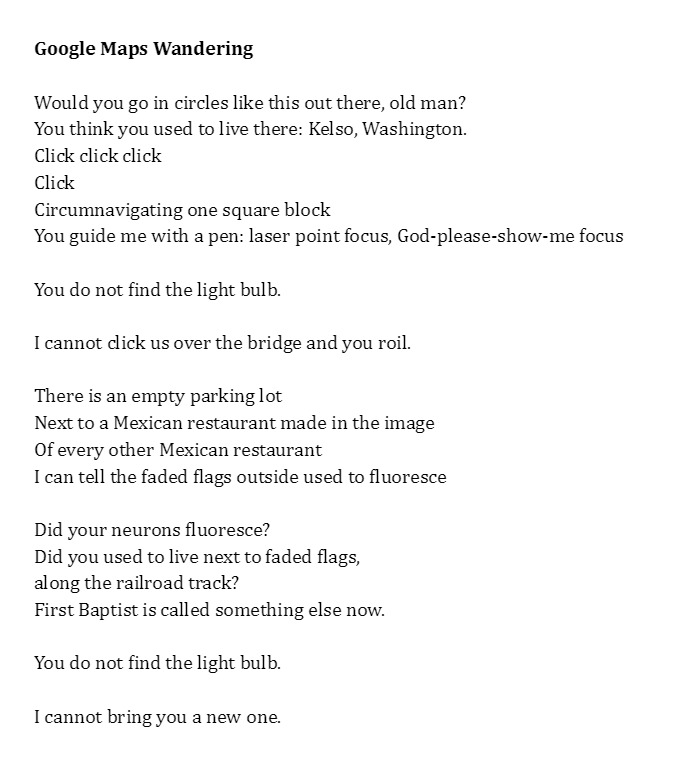
The work that I have been able to do in libraries (that I personally find to be the most meaningful) echo that interaction that Eastell describes. Helping a regular user with dementia use Google Maps to try and remember where they used to live, for example, was something I did on a semi-regular basis. At the time, I wrote the following poem while reflecting on the interaction:

7.13.24

This module’s content has reminded me that although I could not solve the larger mental health issues that this patron faced, I could share that time with them. The brooding tone of the poem was true to my feelings at the time; but now I can see the dual sides of the experience, too. There was no charge for internet access, no tip required for my services. Acting as a fellow citizen, I used my computer skills to help someone try to find what they were looking for.

TEDx Talks. (2019, June 13). How Libraries Change Lives | Ciara Eastell | TedxExeter [Video]. YouTube. https://youtu.be/Tvt-lHZBUwU?si=GmH1yglASVKI7Few

Author’s Note:

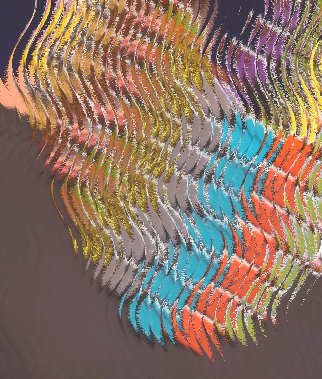
Creative detours were taken in the making of this blog post. Screenshots of Eastell’s glorious jewlery were subjected to my (unimpressive) photo editing skills. Apologies to all graphic designers everywhere, but I had fun doing it:

7.14.26

@staciwright