Like any critical thinker, I have a complex relationship with AI. My desire to thoughtfully and ethically engage with this technology butts up against societal and corporate technolust that rushes everyone to adopt and normalize AI. At the same time, I take the bigger picture view that AI is just the latest trend to usher in doom-and-gloom predictions about libraries. AI cannot replace libraries as long as we remain hyperlinked and keep adapting to serve our communities as hubs of human connection and enrichment. A more fruitful and practical approach to AI is to utilize it as a powerful sidekick for busywork, a helper in the process of information seeking. But I can’t help the side eye.

So to try on this “AI is not my enemy” mindset, I decided to use AI to learn more about AI and libraries. I started with the SJSU King Library AI chatbot, Primo Research Assistant. I asked Primo to find some recent academic articles about Chat GPT and libraries. The results returned 5 sources from 2023-2026 from peer-reviewed journals with a useful overview that included AI chatbot uses in international libraries.
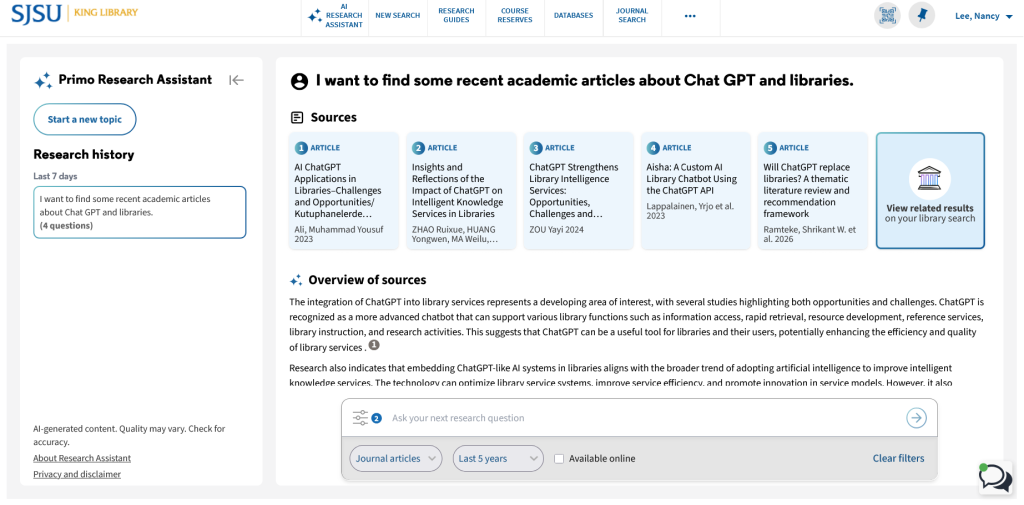
I chose to focus on the 3 most recent articles because the technology has evolved and become so pervasive in recent years that even 2023 may feel outdated. “Will ChatGPT replace libraries? A thematic literature review and recommendation framework” (Ramteke et al., 2026) was a useful overview.
“But the idea that technology might take the place of libraries is a fallacy that stems from a limited understanding of what libraries accomplish in reality. Libraries are democratic spaces, cultural stewards, and moral institutions that go well beyond simply providing access to knowledge. Although helpful, ChatGPT is unable to replace the human judgment, community involvement, and equity-focused goals of libraries and resource centers.” (Ramteke et al., 2026)
I then asked Primo for less academic sources like TED talks or podcasts about the topic, but the chatbot couldn’t deliver relevant results. No surprise, the academic library’s generative AI research assistant remained academic.
OK I’m all about plurality so I switched over to Perplexity and asked for non-academic sources about ChatGPT and libraries. But the results were too focused on ChatGPT and unrelated to libraries. I broadened the search to AI and libraries, which returned too many results. Sifting through Perplexity’s TMI, I chose to focus on a 2024 episode of the ALA podcast Call Number called Decoding AI and a blog post from Bibliotheca, “AI in Libraries: What’s Changed, What’s at Stake.”
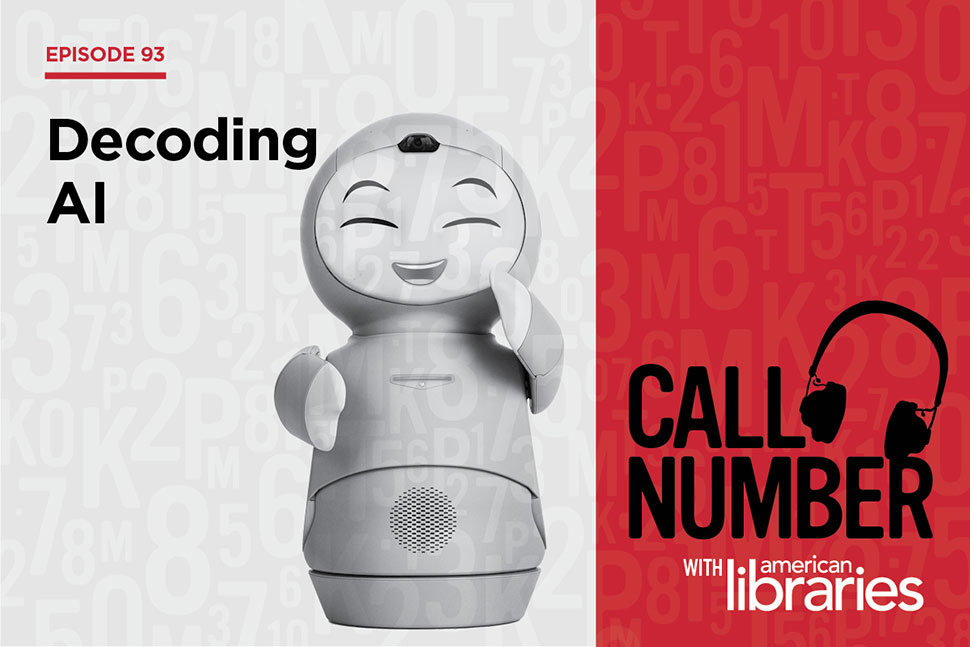
In the podcast episode, I was introduced to Elissa Malespina, a teacher-librarian at Union High School in New Jersey and writer of The AI School Librarians, a Substack newsletter I am now subscribed to. Elissa spoke about not fearing generative AI as a librarian and the importance of AI literacy in today’s world where students and teachers are already using it. Just try it, she advised. I am!

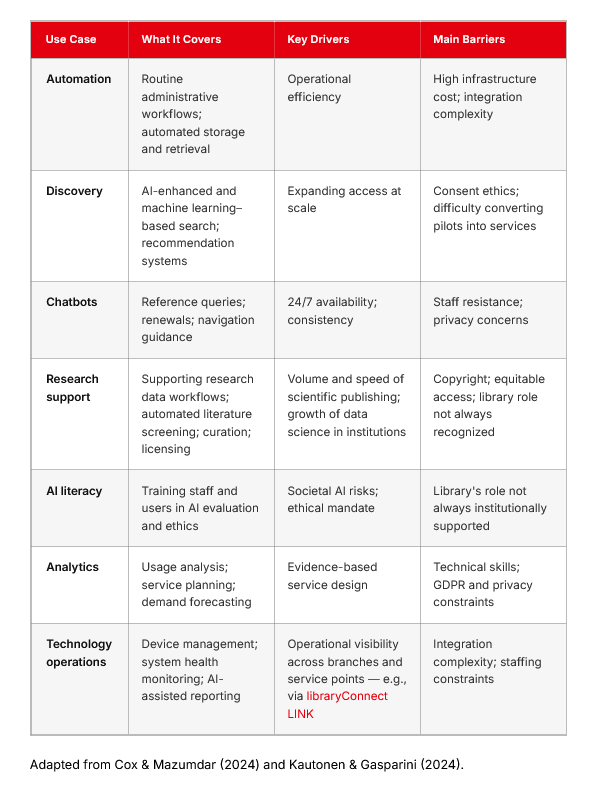
The Bibliotheca blog post had so many gems, including historical and current applications of AI in libraries to streamline back-of-house and frontline duties. Look at this handy chart:
I will conclude this thinking-out-loud reflection post with quotes from the Bibliotheca blog post that I will keep chewing on as I continue to wrestle with AI.
“In reference environments, a confident wrong answer is worse than no answer at all.”
“When a system can synthesize a credible-looking answer in seconds, evaluating that answer matters more than locating it.” (Bibliotheca, 2026)
References
Bibliotheca. (n.d.). AI in libraries. https://www.bibliotheca.com/ai-in-libraries/
Ramteke, S. W., Daphal, Y. B., Ankush, S. M., & Arote, P. P. (2026). Will ChatGPT replace libraries? A thematic literature review and recommendation framework. College & Undergraduate Libraries, 33(1), 65–76. https://doi.org/10.1080/10691316.2025.2576843
American Libraries Magazine. (2024, March 11). Call number podcast: Decoding AI [Audio podcast episode]. https://americanlibrariesmagazine.org/blogs/the-scoop/call-number-podcast-decoding-ai/
@nancylee2026 I really loved your post. You are I share similiar misgivings/feelings about AI. I see a lot value, but am concerned about the reliance on a very imperfect tool. I think viewing AI as a tool, not “the answer” is a helpful way to frame the conversation. I work in education, so this is a hot topic and I have a lot of concerns about the lack of conceptual knowledge before we jump right to the shortcut. I see this a lot with basic math or student’s challenges in telling time on an analog clock. It is great to use calculators and digtial watches, but if you don’t know what it all means, that is problematic. I look forward to listening to the podcast you shared.
Oh naurrrr young people can’t tell time on analog clocks? I did not know that! I think over-reliance on any one tool is misguided, and AI is just the latest buzzy technology. I think we as information professionals need a working knowledge of AI but of course should never outsource our critical thinking skills.
Hi Nancy,
I loved the levity of your posts. It kept me engaged throughout on a topic I am frankly fairly adverse to. I hear you on “just trying it.” However, another area of AI that makes me reluctant is that I know there are horrendous environmental repercussions to AI becoming so widely and rapidly available, especially those caused by the more widely known AI tools. If I am going to give these tools I am already wary of, I want to do so ethically, or at least as ethically as I can.
I can’t blame it all on AI as I have not done the research to decipher which companies or tools have ethical practices, and yes, I still use Google, which I know has environmentally disastrous data centers. Baby steps, I suppose.
Hi Krystal, I hear you! I’m pretty staunchly against OpenAI and ChatGPT but I don’t think there’s an ethical AI company. And there are serious ethical and environmental concerns when it comes to AI usage. But opting out entirely would not be practical or professional for us in the LIS field. And you mentioned how there are ethical compromises we are forced to make in our own personal tech usage. SO what I do is use lots of AI chatbots (besides ChatGPT) when I have to. I am loyal to none.
Hi Nancy,
Thank you for sharing your thoughts! I really enjoyed your post and share your views about AI. Like Krystal (@krystalt), I was initially hesitant to embrace AI because of its impact on the environment. My view began to change after I read an article about Japan using snow to cool data centers and support eel farming at the same time (https://www.asahi.com/ajw/articles/14568865). I also learned that in Europe, people use excess heat from data centers to warm local facilities and even homes in the community (https://local.microsoft.com/blog/datacenter_heat_repurposed/) (https://www.cnbc.com/2026/01/27/data-centers-ai-district-heating-aws-amazon-ireland.html). Hearing about these ideas makes me feel less guilty about using AI, especially since we, as information professionals, need to keep up with new technology and help others do the same. I may be too optimistic but I am hopeful that American companies will keep up with their international counterparts and come up with creative ways to make their data centers more sustainable too.
Ooh I love knowing about those international solutions, Coco! Thanks for sharing. It’s another reminder that we have to keep a broad perspective on the development of AI (and any technology).
Nancy, so many things in this post resonated with me! First, I have to tell you that I use that Yoda quote on my kids all the time! So much that they bought me a t-shirt with it printed on. I just really love the sentiment behind it. Second, I took a INFO 210 last semester with Dr. Tunon and we learned a great deal about AI and the different types of responses you get from different types of AI. It was very enlightening and I highly recommend her class if you haven’t taken it. Third, I worked with a library director who was so terrified of AI to the point that she wouldn’t even talk about it. One day she was out getting her lunch and drove up to a Wendy’s and their drive through was the first in the area to have those AI ordering screens. She was so upset by it that she had to take the rest of the day off! I am torn over it, myself. I hate these massive data centers that are popping up everywhere and the crazy amounts of electricity and water they use. But I do see a use for AI in many areas. I guess being informed is the best way to start, and it sounds like you’re doing just that. Thanks for a great blog post!
Robyn, thanks for your reply. LOL to the Yoda shirt and Wendy’s drive through story. I’m signed up for Dr. Tunon’s class next semester so I’m really happy to read your endorsement of it!
@nancylee2026 I am so glad you decided to do this post and explore what is out there in the recent literature and recent professional media regarding AI and libraries. This is exactly what we should be doing as information professionals to sort out what all of this means for information services and how we might best use it. The chart you shared was fire 🔥.
Hello Nancy,
I appreciate your thoughts and honesty on the topic of AI and you wrap it up with a great quote. I took the Ethics of Data and AI course last term and I found it eye-opening and useful in the sense that I have more information to hang my skepticism on. If you haven’t taken that class yet, I recommend it!
I also think your use of GIFs was top notch!