For my final thoughts on the Hyperlinked Library, I decided to record one more podcast sharing 5 key takeaways in 5 minutes. Encouraged by Michael and classmates, I feel more confident about this medium than I did at the start of the summer.
Author: Nancy Lee
Context and Purpose
I chose Gemini, Google’s AI assistant, as my thought partner to explore ways in which artificial intelligence could help the hypothetical LA Library, a smaller branch library I created last semester for INFO260A: Programming and Services for Children. Loosely inspired by the two branches of the Los Angeles Public Library I know best, the LA Library employs two librarians and relies heavily on volunteers to support programs held both indoors and outdoors. This library setting with limited staff time and capacity could greatly benefit from AI help with preparatory tasks like drafting program flyers and brainstorming new ideas for community partners. Utilizing the year of children’s library programming that was my final project for INFO260A, I grounded the AI experiment in human knowledge of the LA Library audience and local context as well as professional best practices for children’s library services. In this scenario, the librarians created the programming content specifically for their patrons to encourage learning and connection for audiences of different ages. The AI lightened the workload by taking care of busywork like graphic design, document creation, and new ideas for community outreach. The final products and implementation ultimately require human connection and relationship-building, but Gemini sped up and simplified the planning process.
AI Exploration Process & Human Revision/ Professional Judgment
I wanted to test Gemini with both straightforward and multi-step tasks to help librarians with little to no experience with AI. It took me a few tries to get what I wanted from Gemini for the most basic prompt to create event flyer templates from the recurring program information I uploaded, which was mostly text-based with one monthly calendar graphic (see examples below).
I prompted AI to create event flyer templates, which is tedious work for non-designers. I expected ready-to-use PDFs that I could edit slightly as needed, but it took a few exchanges with Gemini to get designed flyers in HTML format. I was unfamiliar with the process, but Gemini provided clear instructions on how to save, open, and print the files to get them into the PDF format I wanted. The results were near-final event flyer templates with minimal, colorful designs and catchy headlines that clearly communicated program details (see examples below). The text needs slight edits, but this was relatively easy and quick.
For the more complex task, I asked Gemini to come up with local or national partners for the LA Library based on the first 3 months of programming with a focus on cultural and community organizations. For a smaller branch library that relies on in-kind donations and volunteers, I asked for recommendations for short-term and long-term community partners. The results needed to be refined with a request to remove mentions of existing program partners. The new suggestions were all useful, especially when they were more specific and less generic. For example, the short-term ideas for January with the monthly theme of “New Beginnings” and a special program for Martin Luther King Jr. Day included Young, Black, & Lit (a national nonprofit that could provide book donations and be a literacy partner) and local senior centers and AARP volunteer chapters (which ones could be invited to be guest readers or vision board mentors?). The first is very helpful for its specificity, and the second feels too broad since the abilities and availability of the seniors vary wildly by each kind of senior center. AARP, while general, is still a useful suggestion since those volunteers could bring an intergenerational element to many children’s and all-ages programs. The actual outreach will be up to the librarian, but these are great starters. For ethical and quality considerations, I started and ended the process with human review and judgment.
Lastly, I wanted to try out Gemini’s ability to create internal staffing and budget planning documents. Prompted to project the rest of the annual budget using the provided Q1 information, the AI output was unrealistically low. I had to supplement my own knowledge of library programming rhythm, directing Gemini to double the programming costs for the later months of the year and add the major cost of the 8-week summer reading program. The revised budget was more accurate, and the draft plan was presented in a clear and concise format. This was not a near-finished product but helped me skip a couple of early drafts (see draft annual budget below).
The AI-generated monthly programs and themes are fine but overly generalized, whereas my LA Library cultural content is community-specific and inclusive. For example, Gemini suggested a fall festival, heritage month, and winter holiday social for Q4. Many of my scheduled library programs go beyond heritage months and celebrate specific holidays and traditions that are important to the many immigrant families from Asia and Latin America who live in the neighborhood.
Critical Reflection on AI in Library Work
With the help of AI, librarians can redeploy their time from administrative busywork to transformational work like planning and implementing programs and connecting with community members. AI helps to save time in generating ideas, documents, and flyers, but the source and final quality control are up to the librarian. The goal is to empower librarians and free them from some of the mundane constraints of the job. AI should not be a threat to librarians. In fact, the time and energy saved could also improve librarians’ professional and personal lives as they recover more bandwidth.
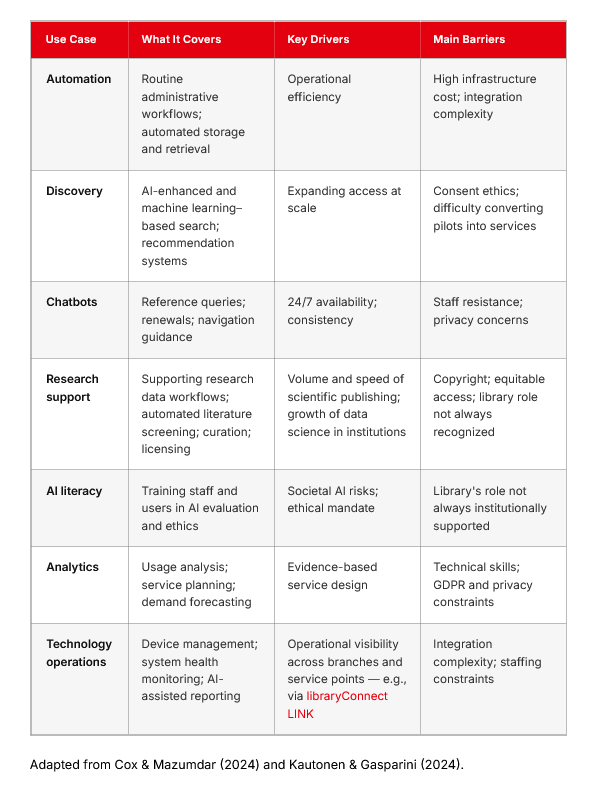
However, the ever-present societal and ethical AI concerns must be acknowledged. Every AI model is trained on massive amounts of data created by humans with blind spots and biases, conscious or unconscious. The risk of reinforcing dominant stereotypes and excluding marginalized perspectives exists with any AI interaction, and library workers need to pay special attention to fill those gaps. Inclusivity, connection, and transformation are at the heart of libraries, and using AI doesn’t change that. My experiment with Gemini waded into the waters of automation, discovery, research support, analytics, and AI literacy (Bibliotheca, n.d.) to help LA Library workers gain operational efficiencies while becoming more familiar with a technology that patrons are also adapting to in their daily lives.
Revelations that Anthropic’s AI assistant Claude destroyed millions of physical books in a massive scanning project to feed training data to build their large language model (Edwards, 2025) exacerbated the anti-AI sentiment among book lovers, which includes many library workers and patrons. Destroying books to save time and money and work around copyright issues is unequivocally bad! AI companies need to be held accountable to adopt non-harmful training methods and energy use for the long-term sustainability of the environment and original information sources. This is our shared responsibility.
Library workers have an ethical and professional responsibility to know about AI. Recently, the American Library Association (ALA) released its Guidance on the Use of Artificial Intelligence in Libraries, and the big picture advice is to filter AI usage through library values and human judgment. AI-assisted workflows require human review and oversight, which includes ethical considerations. Creativity and care remain the cornerstones of creating programs and services for library patrons; thus, we cannot opt out of AI technology as this is a disservice to library users.
Final Product
The final products that Gemini helped me create are 1) event flyer templates, 2) a brainstorming document with ideas for future library partners, and 3) the projected annual budget and staffing plan for 2026. These are not yet polished and ready to share but are practical working drafts of internal documents that will be finalized by librarians. AI accelerated the drafting process but was based on my own critical, human-centered library programming and adjustments. I know from previous jobs how administrative tasks can sit on a to-do list for too long as more urgent or engaging tasks keep taking priority. Using an AI assistant to quickly get these materials to a working draft phase can be a big help. These documents can be brought to meetings to generate fruitful discussions that can delve into more details informed by the deep knowledge and experience that the LA Library workers possess. I believe not being afraid of AI and being open to using the technology without overrelying on it embodies the necessary empathy and curiosity required of a hyperlinked librarian. The ALA guidelines codify the importance of libraries’ human expertise in adapting AI to better serve our staff and user communities. If libraries ignore or reject AI completely, we limit our full functionality as hubs of human connection and enrichment. Staff well-being and capacity are to be enhanced by, not replaced by, AI efficiency. I will continue to approach AI as a useful sidekick that allows me to focus on the humanity that helps me better connect with library patrons.
References
American Library Association. (n.d.). Guidance on the use of artificial intelligence in libraries. https://www.ala.org/tools/standards-and-guidelines/guidance-use-artificial-intelligence-libraries
Bibliotheca. (n.d.). AI in libraries. https://www.bibliotheca.com/ai-in-libraries/
Edwards, B. (2025, June 25). Anthropic destroyed millions of print books to build its AI models. Ars Technica. https://arstechnica.com/ai/2025/06/anthropic-destroyed-millions-of-print-books-to-build-its-ai-models/
Libraries are keepers of stories, among our many connective roles, but we’re not the only ones. The concept of humans as “living books” resonated with me this week, as well as the supportive role libraries can play. People are the keepers of their own stories, and initiatives like the Human Library welcome and elevate storytellers from all walks of life. Their “living books” are people who are part of marginalized communities including the unhoused, LGBTQ+, disabled, BIPOC, religious, and others that are stereotyped and misunderstood. These books volunteer to be available for checkout, engaging in conversations that can open hearts and challenge prejudices. Founded in Denmark in 2000, the Human Library has now expanded to community venues in over 80 countries around the world from public libraries to farmers markets, from festivals to coworking spaces. The versatility of the Human Library model allows for activations in diverse spaces and neighborhoods, all with the common goal of bringing people together.
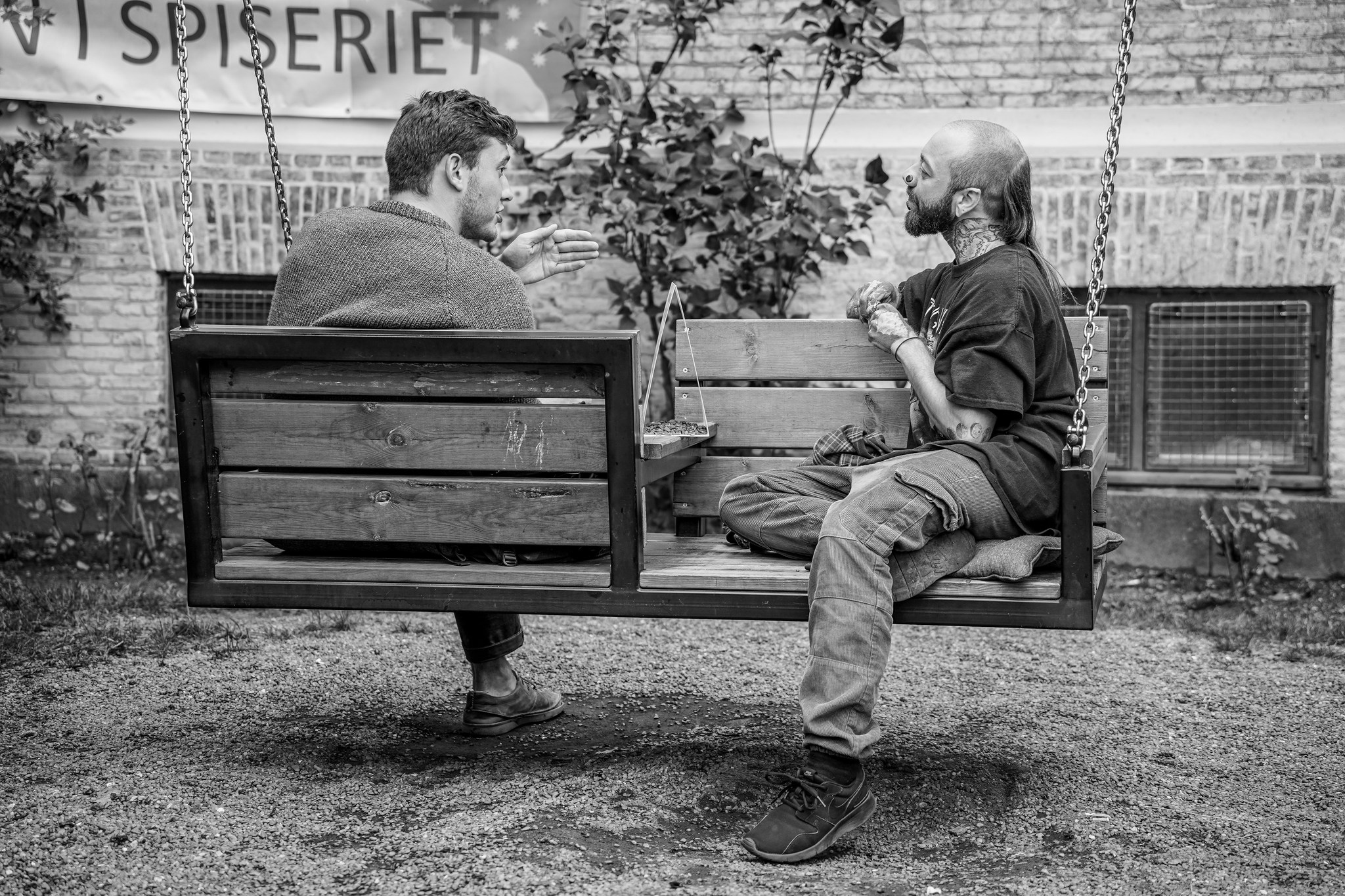
Photo from HumanLibrary.org
The city of Wollongong in Australia turned the concept into a Living Books program that highlights and connects community members who share their unique life stories. Their “living books” come from diverse backgrounds from double amputees to refugees and are updated regularly. Listening to and asking about the lived experiences of neighbors transforms storytelling into a dynamic conversation and relational process with the potential of more than a one-off experience. Wollongong recommends the program for students, community groups and the general public, and the possible venues include but are not limited to the public library.
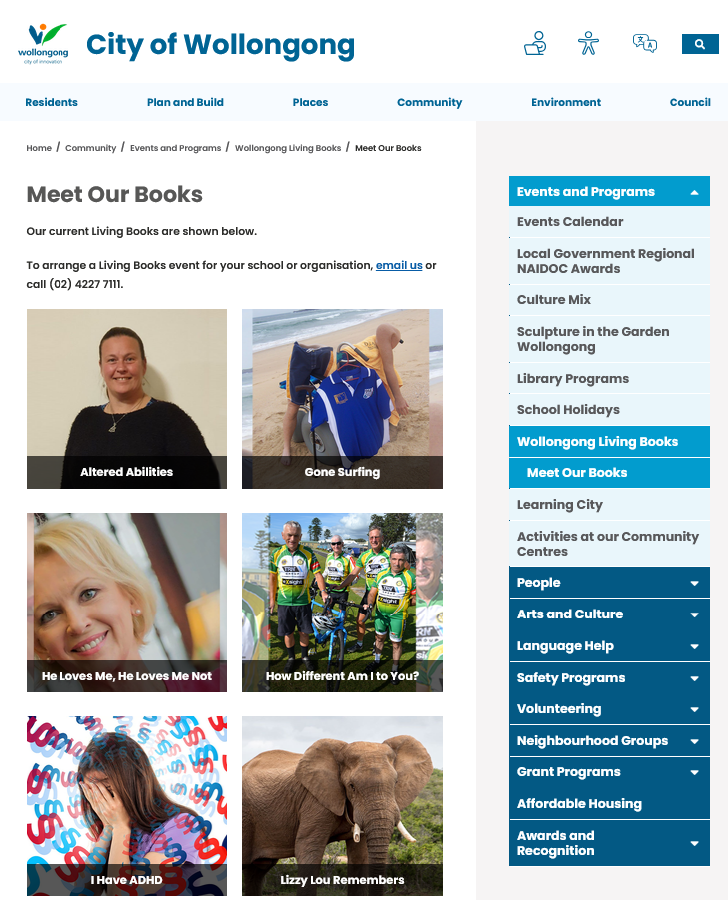
Screenshot of the City of Wollongong Living Books bookshelf on July 27, 2026
Another storytelling initiative that happens outside of but is supported by a library is The Korean American Story, an oral history project that records the stories across generations of the Korean diaspora in the U.S. They create videos and live events that capture and share stories past and present, bridging continents, languages, immigration journeys, and communities of Koreans. The organization invites and uplifts stories from Korean American people, paying particular attention to overlooked groups like queer and trans Koreans. The recorded materials are preserved as part of the Korean American Digital Archive (KADA) within the Korean Heritage Library at the University of Southern California (USC) in Los Angeles. The university library and archives strengthens the reach and duration of these personal and cultural stories.
These storytelling practices touch different organizational settings where information professionals work, from public librarians supporting programs like the Human Library or Living Books to university archivists safeguarding oral histories from community organizations. I believe becoming a hyperlinked librarian requires de-centering the library sometimes and centering important community-led work that emphasizes inclusion, connection, and transformation. We can play support roles in platforming powerful stories that unfold through peoples’ lives, recognizing the value of these “living books.”
References
Human Library Organization. (2023, April 25). The Human Library. YouTube. https://www.youtube.com/watch?v=rxukgiVqb5A
Human Library Organization. (n.d.). About The Human Library. humanlibrary.org/about/
Korean American Story. (2024, June 4). Legacy Project | Queer Joy: Editorial Cut. YouTube. https://www.youtube.com/watch?v=rxukgiVqb5A
Korean American Story. (n.d.). Legacy project. https://www.koreanamericanstory.org/legacy-project
Public Libraries Online. (2013, April 26). Human library. https://publiclibrariesonline.org/2013/04/human_librar/
Wollongong City Libraries. (n.d.). Living books. https://wollongong.nsw.gov.au/my-community/events-and-programs/living-books
Wollongong City Libraries. (n.d.). Meet our books. https://wollongong.nsw.gov.au/my-community/events-and-programs/living-books/meet-our-books
I recorded another podcast and am sharing the mentioned quotes, books, library programs, and article in the show notes below.
Listen to Infinite Learning at the Library podcast.
Show notes:
Quotes
“Hyperlinks are people, too”
– Michael Stephens
“I am slowly learning to embrace the struggles that students experience as they engage with authentic work. If I don’t allow learning to be messy, I eliminate authentic experiences for students as thinkers and creators. I find it important to regularly remind myself that frustration leads to insights and that learning is not necessarily the equivalent of mastery.”
– Joshua Block, Embracing Messy Learning
Books
– The Library Book by Susan Orlean
– Palaces for the People by Eric Klinenberg
Library Programs
– Library Lanes: Virtual Bowling for Older Adults (Brooklyn Public Library)
– Finger Knitting & Radical Rest (Los Angeles Public Library)
Article
Embracing Messy Learning by Joshua Block
Like any critical thinker, I have a complex relationship with AI. My desire to thoughtfully and ethically engage with this technology butts up against societal and corporate technolust that rushes everyone to adopt and normalize AI. At the same time, I take the bigger picture view that AI is just the latest trend to usher in doom-and-gloom predictions about libraries. AI cannot replace libraries as long as we remain hyperlinked and keep adapting to serve our communities as hubs of human connection and enrichment. A more fruitful and practical approach to AI is to utilize it as a powerful sidekick for busywork, a helper in the process of information seeking. But I can’t help the side eye.

So to try on this “AI is not my enemy” mindset, I decided to use AI to learn more about AI and libraries. I started with the SJSU King Library AI chatbot, Primo Research Assistant. I asked Primo to find some recent academic articles about Chat GPT and libraries. The results returned 5 sources from 2023-2026 from peer-reviewed journals with a useful overview that included AI chatbot uses in international libraries.
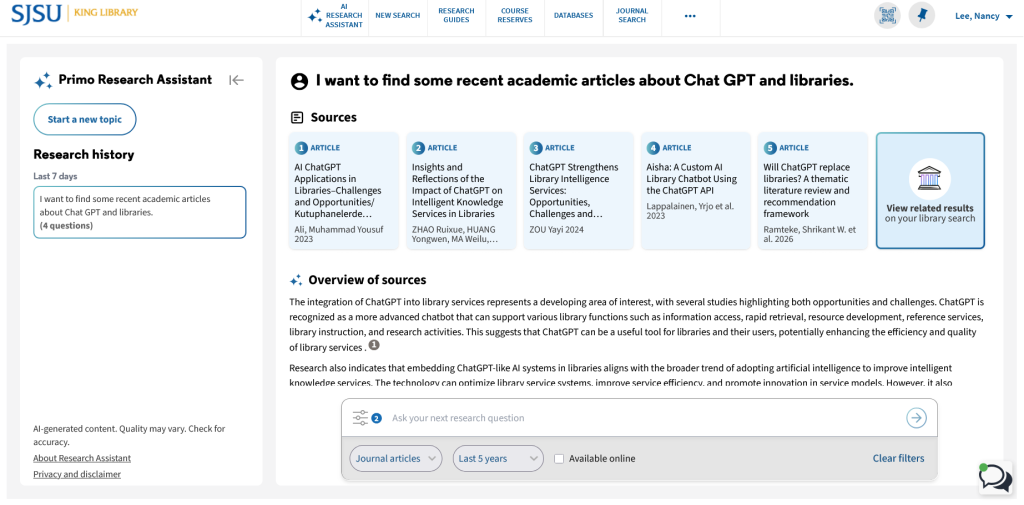
I chose to focus on the 3 most recent articles because the technology has evolved and become so pervasive in recent years that even 2023 may feel outdated. “Will ChatGPT replace libraries? A thematic literature review and recommendation framework” (Ramteke et al., 2026) was a useful overview.
“But the idea that technology might take the place of libraries is a fallacy that stems from a limited understanding of what libraries accomplish in reality. Libraries are democratic spaces, cultural stewards, and moral institutions that go well beyond simply providing access to knowledge. Although helpful, ChatGPT is unable to replace the human judgment, community involvement, and equity-focused goals of libraries and resource centers.” (Ramteke et al., 2026)
I then asked Primo for less academic sources like TED talks or podcasts about the topic, but the chatbot couldn’t deliver relevant results. No surprise, the academic library’s generative AI research assistant remained academic.

OK I’m all about plurality so I switched over to Perplexity and asked for non-academic sources about ChatGPT and libraries. But the results were too focused on ChatGPT and unrelated to libraries. I broadened the search to AI and libraries, which returned too many results. Sifting through Perplexity’s TMI, I chose to focus on a 2024 episode of the ALA podcast Call Number called Decoding AI and a blog post from Bibliotheca, “AI in Libraries: What’s Changed, What’s at Stake.”
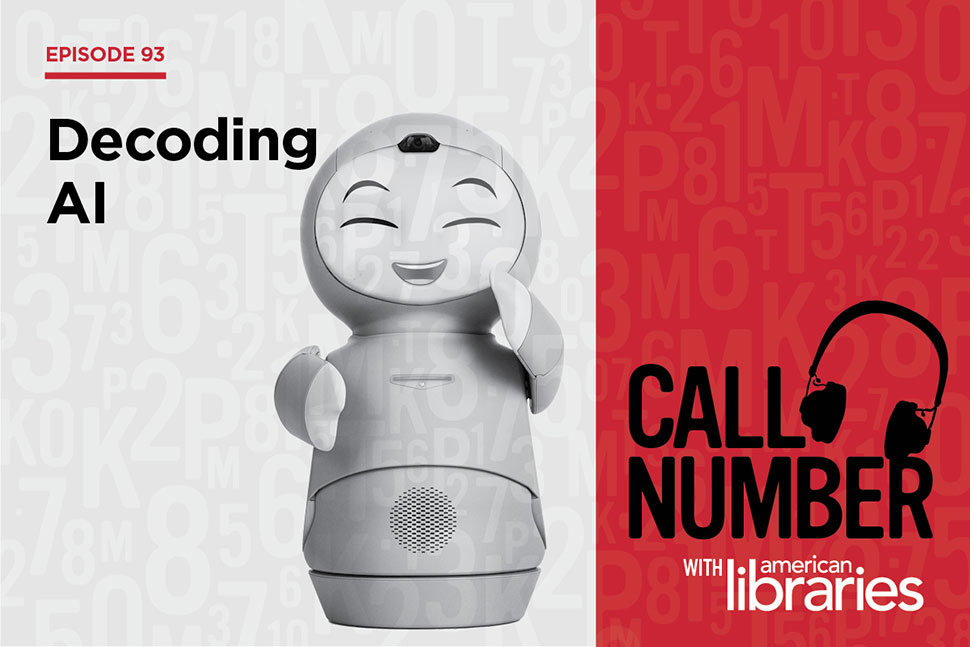
In the podcast episode, I was introduced to Elissa Malespina, a teacher-librarian at Union High School in New Jersey and writer of The AI School Librarians, a Substack newsletter I am now subscribed to. Elissa spoke about not fearing generative AI as a librarian and the importance of AI literacy in today’s world where students and teachers are already using it. Just try it, she advised. I am!

The Bibliotheca blog post had so many gems, including historical and current applications of AI in libraries to streamline back-of-house and frontline duties. Look at this handy chart:
I will conclude this thinking-out-loud reflection post with quotes from the Bibliotheca blog post that I will keep chewing on as I continue to wrestle with AI.
“In reference environments, a confident wrong answer is worse than no answer at all.”
“When a system can synthesize a credible-looking answer in seconds, evaluating that answer matters more than locating it.” (Bibliotheca, 2026)
References
Bibliotheca. (n.d.). AI in libraries. https://www.bibliotheca.com/ai-in-libraries/
Ramteke, S. W., Daphal, Y. B., Ankush, S. M., & Arote, P. P. (2026). Will ChatGPT replace libraries? A thematic literature review and recommendation framework. College & Undergraduate Libraries, 33(1), 65–76. https://doi.org/10.1080/10691316.2025.2576843
American Libraries Magazine. (2024, March 11). Call number podcast: Decoding AI [Audio podcast episode]. https://americanlibrariesmagazine.org/blogs/the-scoop/call-number-podcast-decoding-ai/
For my reflection post on Hyperlinked Environments, I chose to focus on international libraries that were recently awarded the International Federation of Library Associations and Institutions (IFLA) Public Library of the Year. This award requires not only a new building, expansion, or renovation, but also a thoughtful combination of functional and technological innovation. The Deichman Public Library in Oslo, Norway (2021 winner) and the Beijing Library in Beijing, China (2024 winner) serve as more than book repositories or venues for library programming. These buildings connect people to information, technology, services, community, and location—playing an important, holistic civic role for residents and visitors in Oslo and Beijing. The library provides a flexible yet socially cohesive public space, a hyperlinked environment that empowers users.
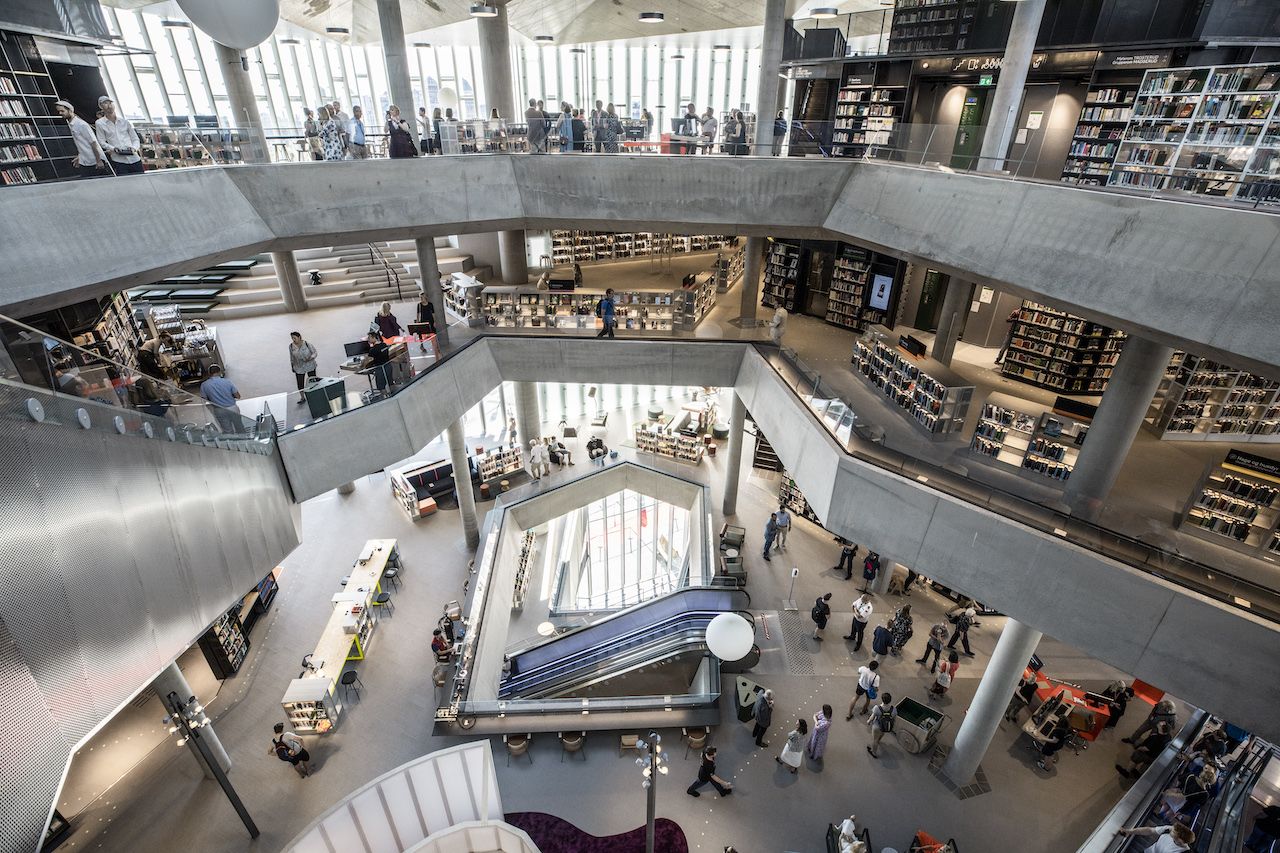
Photo: Erik Thallaug / Deichman Bjorvika
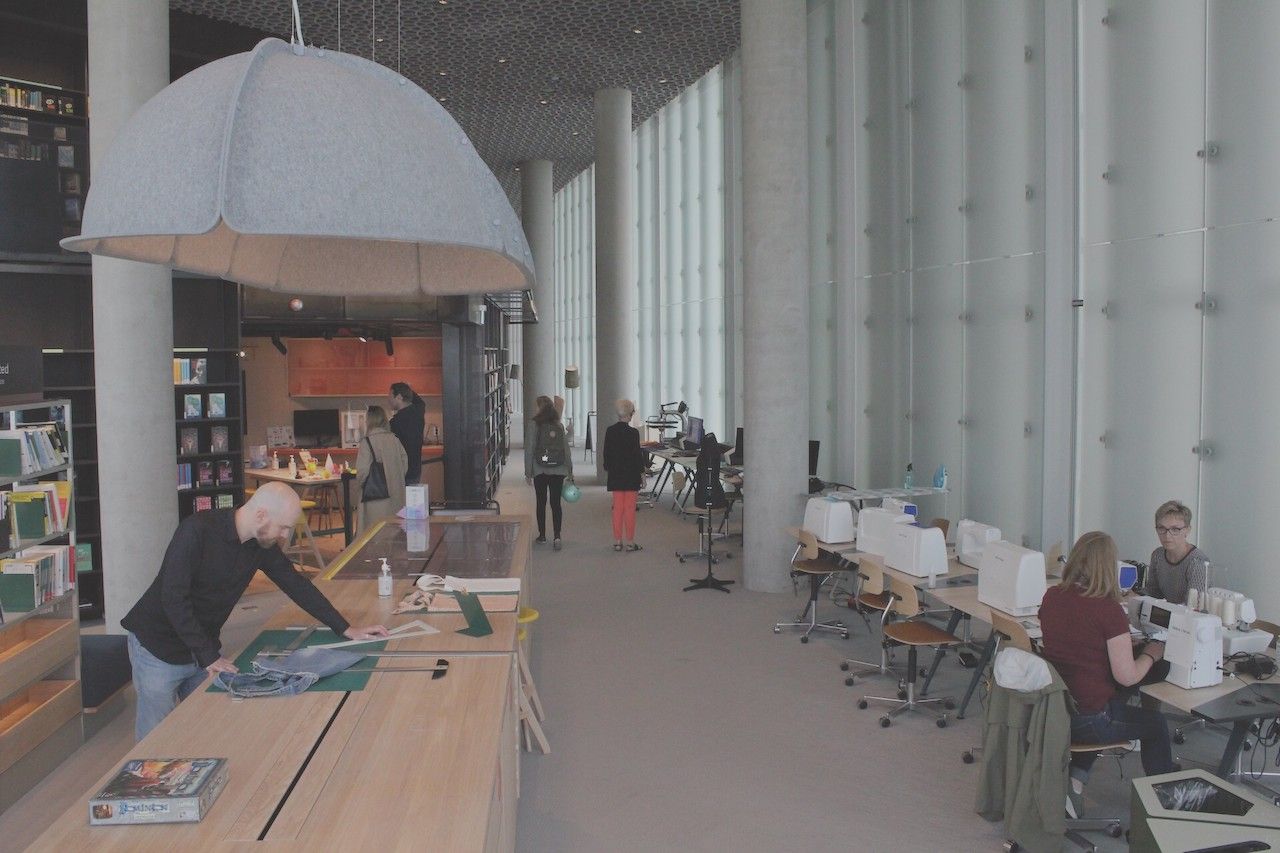
Photo: Maria Bagtas / Deichman Bjorvika
The Deichman Library is Oslo’s main library and a true civic hub. Six light-filled floors offer typical library features like books, reading and study areas, meeting rooms, and a children’s zone (an entire floor), as well as atypical amenities like a cinema, restaurant, café, and auditorium. In addition, the workshop and media resources include 3D printers, sewing machines, music studios, and other creative tools. Together, the building encourages movement, browsing, and gathering—an architectural counterpart to the resources offered within that provide access to many information pathways.

Beijing Library

Beijing Library (interior)
The Beijing Library is similarly expansive and inviting. The grand architecture reflects the surrounding river and landscape in the terraced exterior, while the interior houses the world’s largest climatized reading space, along with modular areas for conferences, exhibitions, performances, and even the restoration of ancient books. It also features the latest green building technologies like climate control, lighting, acoustics, and rainwater collection. As a result, the scale of the Beijing Library is impressive and appropriate for the large urban center that it serves.
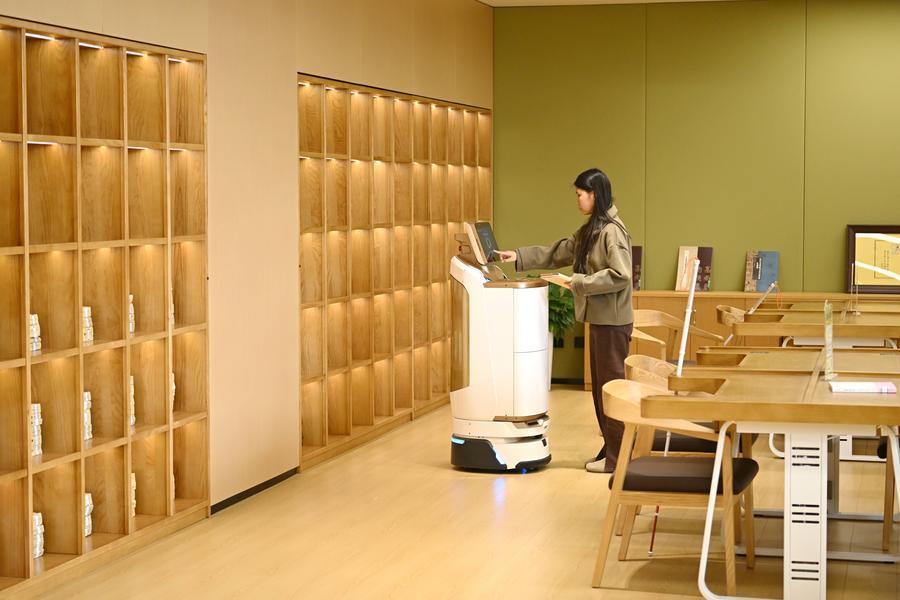
A citizen uses a book delivering robot at a library in Xiong’an New Area, north China’s Hebei Province, March 25, 2026. (Xinhua/Zhu Xudong)
Among the finalists for the 2026 IFLA Public Library of the Year award is another Chinese public library, the Xiong’An Library in Hebei Province, China. Like the other shortlisted libraries, Xiong’An shares the best qualities of a hyperlinked environment: open layouts, adaptable rooms, strong digital services and technology offerings, and a clear connection to local needs. What’s unique is Xiong’An’s robots, part of the fabric of this high-tech “city of the future” and present in the library spaces. Book-sorting carts and humanoid service robots interact with and assist library patrons. These photos from Xiong’An strike me as novel now, but will this become a common sight in libraries throughout the world?
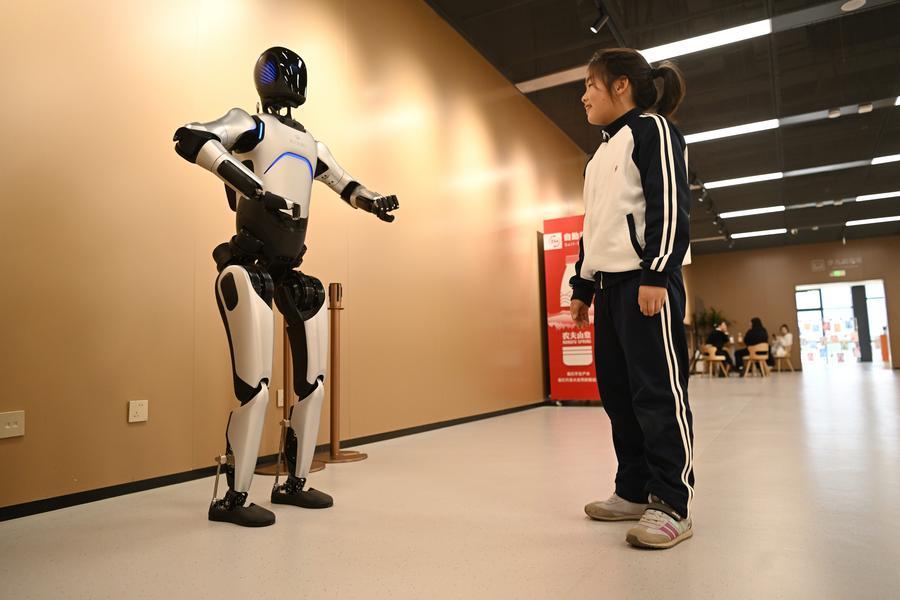
A child interacts with a robot at a library in Xiong’an New Area, north China’s Hebei Province, March 25, 2026. (Xinhua/Zhu Xudong)
Not all libraries have robots, but all hyperlinked environments incorporate technology. Digital catalogs, public computers, Wi-Fi, and self-service checkout are widely available. Many libraries offer makerspaces, media tools, and spaces. Interactive kiosks and robots may be the cutting-edge technology now, but all technology supports a library’s role as a connector. These IFLA award-winning libraries are the best examples of a hyperlinked environment where users can get what they need from the library to support their individual and collective lives and well-being. These thriving information hubs and community spaces expand my ideas about what is possible at the public library.
References
Croissant, M. (2021, September 21). This library was just named the best in the world. Matador Network. https://matadornetwork.com/read/best-library-world/
International Federation of Library Associations and Institutions. (2026, June 19). Shortlisted applicants for IFLA/James Bennett Public Library of the Year Award 2026. IFLA. https://www.ifla.org/news/shortlist-ploty-2026/
International Federation of Library Associations and Institutions. (2024, October 7). IFLA/Baker & Taylor Public Library of the Year Award 2024 announced. IFLA. https://www.ifla.org/news/winner-announced-for-the-ifla-baker-taylor-public-library-of-the-year-award-2024/
Xinhua News Agency. (2026, March 31). EconomyInFocus: Xiong’an New Area dedicated to innovation-driven development. Xinhua English News. https://english.news.cn/20260331/294401df1eda4d75955da66699dd7eac/c.html
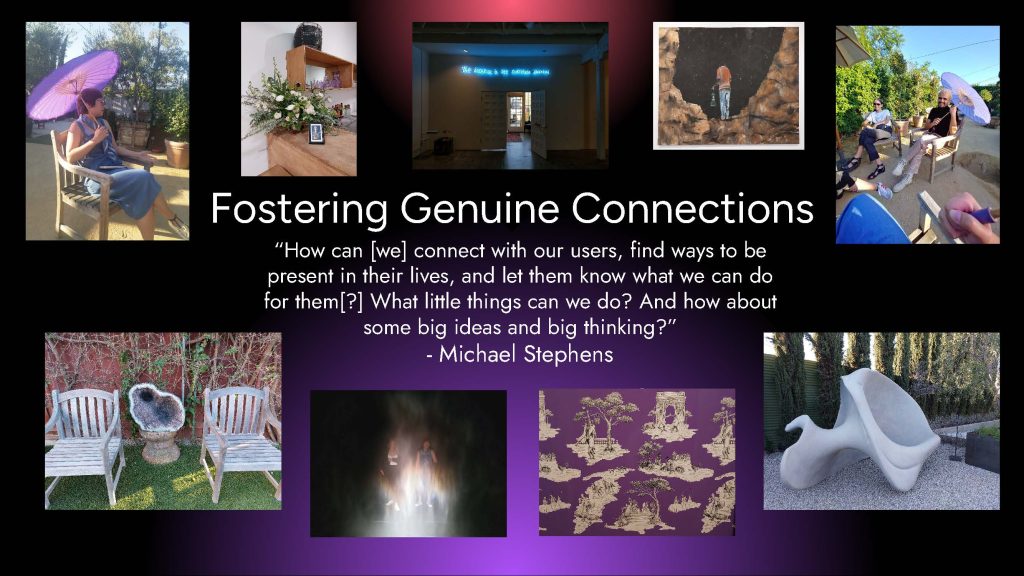
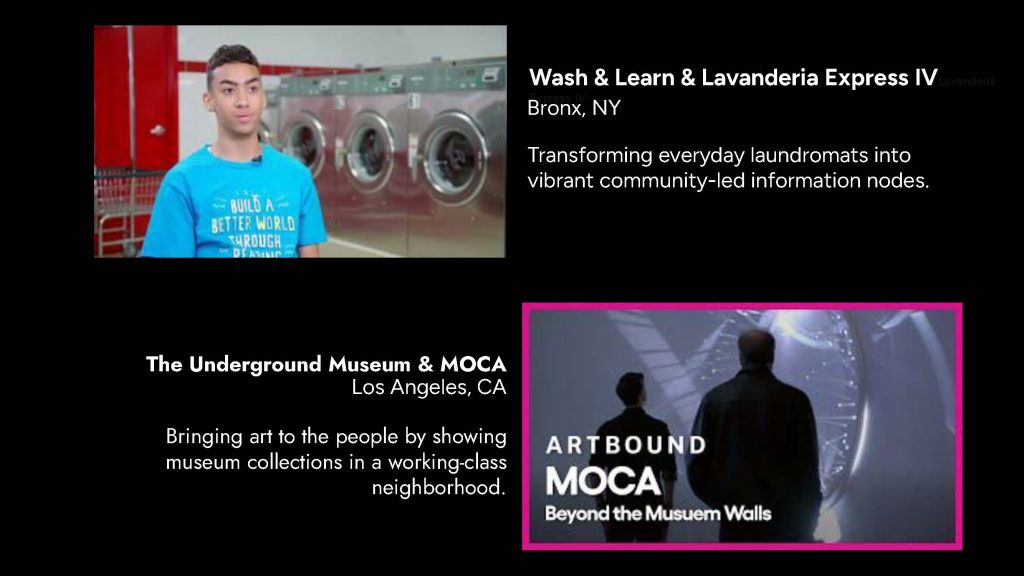
For my reflection on Hyperlinked Communities, I prepared a slideshow about the Wash & Learn Initiative in the Bronx, NY and the collaboration between The Underground Museum and MOCA in Los Angeles, CA. Drawing on my previous career and deep knowledge of art museums, particularly those in LA, I reflected on the hyperlinked community-building efforts of the library and the museum. Here is my favorite slide with personal photos I took at The Underground Museum over many years. I look forward to reading your comments and feedback.
References
Libraries Without Borders. (2017, July 17). “Wash & Learn”: Creating pop-up learning spaces in laundromats in the Bronx. https://www.librarieswithoutborders.org/2017/07/17/wash_and_learn_bronx/
Libraries Without Borders. (2017, July 17). “Wash & Learn” pop-up library program in the Bronx [Video]. YouTube. https://youtu.be/9HM7pQiqDZY
Libraries Without Borders US. (n.d.). Laundromats into libraries. https://www.librarieswithoutborders.us/welcome/ourwork/our-programs/laundromats-into-libraries/
Libraries Without Borders US. (n.d.). Wash & Learn Initiative (WALI) one-pager [PDF document]. https://www.librarieswithoutborders.us/wp-content/uploads/sites/9/2025/09/One-Pager-WALI.pdf
Miranda, C. A. (2015, July 17). An unassuming storefront. A major museum. A collaboration that takes museum art to the people of L.A. Los Angeles Times. https://www.latimes.com/entertainment/arts/miranda/la-et-cam-underground-museum-noah-davis-showcases-works-from-mocas-collection-20150717-column.html
PBS SoCal | Artbound. (2016, May 31). Beyond museum walls: The Underground Museum [Video]. PBS. https://www.pbs.org/video/beyond-museum-walls-the-underground-museum/
Scripps News. (2023, May 1). Laundromats and libraries are fighting book deserts. https://www.scrippsnews.com/us-news/education/laundromats-and-libraries-are-fighting-book-deserts
Stephens, M. T. (2016). The heart of librarianship: attentive, positive, and purposeful change. ALA Editions, an imprint of the American Library Association.
Wonderful Museums. (n.d.). The Underground Museum LA. https://www.wonderfulmuseums.com/museum/the-underground-museum-la/
I was preparing to write a blog post about self-service libraries then decided to follow the spirit of experimentation to try something new (for me) and recorded a podcast episode!
Listen to Exploring Participatory Service & Transparency through Self-Service Libraries.
Download the podcast transcript.
The topic of self-service libraries was surprisingly rich and inspiring, and I did a lot of reading and thinking to create an outline to then riff from instead of a strict script. My final podcast episode clocks in at 11:00 despite my rigorous (and technically rudimentary) editing. Hope that’s OK and that listening to the episode feels like an informed and open-ended conversation with your pal Nancy.
References
American Libraries Magazine. (2019, September 3). Automatic for the people: Are self-service libraries a threat to the profession or an opportunity to better serve patrons? https://americanlibrariesmagazine.org/2019/09/03/automatic-people-self-service-libraries/
Bibliotheca. (2021, March 2). Customer story: Gwinnett County Public Library | open [Video]. YouTube. https://youtu.be/qAQxJw2H_tw?si=uEy3GymWaO1C2GdX
Bibliotheca. (2025, September 1). In Belgium, the library that hardly ever closes: Open+ in action at the B3 Resource Center. https://www.bibliotheca.com/belgium-b3-library-open-plus-extended-access/
CBC News. (2018, October 2). Innovative self-serve program extends library hours in rural Hamilton. https://www.cbc.ca/news/canada/hamilton/innovative-self-serve-program-extends-library-hours-in-rural-hamilton-1.4847083
Left Lane. (2018, November 26). Freellton | Open Plus | Bibliotheca [Video]. Vimeo. https://vimeo.com/302741173
Schmidt, A. (2013, November 5). Earning trust | The user experience. Library Journal. https://www.libraryjournal.com/story/earning-trust-the-user-experience
Stephens, M. T. (2016). The heart of librarianship: attentive, positive, and purposeful change. ALA Editions, an imprint of the American Library Association.
My name is Nancy Lee (she/they), and I’m from Los Angeles, traditional lands of the Tongva people. I’m more than halfway through the MLIS program and interested in public librarianship. Previously I worked in art museums doing PR for 15 years and am excited for a second career as librarian. I chose this course because the emphasis on open-ended and playful adaptation resonated with me. I’m looking forward to thoughtful discussions about how libraries intentionally and ethically engage and evolve, especially in light of AI’s widespread impact in nearly every industry.
I’m a fiber artist (crochet and knitting) and Korean language interpreter. I love when my varied interests and passions come together, and everything feels cohesive for at least a brief moment. One example is a finger-knitting workshop I taught at my local library makerspace. The participants ended up being multilingual so I was able to instruct some folks in Korean and English. Other bilingual attendees were able to help teach monolingual Spanish speakers, and everyone enjoyed themselves while making scarves. The friendly atmosphere of neighbors gathered for a fun and free activity embodied that library magic of third place and community accessibility for me.