
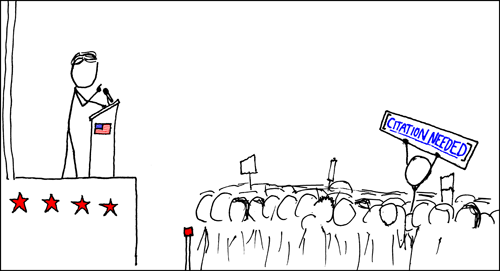
I enjoyed reading the comparison of ChatGPT and Wikipedia in Fister & Head’s article “Getting a Grip on ChatGPT,” and I agree that Wikipedia was comparatively over-vilified as an information source, considering the processes that go into maintaining it—sources are required for each statement, and citations are checked and flagged. An xkcd comic popularized the editing tag “[citation needed],” and I recently happened upon the tag “[failed verification],” which I’d never seen before but was pleased to learn existed. LLMs, on the other hand, are black boxes unable to show their work, famously making up sources and even providing sources that don’t always back up their answers (Mickle et al., 2026). Though Wikipedia has been a top domain cited worldwide by LLMs (at 9.53% of citations according to Semrush data), it’s surpassed by Reddit (11.29%) and LinkedIn (11.03%) and is immediately followed by YouTube (8.77%) and Medium (5.83%). Most of these are questionable as cited sources and should always warrant further research.
This topic is especially interesting when, according to the IFLA Trend Report 2024, trust in authority is declining. On one hand, questioning authority is part of thinking critically—“authority is constructed and contextual,” after all (ACRL, 2015). This could explain why marginalized groups are more likely to be distrusting of mainstream media, as cited in the trend report. On the other hand, the distrust should not be reactionary—we should not reject information simply because we disagree with it. Trump’s cries of “fake news” reflect such a sentiment, appealing to those who seek a truth different from what they see, closer to what they personally believe or hope to be true. It’s therefore unsurprising to me that podcasts, video essays on YouTube and TikTok, and articles on Medium and Substack have become popular sources of information in recent years.
But even though there’s value in hearing stories from underrepresented voices and/or alternative sources, we must continue to think critically. In other words, the declining trust in authority isn’t inherently bad, but that doesn’t mean we should simply place our trust in other entities instead, even if they seem to project confidence and claim to have supporting data. This includes but is not limited to LLMs that provide sources that don’t always corroborate their answers, governmental documents that use imaginary sources and mischaracterize real ones (Jacobs, 2025), and social media creators who might misrepresent cited research to better sell their services (I was just sent one such video by a well-intentioned friend).
Being vigilant about information in casual contexts can be difficult, especially when you’re passively scrolling through social media, as opposed to actively research a topic you’re interested in. Even I get exhausted trying to navigate the vast, rich information landscape that we have at our fingertips these days. But this is precisely why it’s more important than ever that we are checking for sources and verifying them as we encounter information in our day-to-day lives, and that we as LIS professionals effectively promote literacy skills to the public.
References
Association of College and Research Libraries. (2015, February 9). Framework for information literacy for higher education. American Library Association. Retrieved July 18, 2026 from https://www.ala.org/acrl/standards/ilframework
Fister, B., & Head, A. J. (2023, May 04). Getting a grip on ChatGPT. Inside Higher Ed. https://www.insidehighered.com/opinion/views/2023/05/04/chatgpt-reshaping-information-infrastructures-opinion
International Federation of Library Associations. (2024, September 30). IFLA Trend Report 2024: Facing the future of information with confidence [Report]. https://repository.ifla.org/handle/20.500.14598/3496
Jacobs, P. (2025, May 30). Trump officials downplay fake citations in high-profile report on children’s health. Science. https://www.science.org/content/article/trump-officials-downplay-fake-citations-high-profile-report-children-s-health
Mickle, T., Metz, C., Freedman, D., Terol, T. M., & Collins, K. (2026, April 7). How accurate are Google’s A.I. Overviews? New York Times. https://www.nytimes.com/2026/04/07/technology/google-ai-overviews-accuracy.html
Munroe, R. (2007, July 4). Wikipedian protestor [comic]. xkcd. https://xkcd.com/285
Semrush. (March 9, 2026). Leading domains cited by large language models (LLM) worldwide as of January 2026 [Graph]. In Statista. https://www.statista.com/statistics/1660293/most-cited-domains-by-llms-worldwide
@anitayjc I appreciate your thoughts about understanding all the various ways people might get access to news and some of that news may be incorrect/not factual. I have actually gotten fired up about something I’ve seen on Instagram and then went to verify it because it just didn’t seem like it could have happened. Your last line resonates about literacy skills, so important in our current climate and the rapid growth of AI.
@michael That’s such a relatable situation, and it actually reminds me of my Info Literacy final project last year! My conclusion was that literacy requires us to recognize how we emotionally respond to what we see, which is aptly described by Mike Caulfield as “building a fact-checking habit by checking your emotions.” However, I do believe these include not just the faster-traveling emotions like anger and awe but also delight and relief, as realistic, unlabelled AI content is ultimately still a form of misinformation and is incredibly easy to make. Unfortunately, this means that the social media experience can be “ruined” when you try to be critical/discerning, when you’re there for relaxation/entertainment instead. I try to be wary, but I’m sure some misinformation has inevitably slipped through anyway.
@anitayjc that is a good thought, and I would say it is probably the nature of the “beast” as they say that misinformation will always get through.