
In “Embracing the Long Game” Greenwalt describes the Oak Park Public Library’s Idea Box, a participatory space where the community’s contributions build upon each other. The library’s customer service manager Monica Harris had cited inspiration from the way communities emerge and develop online, referring to the way that people “might want to talk about the same things you want to talk about.” However, especially in the anecdote about adding checkmarks to people’s favorite books, I think the Idea Box managed to go beyond that, as the participants not only responded to the given prompt but also gave it a new life. The resulting creative process defied expectations, making it more akin to a public play area than simple “conversation.”
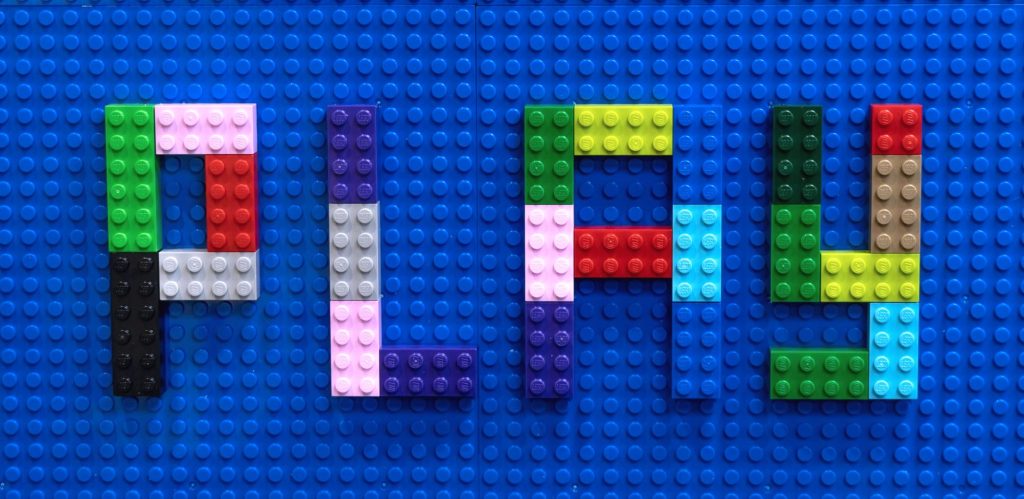
Play is something that everyone should engage with, regardless of their age. As the architect of the British skate park F51 puts it, “Play doesn’t just stop when you get older. If anything, you should make sure you can incorporate play even more” (Dowdy, 2022). Examples of play in this module include the DOKK1 Urban Mediaspace and the LEGO Art Machines at the Exploratorium. In the latter example, workshop facilitator Amos Blanton stresses the importance that such activities be “open-ended.” I especially enjoy when play occurs socially and in unprecedented ways, especially among audiences who are typically thought to have “aged out” of play, so the fact that the Idea Box participants were able to take the activity’s guidelines and make something new out of it was rather inspiring to me. (Side note: The playful riff on existing structures reminded me of Grand Theft Hamlet, a documentary about two actors who managed to put on a production of Hamlet in Grand Theft Auto Online with other players during 2020, as well as Goncharov, a 1973 Scorsese mafia film that has a large fanbase on Tumblr and… doesn’t actually exist, as it was collectively fabricated in 2022 based on a photograph.)
Based on the list of recent topics and the photos on its webpage, it seems like the Idea Box has focused less on public participation and more on displays and exhibits instead, eventually going on hiatus earlier this year, to “clarify vision and establish formal policies and clear procedures.” This is understandable, as play was likely not the original point of the Idea Box. Though themed displays exhibiting local artists and highlighting important holidays are still valuable in community spaces like the OPPL, I do find it unfortunate that the participation and open-endedness has become rather limited in the Idea Box. Then again, I also understand that it is more difficult to measure and monitor play than it is to measure and monitor something with more structure. Still, I hope that the OPPL (and other libraries) are able to provide community members with other/more opportunities to engage with each other in open-ended play.
References
Dowdy, C. (2022, February 7). What the Nordics can teach us about having fun. BBC. https://www.bbc.com/culture/article/20220207-what-the-nordics-can-teach-us-about-having-fun
ELIG.org. (2016, February 4). Creative learning, making and coding at DOKK1 in Aarhus, Denmark [Video]. YouTube. https://youtu.be/G-lCxenhWSk
Greenwalt, R. T. (2013, February 21). Embracing the long game. Public Libraries Online. https://publiclibrariesonline.org/2013/02/embracing
LEGO Foundation. (2016, July 5). What do we mean by learning through play? [Video]. Vimeo. https://vimeo.com/173458519
Oak Park Public Library. (n.d.). Idea Box. Retrieved August 04, 2026 from https://www.oppl.org/news-events/idea-box
@anitayjc I love the idea of play. Not just for kids but for adults too. Library spaces can provide such programming to allow kids of all ages to create and explore all the while giving ideas either to the library or to each other. I would agree that restrictions on the Idea Box may have hampered a bit of the creativity, but I think they just needed some guidelines in order to keep to its original intent. Whether play was a part of that, we all need a place where we can just create and “play”. While I don’t work at a public library, I do know that the public library in my community does offer up both child and adult programming, mostly STEM in the area of play, but it’s worth a conversation as to what other programs may interest the community at large where all are welcome to engage.
Hi @beccaslick! That’s so interesting how so much programming at your library seems to be STEM-focused. I can see why libraries would think it important to keep the community informed about new tech, but I do think other modes of play are just as important. In that regard, I do really appreciate my local library because despite being in the Silicon Valley, its programming is impressively diverse!