
Back in 2016, Facebook was by far the most popular social media platform in the United States (Greenwood, Perrin, & Duggan, 2016), and it was a critical tool in the information landscape of the time, as the older course readings demonstrate through their frequent mentions of it (Stephens; 2016, p. 10; 2019, p. 23). In the decade since, however, social media and the information landscape have drastically changed. Though Facebook is still used by many, TikTok was one of the most-used platforms among U.S. teens in 2025, with 61% of teens using it daily (Faverio & Sidoti, 2025), and an increasing number of adults are using it as well (McClain & Eddy, 2026). As a result of TikTok’s popularity, other platforms such as Instagram and YouTube have also joined in on hosting vertical short-form videos, and the four most-used and fastest-growing social media platforms now are YouTube, Facebook, Instagram, and TikTok (Gottfried & Park, 2025). Since so much of our attention is now dedicated to short-form videos, marketing strategies have shifted from simply posting static text posts or graphics to promote their offerings, to generating lip-syncing videos or even skits in hopes of landing on people’s for-you pages. It therefore makes sense for libraries to join in on creating video content, to reach the teens that they have struggled to reach (Casey & Savastinuk, 2007, p. 62) , as well as anyone else the content resonates with. This has led to the #LibraryTok hashtag, which could be a great tool in both reaching the “long tail” (p. 64) and changing the public’s perceptions of libraries (i.e., it’s not just books!).
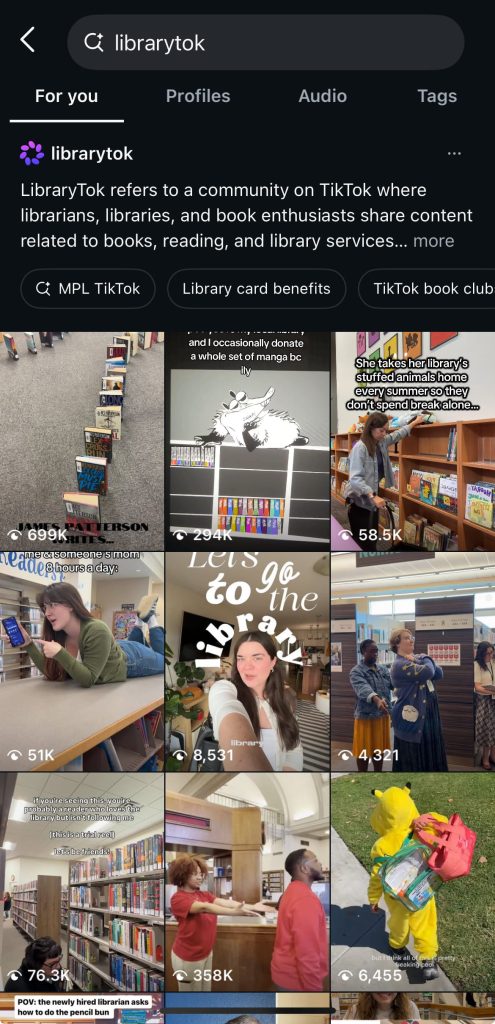
Sure, the top posts on #LibraryTok do include #BookTok creators visiting libraries, and some posts from libraries are more book-centric, but many videos show audiences what libraries are like and what they offer. Trends function a bit like templates, allowing libraries to make their own versions of videos about seeing James Patterson books in every section, or the frustrations of patrons dog-earing books, or forgetting how to spell, or needing to sing the alphabet when shelving. Participating in #LibraryTok is a great way to give your library personality, especially since it shows the faces of and helps build personal connections with the real people working there (Stephens, 2016, p. 27). People can now interact with librarians even when they are not at the library. Milwaukee Public Library, in fact, was so successful with their TikTok account that viewers from outside the U.S. have traveled specifically to the library (Arata, 2026).
One, however, can subsequently argue that such content might not reach the people in the library’s own communities, especially since social media feeds are now more algorithmic and discovery-based, showing fewer posts from local accounts we actually follow, so why invest the time and effort into making videos the local community might not even see? After all, it requires extensive planning, consistent posting, and ethical considerations, and, as one LibGuide puts it, it “may be the hardest platform to target individual groups of users” (PALNI, 2026). Making regular video content might not be feasible for every library, but I do find #LibraryTok to be beneficial to all libraries. I had seen Milwaukee Public Library’s posts before I started my MLIS, and I have non-librarian friends who have shared non-local #LibraryTok posts with me because it showed up on their feeds. Because #LibraryTok videos can have such a far reach, I am hopeful that it can help change the general public’s perception of libraries from simply being quiet bookstacks to being fun places where you can talk to librarians about more than just books.
References
Arata, H. (2026, January 8). Behind the scenes with Milwaukee Public Library’s TikTok. Programming Librarian. https://programminglibrarian.org/articles/behind-scenes-milwaukee-public-librarys-tiktok
Casey, M. E. & Savastinuk, L. C. (2007). Library 2.0: A guide to participatory library science. Information Today.
Faverio, M. & Sidoti, O. (2025, December 9). Teens, social media and AI chatbots 2025. Pew Research Center. https://www.pewresearch.org/internet/2025/12/09/teens-social-media-and-ai-chatbots-2025
Gottfried, J. & Park, E. (2025). Americans’ social media use 2025. Pew Research Center. https://www.pewresearch.org/internet/2025/11/20/americans-social-media-use-2025
Greenwood, S., Perrin, A., & Duggan, M. (2016, November 11). Social media update 2016. Pew Research Center. https://www.pewresearch.org/internet/2016/11/11/social-media-update-2016
McClain, C. & Eddy, K. (2026). 8 facts about Americans and TikTok. Pew Research Center. https://www.pewresearch.org/short-reads/2026/03/02/8-facts-about-americans-and-tiktok
PALNI. (2026). Social media: Best practices: TikTok. https://libguides.palni.edu/social_media/overview
Stephens, M. (2016). The heart of librarianship: Attentive, positive, and hopeful change. ALA Editions.
Stephens, M. (2019). Wholehearted librarianship: Finding hope, inspiration, and balance. ALA Editions.
Thank you for writing about this topic, Anita! I love Library Tok! For me personally, it’s super motivating and exciting as an MLIS student to follow the variety of content – it really feels like going behind the scenes in an industry.
I agree that it’s expanding people’s understanding of what libraries can be. I also think it’s important to see great working examples in other communities to inspire local practice in people’s home libraries. I think of it like NYC thriving under Mamdani’s responsible leadership, healing how many generations across the country think apathetically towards politicians.
Hi Janna, that’s an interesting comparison! I do feel like the apathy/hopelessness that people have toward politicians is kind of warranted though, since politics is still very top-down/unidirectional and far removed from the personal lives of constituents. Even though we vote in elections, a lot of politics is still influenced by corporate lobbying, other nations, etc. To put it in terms of the course’s themes, governments could definitely use a more “Library 2.0” approach. (On the other hand, I feel like libraries overall have been pretty good at listening to their communities.)
Still, I think you’re onto something. Social media isn’t all doomscrolling, and I honestly don’t think it’s *the main* contributor to society’s worsening mental health—it can be used to inspire hope, in this case by reminding people that other people care about them, whether they’re librarians or good mayors!
Hi Anita, I enjoyed reading your post and am also a fan of Milwaukee Public Library’s social media presence. Their Mercedes car ASMR parody video immediately came to mind! Another favorite of mine is the City of Marion Libraries that use trends and deadpan humor perfectly. You point out that not all libraries have the staff or capacity to create social media content, and I certainly don’t think overworked teams need to add social media production to their plate. I agree that examples like the Milwaukee or City of Marion can shift the perception of libraries as welcoming, not stuffy places and librarians as funny and on-trend. Even if just for the viral moment, #LibraryTok content can add up to positive attitudes toward the library and an increased likelihood for engagement. I also like following young and/or POC librarians who share their perspectives and experiences working in libraries.
Hi Nancy, I am also a fan of the City of Marion Libraries’ social media! I especially love how so many comments on their videos are from people outside of Australia saying they want to visit. You also bring up a great point about young and/or POC librarians, because I do feel that these are underrepresented demographics in librarianship, which is known to be predominantly white (https://library.sjsu.edu/c.php?g=1061230&p=8086378). On that note, I actually ran a rough tally early last week out of curiosity, and I think most foundational readings (up to Module 4) were written by men in LIS (some authors wrote multiple readings; this is a count of the individual articles, not authors), while maybe half the woman authors were freelance writers (i.e., not in LIS). The one person of color I recall is someone whose surname passes for white but is actually of Asian American heritage. Even though we might have to go out of the way to deliberately choose to feature more diverse voices, I do feel that centering the voices of people from marginalized communities is an important step in helping the public feel welcomed at/by libraries.