“While AI already exists in much of the technology we engage with in our everyday lives, the potential spread of unregulated generative AI raises questions about how it is being used in education settings, along with the integrity of the data being used by the technology.” IFLA TREND 3: Trust is Being Renegotiated.
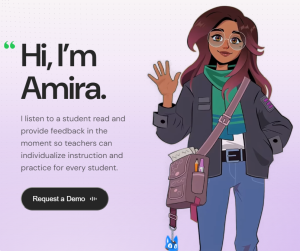
Amira Learning is an AI-powered learning agent that purports to support reading growth through one-on-one engagements with a student who reads to the AI, which in turn provides real-time support and identifies reading errors, among other functionality (Tucker, 2026). Parents and educators across the country are challenging use of Amira based on concerns over privacy, consent, psychological/educational harm to students, among other ethical principles and values (Tucker, 2026).
Amira is being used by the San Francisco Unified School District (and many districts across the country) to help public school students learn how to read. Unfortunately, this is a hallmark example of trust being renegotiated very poorly. (Note: Both of my kids are enrolled in SFUSD and have used Amira.)
The way Amira works is a student reads to AI through a microphone, and an onscreen cartoon provides coaching and correction to the student in real time over the student’s headset. These coaching prompts are not spontaneous but based on programmed algorithms. It is meant to be used approximately 30 minutes total in a given school week (e.g., in 2-3 sessions per week). Amira records student sessions and these recordings are accessible by the student’s teacher at a later date, but are purportedly not shared on broader platforms and are not used to teach Amira’s AI.
Amira was instituted by SFUSD at the start of the 2025 school year in all classrooms K-5 without any notification to or consent by parents, which eroded trust. The program listens to children as they read and provides corrections. SFUSD parents did not have notification of use of the program and were not given a chance to opt out of it, until it had already been in place for one full school year. This breach of trust has sparked outrage among San Francisco parents who have not had a chance to learn about or opt out of the program for an entire school year. The Amira program continues to be used, but an informational document has recently been provided to parents, which includes a notification that parents can contact their student’s teacher to opt out of participation with Amira. It is not clear what supplementary instruction might be available to students who opt out, meaning they may be disadvantaged by not getting any one-on-one instruction from an educator in place of that Amira time.
The list of AI’s potential harms grows increasingly larger as technology becomes integrated into social institutions. The ethical principle of non-maleficence includes not only deliberate harm but also actions that increase the risk of psychological or social harm. AI can create these risks through the collection, processing, storage, and sharing of personal information, all of which are part of Amira’s platform (Mooradian, 2018). It can also create risk through algorithms that have not been properly vetted to achieve their desired outcome or tested for unforeseen impacts, as is the case with Amira.
The principle of fairness is indicated where Amira is being implemented in educational spaces where racial minorities are overrepresented. This means that not only will they be disproportionately impacted but their districts are earmarking important funds for this under-researched technology that may be better invested in other well-established resources such as teacher training or additional para educators.
An opportunity for libraries in this instance is improving AI literacy. Where trust has been breached and public institutions are not properly vetting new technologies being used on vulnerable populations, one of the most important steps that can be taken is learning more about the issue and how to break it down into parts. In this instance, a list of questions are helpful to inform discussion on and reckoning with the use of Amira in classrooms.
- Were parents clearly notified before implementation, and if so, were they informed in understandable language so that they could properly consent or opt out?
- How is student biometric data collected, how is it protected, and how long is it retained?
- Can parents request deletion of student data?
- How are we ensuring student data is not being used to train AI?
- Were students who participated in initial studies appropriately compensated and did their families provide informed consent to enrich Amira with their personal data?
- How is the impact being monitored to ensure that students are not being psychologically, emotionally harmed by Amira’s technology?
- Is this program being used disproportionately in under-served and under-resourced minoritized populations such that they will encounter the brunt of any negative impacts?
- Why are we looking to AI instead of addressing root causes of literacy which are heavily socioeconomic? Is this the appropriate tool to answer this question?
- Why are we not paying teachers more and hiring more teachers and professional educators?
- Is the primary focus of this tool to obscure the root causes of socioeconomic disenfranchisement in marginalized communities that results in lower literacy?
It is concerning that such technology could be so broadly implemented before meaningful engagement in an ethical impact assessment. It is unfortunate that decisionmakers could be so seduced by technology before engaging in and publicizing these risks and assessments of risks before moving forward with such substantial investments with potential impacts on this vulnerable population who have minimal ability to self-advocate. However, where there is conflict and the potential for harm, there is also the potential to learn and grow in community. This circumstance highlights the value of building AI literacy within our community and libraries certainly have a role to play in cultivating this new ethical landscape.
References
Amira Learning. (2026, May). Delivering equity: Evidence that Amira’s reading assessment tests every learner fairly and accurately [White paper]. https://explore.amiralearning.com/hubfs/Amira-Equity-White-Paper.pdf
Dezuanni, M., & Osman, K. (2024). IFLA Trend Report 2024: Facing the future of information with confidence. International Federation of Library Associations and Institutions. https://www.ifla.org/trend-report/
Mooradian, N. (2018). Ethics for records and information management. ALA Neal-Schuman.
Tucker, J. (2026, September 16). This AI tool helps kids learn to read. Why are S.F. parents rallying against it? San Francisco Chronicle. https://www.sfchronicle.com/sf/article/ai-reading-school-san-francisco-22431436.php
@warmbroadglow I have heard about this AI reading tutor, but I appreciate all the ground you covered with this post, so now I know even more about it. The list of questions is right on target, and the school district, in my opinion, made a bit of a mistake when they did not allow parents to opt out.