Reflection on Library as Classroom

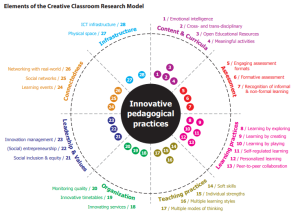
NMC Horizon Report: 2014 Higher Education Edition

Bringing emotional intelligence into the library is deceptively simplistic. One example of this is at the San Francisco Public Library (and likely other public libraries). If anyone (especially a child) does not have their library card, they can go ask a librarian to check out their books without a card by writing down their first and last name and birthdate for the librarian to look up their account. While this may seem like a small or insignificant offering, it is an incredible value add when teaching children, all of whom experienced severe social and communal disconnection during the pandemic and in the years following, how to speak to adults and self-advocate. 

I was made aware of this for the first time by my son who is now 11 years old a couple of years ago. For context, not only is he neurodiverse, he is so unbearably shy that at family gatherings hosted in our own home, he will refuse to come down from his bedroom because there are too many people he may not know in the house. One day my son informed me that even though he did not bring his library card with him (standard!) he did not need to check out books under my card; instead he would go to the librarian and ask them to look up his account. I’m not sure whether you can appreciate the shock of hearing that this child is going up to (trustworthy adult) strangers and asking for what he needs. This was an unexpected experience of the power of libraries as places where children even with different needs can feel accepted and supported by library workers who they have never met before and may never see again. 

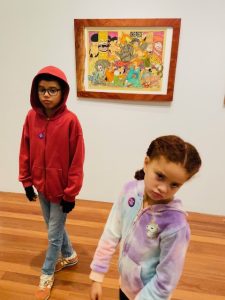
We have continued to use the library as a space to build confidence and self-advocacy. In many branches they host a scavenger hunt in the children’s section where there are small cut out pictures hidden around, and children can take a sheet with all of the pictures and cross them off as they find them. Once they find all of the images, they can go to the librarian desk and select a small prize. However, even with my help, my 7 year old daughter often cannot find all of the pictures. When this happens, I let her know that she is welcome to go ask the librarian for a hint. At first when she was a bit younger and newer to this, she refused to do this and demanded that I accompany her to request help, which I did. One day I said, no you can go on your own. If you feel too shy you can ask your brother to go with you. Now, my daughter is competitive and I do not think she liked the insinuation that her brother could do something that she could not. Nevertheless, she asked him to go with her and they got the information she needed. Eventually, she built up the courage to go ask the librarian for help and even go turn in her finished sheet to collect a prize by herself. 

I teach my kids that asking for help is an important life skill and a sign of maturity. I feel so fortunate that the library provides a space for these lessons to be tested and reinforced in real time. 

Reflection on New Horizons: AI & Trust

image

“While AI already exists in much of the technology we engage with in our everyday lives, the potential spread of unregulated generative AI raises questions about how it is being used in education settings, along with the integrity of the data being used by the technology.” IFLA TREND 3: Trust is Being Renegotiated. 

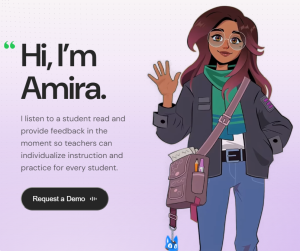
Amira Learning is an AI-powered learning agent that purports to support reading growth through one-on-one engagements with a student who reads to the AI, which in turn provides real-time support and identifies reading errors, among other functionality (Tucker, 2026). Parents and educators across the country are challenging use of Amira based on concerns over privacy, consent, psychological/educational harm to students, among other ethical principles and values (Tucker, 2026).

Amira is being used by the San Francisco Unified School District (and many districts across the country) to help public school students learn how to read. Unfortunately, this is a hallmark example of trust being renegotiated very poorly. (Note: Both of my kids are enrolled in SFUSD and have used Amira.)

The way Amira works is a student reads to AI through a microphone, and an onscreen cartoon provides coaching and correction to the student in real time over the student’s headset. These coaching prompts are not spontaneous but based on programmed algorithms. It is meant to be used approximately 30 minutes total in a given school week (e.g., in 2-3 sessions per week). Amira records student sessions and these recordings are accessible by the student’s teacher at a later date, but are purportedly not shared on broader platforms and are not used to teach Amira’s AI.  

Amira was instituted by SFUSD at the start of the 2025 school year in all classrooms K-5 without any notification to or consent by parents, which eroded trust. The program listens to children as they read and provides corrections. SFUSD parents did not have notification of use of the program and were not given a chance to opt out of it, until it had already been in place for one full school year. This breach of trust has sparked outrage among San Francisco parents who have not had a chance to learn about or opt out of the program for an entire school year. The Amira program continues to be used, but an informational document has recently been provided to parents, which includes a notification that parents can contact their student’s teacher to opt out of participation with Amira. It is not clear what supplementary instruction might be available to students who opt out, meaning they may be disadvantaged by not getting any one-on-one instruction from an educator in place of that Amira time.

The list of AI’s potential harms grows increasingly larger as technology becomes integrated into social institutions. The ethical principle of non-maleficence includes not only deliberate harm but also actions that increase the risk of psychological or social harm. AI can create these risks through the collection, processing, storage, and sharing of personal information, all of which are part of Amira’s platform (Mooradian, 2018). It can also create risk through algorithms that have not been properly vetted to achieve their desired outcome or tested for unforeseen impacts, as is the case with Amira. 

The principle of fairness is indicated where Amira is being implemented in educational spaces where racial minorities are overrepresented. This means that not only will they be disproportionately impacted but their districts are earmarking important funds for this under-researched technology that may be better invested in other well-established resources such as teacher training or additional para educators. 

An opportunity for libraries in this instance is improving AI literacy. Where trust has been breached and public institutions are not properly vetting new technologies being used on vulnerable populations, one of the most important steps that can be taken is learning more about the issue and how to break it down into parts. In this instance, a list of questions are helpful to inform discussion on and reckoning with the use of Amira in classrooms. 

  • Were parents clearly notified before implementation, and if so, were they informed in understandable language so that they could properly consent or opt out?
  • How is student biometric data collected, how is it protected, and how long is it retained?
  • Can parents request deletion of student data?
  • How are we ensuring student data is not being used to train AI?
  • Were students who participated in initial studies appropriately compensated and did their families provide informed consent to enrich Amira with their personal data?
  • How is the impact being monitored to ensure that students are not being psychologically, emotionally harmed by Amira’s technology?
  • Is this program being used disproportionately in under-served and under-resourced minoritized populations such that they will encounter the brunt of any negative impacts?  
  • Why are we looking to AI instead of addressing root causes of literacy which are heavily socioeconomic? Is this the appropriate tool to answer this question?
  • Why are we not paying teachers more and hiring more teachers and professional educators? 
  • Is the primary focus of this tool to obscure the root causes of socioeconomic disenfranchisement in marginalized communities that results in lower literacy?

It is concerning that such technology could be so broadly implemented before meaningful engagement in an ethical impact assessment. It is unfortunate that decisionmakers could be so seduced by technology before engaging in and publicizing these risks and assessments of risks before moving forward with such substantial investments with potential impacts on this vulnerable population who have minimal ability to self-advocate. However, where there is conflict and the potential for harm, there is also the potential to learn and grow in community. This circumstance highlights the value of building AI literacy within our community and libraries certainly have a role to play in cultivating this new ethical landscape.


References

Amira Learning. (2026, May). Delivering equity: Evidence that Amira’s reading assessment tests every learner fairly and accurately [White paper]. https://explore.amiralearning.com/hubfs/Amira-Equity-White-Paper.pdf 

Dezuanni, M., & Osman, K. (2024). IFLA Trend Report 2024: Facing the future of information with confidence. International Federation of Library Associations and Institutions. https://www.ifla.org/trend-report/

Mooradian, N. (2018). Ethics for records and information management. ALA Neal-Schuman. 

Tucker, J. (2026, September 16). This AI tool helps kids learn to read. Why are S.F. parents rallying against it? San Francisco Chronicle. https://www.sfchronicle.com/sf/article/ai-reading-school-san-francisco-22431436.php

[WILD CARD Reflection] Global Library Trends & Romance Readers

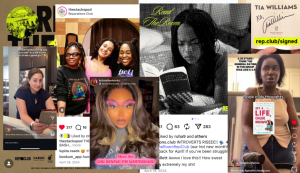
[image sources: @bookitwithehss; @britandherbooks; @docmollyreads;  @reparations.club; @thestackspod]


Two trends outlined in the IFLA Trend Report, which is designed to help support the future of libraries so that they can remain resilient and sustainable, highlight the power and opportunity for global impact for romance novel readers as an information community.

One trend is related to the social isolation and loneliness and the significance of this problem worldwide across age groups, with detrimental health impacts as comparable to smoking and obesity. Globally, people are seeking or in dire need of community connections on a variety of levels, whether local, online or somewhere in between.

Another trend closely related to the romance reader information community is improvement of equity in knowledge systems. Knowledge is and will continue to expand beyond existing privileged, Western, patriarchal voices and norms. People are seeking diverse stories as a basis for connection and learning, and this expansion will heal and build communities.

Romance & Addressing the Loneliness Epidemic

Romance readers are a lively bunch and enjoy the connections that reading this genre can yield, whether it’s via social media or connecting with friends in real live. While there has traditionally been a hefty amount of stigma associated with reading romance novels due to their varying degrees of salacious sexual content, the increasing activity of romance readers online communities has bolstered the credibility and validity of this genre. “One of the joys of smut is the sense of community it builds. There’s something special about realizing a friend is ‘in on it’” (Huizenga, 2024).

TikTok (aka “BookTok”), Instagram (aka “Bookstagram”), and forums like Reddit’s “r/RomanceBooks” have contributed to destigmatization the genre by giving romance readers a platform to “share their love for steamy reads with pride, even humorously celebrating them in ways that once might have been considered taboo” (Huizenga, 2024).Some libraries dedicate substantial efforts to romance programming, thereby investing in community building both in person and online. The Arlington Public Library’s author talk series, Arlington Reads, hosted five romance authors in 2025. The Berkeley Public Library North branch sponsors the Modern Romance Book Club and hosted five in-person events in 2025. There are many opportunities and formats for libraries to support the romance reader information community and thus providing frameworks to address the future of the loneliness epidemic.

Romance & Futuristic Ways of Knowing

Romance novels, writers and the overall publishing industry have historically not embraced diversity in many categories including, race, neurodivergence, disability and fat representation. However, there are writers who are presently contributing to enriching the genre with their characters and storylines (Nankervis, 2022). The publishing industry’s current repertoire is far too white, cis, hetero, neurotypical, able bodied and thin; industry has an obligation to use money and influence to promote diverse writers and stories, because these stories sell and they deserve to be told and read by all (Nankervis, 2022).

Diversity and representation in romance novels are important not only to readers who represent certain marginalized and minoritized communities, but also to all readers, because readers can and do identify with characters who are different from them (Nankervis, 2022). Romance readers do not need to explicitly share an identity with the characters in the books they read in order to enjoy them (e.g., vampires, werewolves, etc.) (Nankervis, 2022).

Often this genre is denigrated based on its association with women readers and its perception as a “frivolous, escapist pursuit” (Greenhaus, 2023). However, as discussed above regarding the immense health benefits of reading and talking about romance novels in community, not to mention promoting literacy, reading this genre allows for self-replenishing as well as tending to individual emotional needs (Dewan, 2010; Greenhaus, 2023). That the benefits of romance novel reading are so clear and well known in certain marginalized circles, and yet not discussed or central in the discourse of this genre, is because these impacts are enjoyed by (mainly) women.

Globally, from the United States to New South Wales, librarians’ treatment of romance on the shelves can connote negativity, held broadly in society—marking romance novels with a heart in fiction sections, harkening to romance readers and yet informing other fiction readers to look away, or placing them in carousels away from “normal” fiction (Veros, 2023). To these librarians, romance fiction is a dalliance, not meaningful, intellectual or otherwise nourishing (Veros, 2023).

Harlequins serve as an important fantasy vehicle that offers an escape route for women trapped in dysfunctional families, [bell hooks] says. Not because someday your prince will come, but because “you will triumph over it and it will all come right in the end.” (Parker, 1999)

Romance readers reflect an opening up of possibilities and eschewing the limits of toxic patriarchy. “Without an ethic of love shaping the direction of our political vision and our radical aspirations, we are often seduced, in one way or the other, into continued allegiance to systems of domination–imperialism, sexism, racism, classism” (hooks, 2006, p. 243).

Even among a range of romance readers who have, at best, never heard of bell hooks or, otherwise, would say they disagree fundamentally with her values, would likely agree that romance novels are like old medicine and wisdom passed down through generations, with readers healing themselves and allowing them the respite to continue to show up with and for their communities in the face of capitalist, patriarchal oppression—even if they would not fashion their lived experiences in such politicized terms.

As librarians are uniquely situated in institutions nearly exclusively focused on lifelong learning and supporting communities, the collective impact of embracing and supporting the romance reader information community cannot be understated (Dewan, 2016). Where librarians ascribe to the overt or subconscious framing of romance as a lesser form of fiction, they do a disservice to their readers and the community (Veros, 2023).

Investigation into and support for what the romance reader information community can offer is imperative at a time when society is challenging traditional, heteronormative, patriarchal approaches to leisure, value and who gets to write history and define what matters. Let’s listen to and study the collective wisdom of romance readers.   

References:

Dewan, P. (2010). Why your academic library needs a popular reading collection now more than ever. College & Undergraduate Libraries, 17(1), 44–64. https://doi.org/10.1080/10691310903584775

Dewan, P. (2016). Economic well-being and social justice through pleasure reading. New Library World, 117(9/10), 557–567. https://doi-org.libaccess.sjlibrary.org/10.1108/NLW-03-2016-0019

Dezuanni, M., Osman, K. Burton, A. & Heck, E. (2024). IFLA Trend Report: Facing the future of information with confidence: Phase 2. Brisbane: Digital Media Research Centre. https://www.ifla.org/trend-report/

Greenhaus, R. (2023). Sex in the stacks: Examining the treatment of explicit materials in American libraries. Libri: International Journal of Libraries & Information Services, 73(1), 77–84. https://doi.org/10.1515/libri-2021-0133

hooks, b. (2006). Outlaw Culture: Resisting Representations. Routledge.

Huizenga, H. (2024, December 3). SMUT: The juicy secret we’re all finally talking about. Medium. https://baos.pub/smut-the-juicy-secret-were-all-finally-talking-about-7e9401415ff4

Nankervis, M. (2022). Diversity in romance novels: Race, sexuality, neurodivergence, disability, and fat representation. Publishing Research Quarterly, 38(2), 349–363. https://doi.org/10.1007/s12109-022-09881-6

Parker, L. O. (1999, February 20). Fantasy aisle: Harlequin romance novels steam through 50 years of changing mores. The Washington Post.

Veros, V. (2023, May 30). Nobody puts romance fiction in the corner: Public librarians in New South Wales and their dalliance with romance fiction. Journal of Popular Romance Studies. https://www.jprstudies.org/2023/05/nobody-puts-romance-fiction-in-the-corner-public-librarians-in-new-south-wales-and-their-dalliance-with-romance-fiction/
Innovation Roadmap: Read with Me?

Read with Me? connects adolescents and trusted adults through middle-grade and young adult literature. 

Introduction

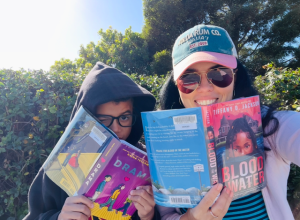
My 11-year-old son is in middle school, and he still asks me, “Mom, will you come read with me?” He also recommends books he thinks I will enjoy, especially graphic novels with social justice themes. We can sit and connect, even if we are reading different books. 

Read with Me? is a participatory middle grade / YA reading service connecting middle school students with trusted adults in their lives through book recommendations. In partnership with local middle schools, students would recommend middle grade and YA novels through written reviews, audio recordings, or short videos created in a school library or language arts class. The original recordings would initially be shared with classmates, teachers, school librarians, parents and participating public library staff during a school hosted event or town hall. 

In tandem, the library would curate an adult-facing YA display featuring student recommendations, including direct quotes, and QR codes linking to the library catalog. Extra copies of recommended books would be available for circulation at select locations. Students could volunteer to help design these installations, in partnership with the library staff. The goal is to create opportunities for intergenerational connection, understanding, and conversation. 

Mission & Institutional Context

San Francisco Public Library’s mission is to “connect our diverse communities to learning, opportunities and each other.” Its strategic priorities include serving as a Literacy Champion, Cultural Amplifier, Community Catalyzer, Thoughtful Navigator, and Resource Provider (San Francisco Public Library). Read with Me? supports these priorities by connecting literacy, youth voice, family engagement, and participatory library service.

SFPL already recognizes the importance of teen-centered spaces and services. The Mix at SFPL is a space for youth ages 12–18 that supports creativity, digital media production, music, gaming, and social connection. That space could support the media-creation portion of the project while keeping the recordings within a supervised, youth-centered environment.

The innovation responds to two needs. First, middle school students often have strong opinions about books but limited opportunities to influence library services. Second, adults may enjoy YA literature but feel uncertain about entering teen spaces or knowing where to begin. A partnership with local middle schools would allow students, school librarians, teachers, public librarians, and families to shape the program together.

Action Brief Statement (Students/Adults)

Convince middle school students and the trusted adults in their lives that by sharing and exchanging middle grade / YA book recommendations through Read with Me?, they will discover new ways to understand and connect with one another, which will strengthen reading for pleasure and intergenerational relationships, because the library connects diverse communities to learning and to one another. 

Action Brief Statement (School and Public Librarians)

Convince public and school library staff that by collaborating with middle-school students to design and pilot Read with Me?, they will gain a more meaningful understanding of young people’s reading lives and create a safer, more responsive intergenerational service, because sustainable library innovation depends on shared ownership, staff readiness, and amplifying community knowledge. 

Where did you find inspiration? 

  • Dave Eggers Opens a Library for Youth, by Youth in San Francisco: Every Sunday afternoon, Dave Eggers has partnered with Middle School Librarian, Gina Cargas, to host the Golden Gate Reading Club at the International Library for Youth for kids and their adults.
  • SFPL One City One Book: “One City One Book is a citywide literary event that encourages members of the San Francisco community to read the same book at the same time and then discuss it in book groups and at events throughout the City. By building bridges between communities and generations through the reading and, most importantly, the discussion of one book, we hope to help to make reading a lifelong pursuit and to build a more literate society.”    
  • Stephens, Taming Technolust: Ten Steps for Planning in a 2.0 World: “Let go of control!”
  • Barbakoff & Lenstra, Working Hand in Hand: “Community-led planning values the process and the relationships it builds as much as it values the product. It treats human relationships as a valid way of knowing and doing.”
  • The Mix at SFPL: At SFPL’s main branch, teens can reserve two media studios to produce videos and podcasts, in addition to playing and recording music.

Guidelines & Policies

  • Establish Read with Me? as a partnership between SFPL, participating middle schools, school librarians, teachers, students, and guardians.
  • Create a small planning group that includes public library staff, school librarians, teachers, students, and, where appropriate, caregivers.
  • Seek student participation and obtain caregiver permission when required by school and/or library policy.
  • Allow students to participate in the book recommendation collection process through written reviews, audio, animation, etc. 
  • Use only consented, carefully edited excerpts or voice clips in public library promotion to preserve student privacy.
  • School administrators, district personnel, public library administrators, and legal or privacy staff to review the consent, media, and data-retention procedures prior to publication outside of the school setting.

Timeline for Implementation

  • Dates must be fluid and at the discretion of student and teacher schedules, including state testing schedules; however, it is possible that some coordination and work could occur outside of school sessions, during summer, winter or spring breaks, based on student availability. 
  • Spring (before end of school): Connect with middle school librarian to gain interest and alignment, recruit and form the planning group, based on input from school librarian and public library branch staff. Finalize plan and proposed timeline for upcoming school year. 
  • September – December: Begin to engage in proactive partnership with and solicit content from students, in coordination with school administrators (including over winter break). Begin to staff and plan for public library installation and other activities, including school viewings. 
  • January – March: Schedule viewings at school for students, parents, and library partners. Launch the public library display/installation. Gather feedback and develop a plan for production of any public-facing social media accompaniments. Establish a process and timeline for evaluating feedback and measuring success metrics.

Marketing & Promotion

  • Displays near the adult and teen collections with catchy signage (can also be student-designed)
  • School newsletters and family communications
  • SFPL branch newsletters and website announcements
  • QR codes with reading lists and recommendations at adult fiction displays
  • Viewings of finished product during school assemblies and or class/library time
  • Social media production based on approved, finished content
  • Read with Me? sticker on books, bookmarks

Staff Training & Readiness

  • Facilitating youth participation 
  • Consent and privacy procedures
  • Sensitivity and mandated reporter training
  • Collecting feedback without gathering unnecessary personal information
  • Leverage intact training utilized for teen collaboration spaces and media rooms

Evaluation & Future Expansion

  • Feedback from participating students and their caregivers/guardians, in person and also via survey
  • Volume of selected books checked out or put on hold at local branches or online (before and after launch), QR code scans
  • Teacher/administrator, school librarian, and public librarian and staff feedback, including incremental workload and perceived impact
  • Success metrics and indicators for expansion:
    • Students feel they have a meaningful voice in a public institution
    • Perception of strengthened relationship between students, adults, school librarian, public library spaces (in any configuration!); for example, a student shares that an adult they know read their recommended title, or a meaningful conversation occurred based on program participation 
    • Reinforcement of public library as a community hub where all are welcome

Reflection on Hyperlinked Environments: The Kyoto International Manga Museum

I became interested in manga for a pretty practical reason: my son was reading a lot of One Piece, and I wanted to understand what he was so absorbed in. I also took a graphic novels class this past summer. I personally did not read manga for the class (it feels like manga could be its own course!), but I learned a lot about graphic novels as a medium, especially how images, text, pacing, and visual sequencing work together. I also learned about the deep history and tradition that encompass manga. That made me even more curious about manga as its own form of storytelling.
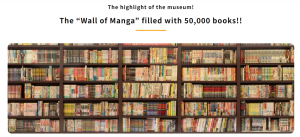
I recently had the chance to visit the Kyoto International Manga Museum. I was interested in how the museum would present manga. What stood out to me most was that it did not feel like a traditional museum where everything is placed behind glass. It felt much more like a library and a community space because it was warm, inviting, encouraging of exploration and curiosity.

One of the museum’s highlights is its “Wall of Manga,” a 200-meter-long open-access library containing approximately 50,000 manga publications, primarily from the 1970s through 2005 (Kyoto International Manga Museum, n.d.). The books are organized by category and then shelved by the author’s name. The first floor features shōnen manga, the second floor features shōjo manga, and the third floor features seinen manga. Visitors can simply take a book from the shelf and find a place to read (Kyoto International Manga Museum, n.d.). I’ve never been to a museum that is more like a library. Usually museums that are more for exploration are geared towards children, but this was not (although they of course have a lovely children’s reading area). 

That freedom was what I loved about the museum; I felt like I could wander and slowly soak things in. The museum also includes a Manga Expo section with translated manga and comics from around the world, a children’s library, a research reference room, and a searchable database. It is simultaneously a museum, a library, a research center, and a community space. That combination connects to Jaqueline Berndt’s discussion of how visitors may approach the museum less as a conventional museum and more as a place to browse and read (Berndt, 2012).

I also appreciated the relatively low admission cost and the building itself, which is a former elementary school, emphasizing the positioning of the visitor as a child with a big imagination and appetite for creative content. The setting made the museum feel approachable rather than intimidating. Last winter, my kids and I visited the Art of Manga exhibition at San Francisco’s de Young Museum, which was also fascinating. But the Kyoto museum stayed with me because it emphasized access and approachability; the goal of this museum is preserving and amplifying a national art form. I could hold manga copies, see them serialized across a shelf, and take in the scope of the art form in its actual format. While Art of Manga was beautiful and flashy (read: slick curation! expensive entry!), I preferred the Kyoto museum’s presentation and experience, mainly due to its focus on physical artifacts.

The Kyoto International Manga Museum embodies a hyperlinked environment where books, people, history, popular culture, research, and community all connect.

Reflection on Hyperlinked Communities

Social media is the devil… AND libraries are brilliantly leveraging that evil for good.

Inspired by this week’s readings, I want to highlight a few library accounts and reels that are keeping libraries relevant, approachable, and accessible across platforms.

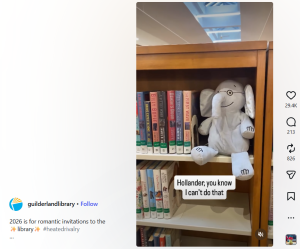
[reel]

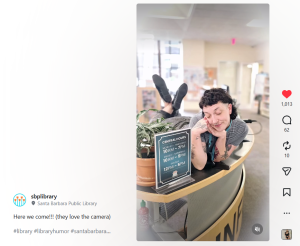
Library social media teams are quick, creative, and clearly paying attention. When the “I’m coming to the cottage” earworm from Heated Rivalry went viral, the Guilderland Public Library in New York was one of many libraries to jump on the trend with this reel.

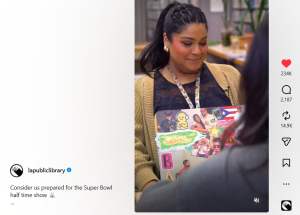
And for the Bad Bunny concert—I mean, the Super Bowl—this past February, the Los Angeles Public Library fully met the moment. Its reel showcased the power of reference librarians and received more than 234,000 likes.  

Librarians are finding ways to navigate the chaos and turn it into community connection. They are meeting people where they already are, using the language and formats people understand and prefer, and showing that libraries are not stuffy boring institutions waiting for people to walk through the doors. Libraries are active participants in culture, and libraries are for everyone.

Social media is also a phenomenal storytelling canvas. So much of what libraries can offer hyperlinked communities is the opportunity to tell and amplify the story of the community.

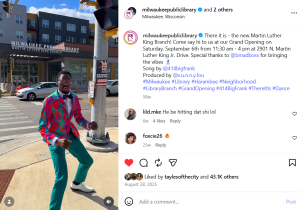
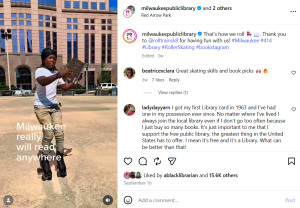
The Milwaukee Public Library social media team did exactly that when it publicized the grand opening of its Martin Luther King Jr. Branch. The reel, created by a local producer, features Milwaukee choreographer and dancer Christopher Gilbert dancing across the street and into the library’s newly renovated building to music by Milwaukee musician Big Frank. It is so fun and creative.

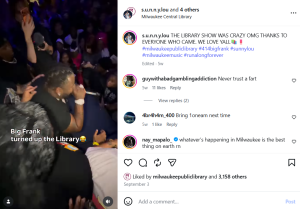
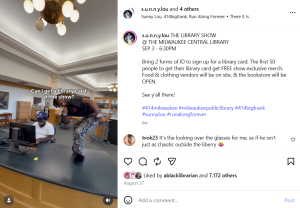
The library is telling a story about its community through local artists, local music, movement, and a new public space. It has more than 734,000 views. One year later the library hosted a concert in its main branch where Big Frank performed the song featured in the MLK Branch reel, and also put that in Instagram [reel]. 

I live nowhere near Milwaukee and have never considered visiting it, but this post helped me learn something about the city and its culture. I showed it to my kids, and now they are begging me to plan a family vacation to Milwaukee so they can visit the MLK branch.

Hyperlinked librarianship uses technology to connect people not only to library services, but also to place, culture, creativity, and one another across platforms, physically and virtually. Truly hyperlinked communities.

[reel]

Assignment X: Black Women as Bellwethers of Hyperlinked Librarianship

“Hyperlinks are people.”

People preserve stories. People create spaces where knowledge can move. People connect communities that institutions often overlook. 

Black women have always been doing this work, even when the profession did not always recognize or welcome them. Black women librarians have held onto knowledge, shared knowledge, created spaces for learning, and built community under circumstances that made all of those things difficult.

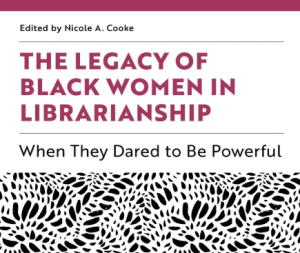
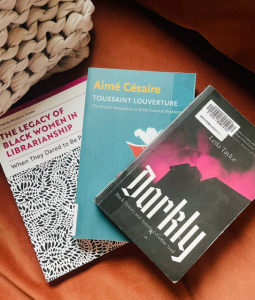
The Legacy of Black Women in Librarianship: When They Dared to Be Powerful

“The restriction of literacy is a painful part of Black history in this country, and it’s a critical piece of history for Black librarians in understanding their roles, says Tracie Hall, the executive director of the American Library Association.” Why Aren’t There More Black Librarians? 

As Tracie Hall explains, that history is essential to understanding both the shortage of Black librarians today and the importance of Black librarians in the communities they serve.

In The Heart of Librarianship, Michael Stephens describes hyperlinked librarianship as “playfully approaching opportunities to create learning experiences and engaging information-based services.” I love the word playfully here. It leaves room for creativity, humor, personality, experimentation, and importantly, Instagram reels. 

https://www.instagram.com/reels/DA0twPvv0jv/ 

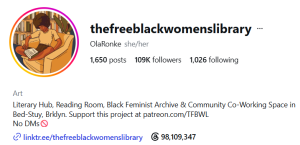
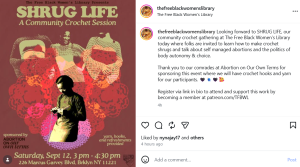
The Free Black Women’s Library, founded by OlaRonke Akinmowo, is a brick and mortar establishment with a collection that centers books by Black women and Black nonbinary authors. The Instagram account helps people find books, events, ideas, and community. The library may have roots in Brooklyn, but its connections are much bigger than Brooklyn. A superb video write-up captures the essence better than a blurb in this blog. 

https://www.instagram.com/p/DaqjgrqvwvJ/

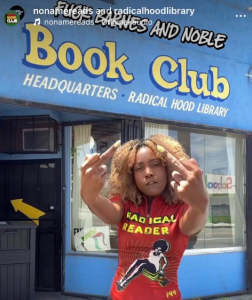
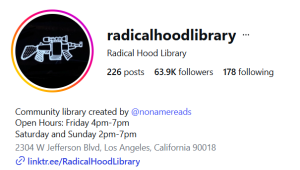
In Los Angeles, Radical Hood Library is a community library which hosts monthly prison program support days—an event for community members to come and package books to be sent to incarcerated community members, meeting them where they are. It also hosts Noname Book Club meetings, open mics, film screenings, game nights, and workshops for writers. This is a library as gathering place, cultural space, and community project, and of course a beautifully curated social media presence to inspire those of us who do not live in the City of Angels.

https://www.instagram.com/p/DdCtvB-SQ-9/

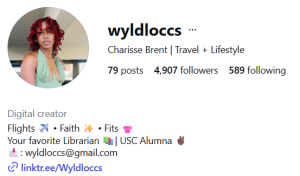
@wyldloccs uses Instagram to share The Life of a Black Archivist & Librarian. Her videos make archival work feel less mysterious and more possible. She shows what the work looks like and helps people imagine themselves doing it. She is creating a professional pathway one reel at a time.

https://www.instagram.com/p/C-EYX_2PVmA/

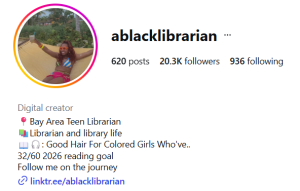
@ablacklibrarian shares the funny, heartfelt, and sometimes surprising reality of being a teen librarian at Oakland Public Library. One post particularly stayed with me: a back-to-school event, Haircuts, Braids and Backpacks, brought barbers and hair braiders into the library to do children’s hair so they could look and feel their best on the first day of school. This is hyperlinked librarianship and participatory service in action. 

https://www.instagram.com/p/DPwl1J5kQ2d/

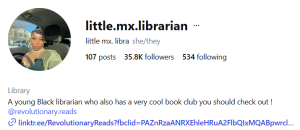
@little.mx.librarian brings personal style, professional honesty, and reading community together. Through her virtual book club, Revolutionary Reads, reading becomes a shared practice of learning and connection. They also talk about becoming an academic librarian, burnout, workplace disillusionment, and respectability politics.

https://www.instagram.com/p/DG-01Jtxzih/

Black women librarians have long been at the vanguard of hyperlinked librarianship, and they will continue to connect and lead as bellwethers for the future.

https://www.instagram.com/p/DdL3_nqvq58/

Intro: Gemini Sun / Aquarius Moon with Vanity Library Book Stacks

I am loving the first few days of sinking into the materials for this course. I chose this course after really enjoying aspects of INFO 200 where the hyperlinked library was explored. It feels like a very dynamic and changing concept with many layers. As a Gemini sun / Aquarius moon, this is all very appealing to me! 

My area of interest in the library world is also in flux. The MLIS journey is a passion project for me and I do not plan to make this into a career yet, although I do see myself moving into this space during my next professional chapter. I studied Art History in undergrad, then went to law school, practiced civil litigation, and now have worked in the biotechnology industry for over a decade writing commercial contracts. My career journey continues. 

I have lived in San Francisco for 20 years and I love dragging my kids to different library branches every weekend. I am notorious for checking out books and returning them mostly unread. I do most of my reading via the Libby App with my various library cards but still cannot resist leaving the library with a fat stack of great titles. 

Here is the most recent set of books that I did not get to read, but I did memorialize them with a photo before returning them. 

Right now on my iPhone/iPad, I am eyeball reading 😳 Dungeon Crawler Carl (so far a meh for me, but I want to push through) and am listening to the audio 🎧 of A Quiet Place by Seichō Matsumoto and it is eerie and reminds me of Marie NDiaye’s writing, which is slightly disturbing and thus very compelling. 

I am happy to be taking this course and excited for the semester.