Another trend closely related to the romance reader information community is improvement of equity in knowledge systems. Knowledge is and will continue to expand beyond existing privileged, Western, patriarchal voices and norms. People are seeking diverse stories as a basis for connection and learning, and this expansion will heal and build communities.
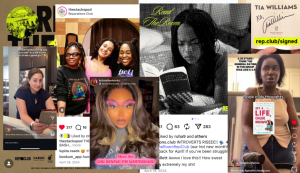
Romance readers are a lively bunch and enjoy the connections that reading this genre can yield, whether it’s via social media or connecting with friends in real live. While there has traditionally been a hefty amount of stigma associated with reading romance novels due to their varying degrees of salacious sexual content, the increasing activity of romance readers online communities has bolstered the credibility and validity of this genre. “One of the joys of smut is the sense of community it builds. There’s something special about realizing a friend is ‘in on it’” (Huizenga, 2024).
TikTok (aka “BookTok”), Instagram (aka “Bookstagram”), and forums like Reddit’s “r/RomanceBooks” have contributed to destigmatization the genre by giving romance readers a platform to “share their love for steamy reads with pride, even humorously celebrating them in ways that once might have been considered taboo” (Huizenga, 2024).Some libraries dedicate substantial efforts to romance programming, thereby investing in community building both in person and online. The Arlington Public Library’s author talk series, Arlington Reads, hosted five romance authors in 2025. The Berkeley Public Library North branch sponsors the Modern Romance Book Club and hosted five in-person events in 2025. There are many opportunities and formats for libraries to support the romance reader information community and thus providing frameworks to address the future of the loneliness epidemic.
Romance & Futuristic Ways of Knowing
Romance novels, writers and the overall publishing industry have historically not embraced diversity in many categories including, race, neurodivergence, disability and fat representation. However, there are writers who are presently contributing to enriching the genre with their characters and storylines (Nankervis, 2022). The publishing industry’s current repertoire is far too white, cis, hetero, neurotypical, able bodied and thin; industry has an obligation to use money and influence to promote diverse writers and stories, because these stories sell and they deserve to be told and read by all (Nankervis, 2022).
Diversity and representation in romance novels are important not only to readers who represent certain marginalized and minoritized communities, but also to all readers, because readers can and do identify with characters who are different from them (Nankervis, 2022). Romance readers do not need to explicitly share an identity with the characters in the books they read in order to enjoy them (e.g., vampires, werewolves, etc.) (Nankervis, 2022).
Often this genre is denigrated based on its association with women readers and its perception as a “frivolous, escapist pursuit” (Greenhaus, 2023). However, as discussed above regarding the immense health benefits of reading and talking about romance novels in community, not to mention promoting literacy, reading this genre allows for self-replenishing as well as tending to individual emotional needs (Dewan, 2010; Greenhaus, 2023). That the benefits of romance novel reading are so clear and well known in certain marginalized circles, and yet not discussed or central in the discourse of this genre, is because these impacts are enjoyed by (mainly) women.
Globally, from the United States to New South Wales, librarians’ treatment of romance on the shelves can connote negativity, held broadly in society—marking romance novels with a heart in fiction sections, harkening to romance readers and yet informing other fiction readers to look away, or placing them in carousels away from “normal” fiction (Veros, 2023). To these librarians, romance fiction is a dalliance, not meaningful, intellectual or otherwise nourishing (Veros, 2023).
Harlequins serve as an important fantasy vehicle that offers an escape route for women trapped in dysfunctional families, [bell hooks] says. Not because someday your prince will come, but because “you will triumph over it and it will all come right in the end.” (Parker, 1999)
Romance readers reflect an opening up of possibilities and eschewing the limits of toxic patriarchy. “Without an ethic of love shaping the direction of our political vision and our radical aspirations, we are often seduced, in one way or the other, into continued allegiance to systems of domination–imperialism, sexism, racism, classism” (hooks, 2006, p. 243).
Even among a range of romance readers who have, at best, never heard of bell hooks or, otherwise, would say they disagree fundamentally with her values, would likely agree that romance novels are like old medicine and wisdom passed down through generations, with readers healing themselves and allowing them the respite to continue to show up with and for their communities in the face of capitalist, patriarchal oppression—even if they would not fashion their lived experiences in such politicized terms.
As librarians are uniquely situated in institutions nearly exclusively focused on lifelong learning and supporting communities, the collective impact of embracing and supporting the romance reader information community cannot be understated (Dewan, 2016). Where librarians ascribe to the overt or subconscious framing of romance as a lesser form of fiction, they do a disservice to their readers and the community (Veros, 2023).
Investigation into and support for what the romance reader information community can offer is imperative at a time when society is challenging traditional, heteronormative, patriarchal approaches to leisure, value and who gets to write history and define what matters. Let’s listen to and study the collective wisdom of romance readers.
References:
Dewan, P. (2010). Why your academic library needs a popular reading collection now more than ever. College & Undergraduate Libraries, 17(1), 44–64. https://doi.org/10.1080/10691310903584775
Dewan, P. (2016). Economic well-being and social justice through pleasure reading. New Library World, 117(9/10), 557–567. https://doi-org.libaccess.sjlibrary.org/10.1108/NLW-03-2016-0019
Dezuanni, M., Osman, K. Burton, A. & Heck, E. (2024). IFLA Trend Report: Facing the future of information with confidence: Phase 2. Brisbane: Digital Media Research Centre. https://www.ifla.org/trend-report/
Greenhaus, R. (2023). Sex in the stacks: Examining the treatment of explicit materials in American libraries. Libri: International Journal of Libraries & Information Services, 73(1), 77–84. https://doi.org/10.1515/libri-2021-0133
hooks, b. (2006). Outlaw Culture: Resisting Representations. Routledge.
Huizenga, H. (2024, December 3). SMUT: The juicy secret we’re all finally talking about. Medium. https://baos.pub/smut-the-juicy-secret-were-all-finally-talking-about-7e9401415ff4
Nankervis, M. (2022). Diversity in romance novels: Race, sexuality, neurodivergence, disability, and fat representation. Publishing Research Quarterly, 38(2), 349–363. https://doi.org/10.1007/s12109-022-09881-6
Parker, L. O. (1999, February 20). Fantasy aisle: Harlequin romance novels steam through 50 years of changing mores. The Washington Post.
Veros, V. (2023, May 30). Nobody puts romance fiction in the corner: Public librarians in New South Wales and their dalliance with romance fiction. Journal of Popular Romance Studies. https://www.jprstudies.org/2023/05/nobody-puts-romance-fiction-in-the-corner-public-librarians-in-new-south-wales-and-their-dalliance-with-romance-fiction/