Participatory Service in Action
“Participation occurs when someone welcomed as a
guest feels as though they become a host.”
-Michael Stephens from The Heart of Librarianship
As librarians and library professionals, we often refer to our roles as serving the community. We plan events for our community to attend, we select books for our community to read, we ourselves read the books to our youngest patrons during storytimes, and I say all this to emphasize how our role is often one where we welcome and host our guests in our space (AKA the library). But @michael‘s quote really struck me because it prompted me to think about the ways in which my community libraries have implemented participatory models where the guests become the hosts.

The new South San Francisco Public Library opened on October 28, 2023.
This is a library near my home: the South San Francisco Public Library. It is formally known as the Library | Parks and Recreation Center. It’s not only a beautiful building, but it is also unique in that it is shared by both the city’s Parks and Recreation department and the city’s Main Library. It has a makerspace, digital media lab, and various multi-purpose rooms. The first floor’s Social and Banquet Halls often serve as venues for weddings, baby showers, and exercise classes. The second floor’s Makerspace and Community Room often host library programs and events. Similar to San Francisco’s public library system, these multi-purpose rooms allow community members and residents to plan their own events and clubs (O’Brien, 2019).
I often find myself in this building as both a library user and as a staff member, but because I am here so frequently, I have failed to recognize that a participatory service model has been right under my nose this whole time.
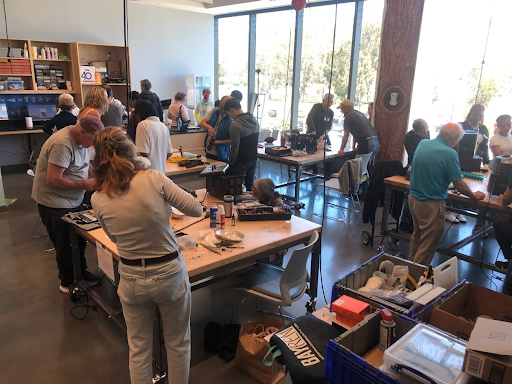
South San Francisco Public Library Makerspace
The Makerspace (pictured above) sets out button-making supplies, craft supplies, sewing machines, and donated fabrics for patrons to use. As a creative space, patrons are welcomed in and encouraged to bring their imagination to life! I’ve seen teens use this space to host their own club meet-ups and sewing tutorial workshops, making this an example of the participatory service model in action. Rather than book storage facilities, libraries are now learning hubs and community-driven spaces where patrons are not only consuming what librarians provide, but actively creating something new. Library patrons are not only learners, but also teachers.
Speaking of Makerspaces — the community of a nearby city, San Carlos, also had the opportunity to design their new makerspace. San Mateo County Libraries (SMCL) heavily weighed community input in its plan to build a new makerspace within the San Carlos Library. The library asked community members to participate in the design process by asking questions such as: What would you accomplish in your dream makerspace?
Check out SMCL’s blog post!
Not too far from South San Francisco, the Daly City Library is also implementing a hyperlinked library element that invites patron participation. As community members take a walk around the library and into the adjacent park, they’ll find weather-proof posts featuring pages from popular children’s books. This story walk is part of a larger initiative called The StoryWalk® Project created by Anne Ferguson and developed in collaboration with the Kellogg-Hubbard Library in Montpelier, Vermont. Prior to this course’s Participatory Service module, I didn’t really have the perspective to view Daly City’s Storywalk as a hyperlinked library element (despite having interacted with it some many times). But now that I reflect on it, I see now how storywalks can invite participation through storytelling. Like how library storytimes are hosted by a storyteller, storywalks allow participants to become the storytellers themselves.

Bayshore Heights Park, Daly City, CA
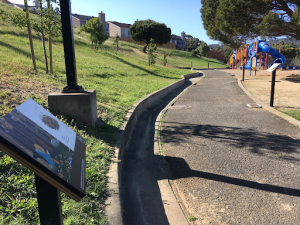
Gellert Park, Daly City, CA
Across these examples of participatory service, I’m seeing a common thread: the boundaries between community members, library users, and library staff begin to dissolve. We are not confined to a single role. We are teachers and learners, guides and explorers. We are storytellers, creators, and designers of shared experiences and shared spaces. Most importantly, we are collaborators, each contributing knowledge and perspective to build something greater than any one of us could create alone.
@tinazhen signing off! 🙂
References
Stephens, M. (2016). The age of participation.. In The Heart of Librarianship: Attentive, Positive, and Purposeful Change. ALA Editions.
O’Brien, C. (2019, June 24). How San Francisco’s public libraries are embracing their changing role. Shareable. https://www.shareable.net/how-san-francisco-public-libraries-are-embracing-their-changing-role/
Dominguez, E. (2024, March 1). San Carlos Library is getting a new makerspace! San Mateo County Libraries. https://smcl.org/blogs/post/sclmakerspace/
Daly City Public Library. (n.d.). StoryWalks. City of Daly City. https://www.dalycity.org/1141/Storywalks
Let’s Move in Libraries. (n.d.). StoryWalk®. https://letsmovelibraries.org/storywalk/
0 Comments