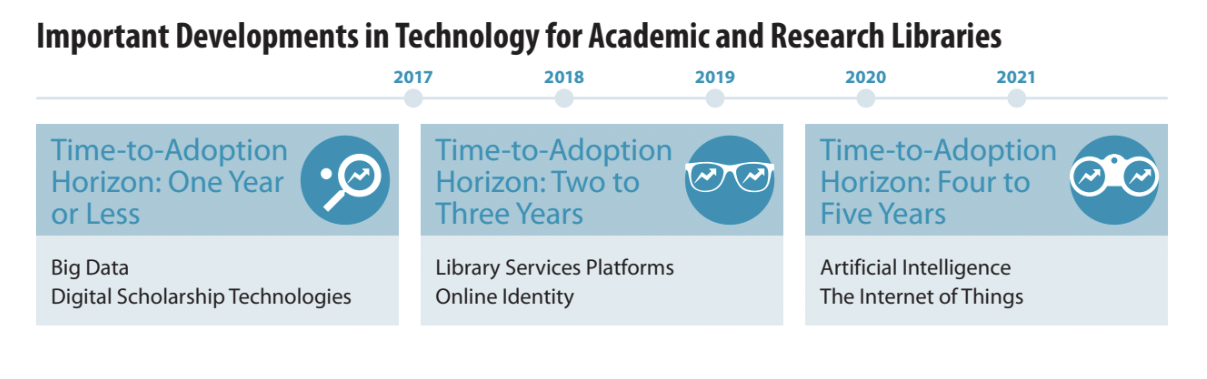
NMC Horizon Report – Library Edition 2017 At-a-Glance
As I was reading through the last NMC Horizon Report, Library Edition, I was surprised to see how accurately the report saw the emerging trends. They even got the timeline right! I was mostly impressed by how confident they were about AI’s time to adoption. Having been published in 2017, 5 years is accurately the time it took for AI to take the world by storm.
6 years after 2017, Papini writes about Chat GPT from a critical library lens. In her article, she discusses how AI can help – and where its limits are – when it comes to information literacy instruction (Papini, 2023). As librarians base information literacy instruction (IL) on the Association of College and Research Libraries (ACRL) Framework, Papini lays out the 6 Frames and explores how Chat GPT intersects with each Frame.
From her article, my main takeaway is that rather than seeing Chat GPT as a detriment to student learning, a better way to view this is that it can actually help students become more aware of the six ACRL Frames. More specifically, the use of Chat GPT in information literacy instruction provides starting points for librarians to dive in and intercept. For example, for the Frame discussing Authority is Constructed and Contextual, Chat GPT can’t always cite its sources as it pulls information from a variety of places, meaning it cannot be considered a credible source. Instead of shying away or fearing Chat GPT – or telling students to avoid it in general — I think this makes for a great opportunity for librarians and information professionals to chime in. While Chat GPT can’t always tell you where a piece of information was acquired from, we can! And as information professionals of the 21st century and of this ever-changing technological landscape, it is our job to help students and community members evaluate the reliability of AI’s outputs.
I foresee a future with a lot of noise, both online and in the real world. As it becomes harder to figure out what’s real and what’s not, I think critical reading and thinking skills will become a bigger priority in many librarians’ information literacy instruction sessions.
Even now, I’m seeing many public libraries embrace this new technology by hosting creative AI workshops. Academic libraries are also training students on how to fact check and how to research. What other AI-related programs have you seen at your library?
@tinazhen signing off!
References
New Media Consortium. (2017). NMC Horizon Report: 2017 library edition. The New Media Consortium.
Papini, A. (2023, January 27). ChatGPT: A library perspective. Douglas & Judith Krupp Library, Bryant University. https://library.bryant.edu/chatgpt-library-perspective
Abytesized, M. (2025). AI storytelling 2.0: Reimagining creativity in 2025. Palo Alto City Library. https://library.cityofpaloalto.org/blogs/post/ai-storytelling-2-0-reimagining-creativity-in-2025/
The Chicago School Library. (2023). Information literacy & AI. https://library.thechicagoschool.edu/artificialintelligence/ailiteracy
0 Comments