Recall the mantra of Erik Boekesteijn (Doklab consultant and senior advisor to the National Library of The Netherlands)?
“Libraries should keep stories, share stories, and make stories.”
It’s indeed a beautiful way of seeing libraries – I’d even say it’s one of the libraries greatest superpowers and really what drew me into this field of work.
A typical member of the public may see libraries as story keepers and story sharers simply because of their affiliation with books; after all, books are in and of themselves stories. In this sense, librarians literally keep (i.e., store) and share (i.e., circulate) stories. However, as library professionals and future librarians, we know that this mantra means way more than what’s apparent at face value.
Beyond keeping and sharing stories, libraries make stories. A library often plays a pivotal role in many people’s stories – think of it as like a fairy godmother role where although it is rarely the main character, it quietly empowers others to achieve their goals and discover new possibilities.
In Storm Reyes’ story, the public library suddenly showed up in the form of a Bookmobile, providing Reyes a glimpse of “how huge the world was,” giving her the courage to leave the camps (Popova, 2016). In many other stories, libraries appear as catalysts for change, allowing the main characters to rewrite the course of their own narratives. By providing immigration workshops, unemployment assistance, and housing or food insecurity resources, individuals are empowered to overcome the challenges in front of them.
Libraries are also the backdrops of many stories. For example, 2014 Los Angeles poet laureate Luis J. Rodriguez uses the library as a homebase to “host workshops, readings, and podcasting” (Szabo, 2025). With the library’s resources, he continues to tell his story from impoverished beginnings to now a major figure in contemporary Chicano literature.
Although compared to fairytales and literary story-writing elements, I’d like to acknowledge that these are very real stories. My point is that libraries are often the quiet force behind transformative moments. They may not cast magic spells, but are surely the makers and tellers of beautiful, inspiring stories.
On a side note, I was trying to find and insert a relevant image here — but thought, how about we play around with some generative AI? I prompted Chat GPT to create an image of the library personified as a fairy godmother and her magic as all the resources libraries provide. Take a look below!
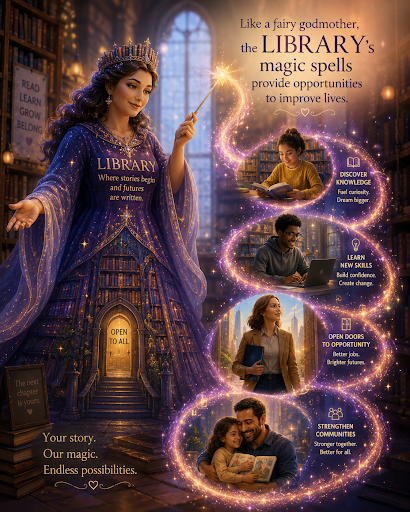
AI-generated image personifying the library
@tinazhen signing off! 🙂
References
Stephens, M. (2019). Wholehearted librarianship: Finding meaning, purpose, and passion in your library work. ALA Editions. (“Telling Stories,” p. 92)
Popova, M. (2016). How libraries save lives. The Marginalian. https://www.themarginalian.org/2016/10/06/libraries-storycorps-bookmobile/
Szabo, J. (2025). In L.A., the Public Library Is a Storyteller. Zócalo Public Square. https://www.zocalopublicsquare.org/in-los-angeles-public-library-storyteller/
0 Comments