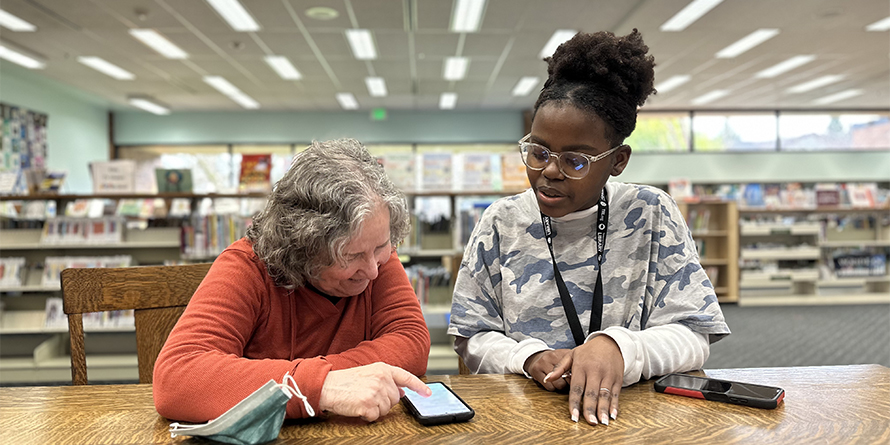
Teen Tech Tutors Program at Olympia Timberland Library, WA
In Nygren’s article, the idea of connected learning is one I’d like to focus on in this blog post. As mentioned, connected learning promotes participation and social connection through group-based activities that bring people together using a shared purpose (Nygren, 2014).
Beyond engaging community partnerships to enhance learning experiences, I would like to discuss the concept of connected learning from the perspective of the types of library programs librarians can curate. As I was exploring this idea, I was reminded of an interaction I witnessed at my library:
One day, while I was staffing the information desk, I noticed an elderly woman chatting with one of our high school volunteers over a flip phone. For the volunteer, it was their first time seeing a real, working flip phone! On the other hand, the elderly woman was trying to get access to photos her family overseas had sent to her. Together, they patiently explored the tiny buttons and menus, laughing as they figured things out together. To me, this interaction seemed like a delightful meeting of two generations.
I bring this story up because when I think of connected learning, I think of moments like this one, where people learn by working through challenges together. Being that librarians are both teachers and curators of learning experiences (Matthews, 2013), I think interactions like this demonstrate the power of creating environments where people of different ages, backgrounds, and experiences can connect through a common goal. The library as classroom is in full motion when programs provide the safe space for this to happen, more specifically, with intergenerational programming.
With intergenerational programming, we open up the “opportunities for kids and adults to collaborate (and) give each population a chance to learn from one another,” (Moore, 2013). Intergenerational programs also help younger participants build their confidence as they interact with adults as equals, while adults gain valuable insight into the experiences of teenagers and may even positively influence their growth. Some great examples of intergenerational programming I’ve seen are:
- Teen Tech Tutors
- Family Board Game Nights
- Intergenerational Book Clubs
What kinds of intergenerational programs have you seen? I’d love to hear other ideas!
@tinazhen signing off!
References
Nygren, Å. (2014, August). The public library as a community hub for connected learning. In IFLA World Library and Information Congress 2014: Libraries, Citizens, Societies: Confluence for Knowledge. International Federation of Library Associations and Institutions.
Mathews, B. (2013, September 5). Curating learning experiences: A future role for librarians? The Ubiquitous Librarian. https://www.chronicle.com/blognetwork/theubiquitouslibrarian/2013/09/05/curating-learning-experiences-a-future-role-for-librarians/
Moore, C. (2013, May 25). Intergenerational programming at your library. ALSC Blog. Association for Library Service to Children. https://www.alsc.ala.org/blog/2013/05/intergenerational-programming-at-your-library/
Timberland Regional Library. (2023, August 9). Teen Tech Tutors program brings generations together at the Olympia Timberland Library. https://trl.org/news/teen-tech-tutors-program/
Ehrenstein, J., & Leonard, S. (2024, March 13). Creating connections: Intergenerational book club. Programming Librarian. American Library Association.
1 Comment
Maria Ramos-Yoo · August 1, 2026 at 3:42 am
Hi Tina, I love your blog post focused on connected learning and intergenerational collaborative learning. That is one reason I love Intergenerational programming because it shows patrons of all ages that they can learn from one another despite a great difference in age and generational thinking. That is one reason I loved playing a video game recently I knew nothing about, and my 16- and 20-year-old sons taught me how to use a controller and beat the bad guys while they squirmed and cringed at all the terrible moves I made while learning. I learned so much from them and tried harder at getting better because of them, even though I am thirty years older than they are. A great Intergenerational program could be having teens teach gaming. They can even call themselves game tutors. Thank you for your thoughtful post.