Reflection Blogging – The Power of Stories: Adults Benefit From Story Times Too!


Credit: D-GM at https://pixabay.com/photos/wood-story-story-time-storytelling-1786472/

In this week’s module I was inspired by the “Library Up Late: Grown Up Story Time” program at the Tea Tree Gully Library that was mentioned in Stephens’ (2019) book, the Wholehearted Librarianship (p. 92). It led me to do some research about what kinds of story time services libraries are offering for adults. This blog post is simply me reflecting on a couple cool programs I found and my thoughts about them. 

One article I found was about the “Storytime for Grown-ups” program hosted at a few locations in the Timberland Regional Library system (Lotz, 2026).  What I love about this adult story time is that the books being read aren’t for adults, they are for children. Lotz explains his vision for the program stating, “I began this to share the art, but the stories have become just as important to me and the participants” (para. 7). I’m going to share the photo in the article because I love how engaged and relaxed the man in the plaid shirt is. 
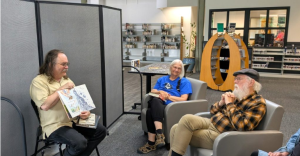
Credit: https://trl.org/blogs/post/storytime-for-grown-ups-what-why/

I love this idea for three reasons: 

    1. It is both relaxing and intellectually stimulating: Adults can come and relax and listen to a story that is not complicated to understand while also having discussions that are intellectually stimulating. Lotz (2026) explains that, “the people who come seem to love it, and they participate with a delightful blend of excited child-like appreciation and intelligent adult analysis” (para. 2). 
    2. It may connect adults back to fond childhood memories and allow them to connect to their childhood whimsy 
    3. It connects adults to other adults in their community 

I love this next program I found from the Ann Arbor District Library called “Show & Tell for Grownups” (Ann Arbor District Library, 2014). If you visit their website here, you can see a recorded Show & Tell event from 2014. This program really piques my interest because as someone who goes antiquing and thrifting, it’s not as fun when you find something amazing and you have nobody to tell. It’s a similar way I feel about doing family history research. If I find something cool, I want to share it with someone. Luckily, I’m able to share my finds with my mom who is always excited with me. I would definitely attend this event if one of my local libraries hosted it. I think it’s a great free event to go to with your friends or even on a date night. It is a great way to meet people in your community as well. If you are interested in something they shared, you can talk to them after the show. 

Libraries have the power to connect adults to the whimsy of their childhood and bring back heartwarming memories through story time events. And who doesn’t need a little bit of that in their lives? 

Credit: Willgard at https://pixabay.com/photos/fantasy-books-houses-cobblestones-6092469/

References 

Ann Arbor District Library. (2014, September 11). Show & tell for grownups. https://aadl.org/node/264766 

Lotz, S. (2026, May 6). Storytime for grown-ups…what?! why?. Timberland Regional Library. https://trl.org/blogs/post/storytime-for-grown-ups-what-why/ 

Stephens, M. (2019). Wholehearted librarianship: Finding hope, inspiration, and balance. The American Library Association.
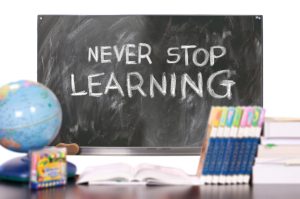

Reflection Blogging on Infinite Learning: Libraries Offer the Time and Space to Learn That Schools Do Not


Credit: geralt at https://pixabay.com/photos/to-learn-school-board-desk-3968765/

When I got to 7th grade, I started taking school very seriously. I wanted to do my best but learning never came easy to me. It took me a long time to grasp concepts and to do my assignments. While I got good grades, I found the way I could meet deadlines and study for tests was by memorizing patterns rather than truly understanding concepts. When I started my undergraduate degree, I was a biology major (I later switched to history). I found the time restriction of lab classes completely ruined the learning experience for me. The environment was stressful and you had to finish the lab within the amount of time you were given. If you didn’t understand something or you needed more time, it was too bad for you. My problem was whenever I had a stressful time limit placed on me, I’d go into freeze mode and could not problem solve because my mind would go blank. All that to say, the STEM environment I experienced as a student was not conducive to learning. 

In the infinite learning module, the article by Joshua Block titled “Embracing Messy Learning” stood out to me because he discusses the idea of “messy learning” in the classroom (Block, 2014). He discusses how the projects he assigns students are challenging and he sees some of them struggle through the process. Block provides students the time and space to problem solve. He explains that, “if I don’t allow learning to be messy, I eliminate authentic experiences for students as thinkers and creators” (Block, 2014, para. 6). 

Credit: FeeLoona at https://pixabay.com/photos/christmas-background-child-tower-1864718/

I like this concept and appreciate Block’s efforts but his approach is not the norm. Our school system does not allow for messy learning. Instructors must fit the required curriculum into a certain amount of time and students have to meet deadlines and pass standardized tests. I think this is why libraries are so important for learning because they give time and space for learning without the pressure of tests and grades. 

Credit: Sunriseforever at https://pixabay.com/photos/chemistry-baby-experiment-science-5632651/

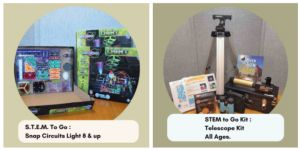
What is great is that libraries are providing spaces for kids to learn STEM without the constraints they may experience in school. The Urban Libraries Council’s (2019) article titled “Public Libraries are Teaming Up to Prepare Middle Schoolers for 21st Century Careers and Increase Access to STEM Learning Opportunities” briefly describes 10 STEM pilot programs at public libraries in the U.S. The goal of the pilot programs were “to test new approaches to engaging low-income middle school youth in science, technology, engineering and mathematics (STEM) education” (para. 1). One program mentioned in the article was the STEM kits at Algona Public Library in Iowa. This caught my eye so I decided to Google it for more information. I found a collection of STEM To Go kits at the State Library of Iowa available for checkout by librarians for STEM programs (State Library of Iowa, n.d.-a). You’ll see in the catalog record, they are titled “S.T.E.M. To Go” followed by the topic and intended audience (State Library of Iowa, n.d.-b). Two kits that sparked my interest were the “Snap Circuits Light Ages 8 & Up” and the “Telescope Kit All Ages” (State Library of Iowa, 2023a, 2023b). 

Credit: State Library of Iowa Youth Service Kits Catalog Records: Snap Circuits and Telescope Kit. 

My main takeaway from the infinite learning module is that libraries have the unique ability to offer the time and space for the “messy learning” that Block (2014) discusses in his article, a style of learning that our school system frequently fails to provide.

References 

Block, J. (2014). Embracing messy learning. Edutopia. https://www.edutopia.org/blog/embracing-messy-learning-joshua-block 

State Library of Iowa. (n.d.-a). STEM to go & storytime kits. https://statelibraryofiowa.gov/resources/toolkits-guides/stem-go-storytime-kits 

State Library of Iowa. (n.d.-b). Youth services kits [Library catalog]. https://sliowa.bywatersolutions.com/cgi-bin/koha/opac-shelves.pl?page=1&direction=asc&shelfnumber=74&op=view&sortfield=title 

State Library of Iowa. (2023a). S.T.E.M to go: Snap circuits light ages 8 & up [Library catalog record]. https://sliowa.bywatersolutions.com/cgi-bin/koha/opac-detail.pl?biblionumber=77713 

State Library of Iowa. (2023b). S.T.E.M to go: Telescope kit all ages [Library catalog record]. https://sliowa.bywatersolutions.com/cgi-bin/koha/opac-detail.pl?biblionumber=77767 

Urban Libraries Council. (2019, March 18). Public libraries are teaming up to prepare middle schoolers for 21st century careers and increase access to STEM learning opportunities. Libraries Technology News Service. https://librarytechnology.org/pr/24146/public-libraries-are-teaming-up-to-prepare-middle-schoolers-for-21st-century-careers-and-increase-access-to-stem-learning-opportunities