Credit: geralt at https://pixabay.com/photos/to-learn-school-board-desk-3968765/
When I got to 7th grade, I started taking school very seriously. I wanted to do my best but learning never came easy to me. It took me a long time to grasp concepts and to do my assignments. While I got good grades, I found the way I could meet deadlines and study for tests was by memorizing patterns rather than truly understanding concepts. When I started my undergraduate degree, I was a biology major (I later switched to history). I found the time restriction of lab classes completely ruined the learning experience for me. The environment was stressful and you had to finish the lab within the amount of time you were given. If you didn’t understand something or you needed more time, it was too bad for you. My problem was whenever I had a stressful time limit placed on me, I’d go into freeze mode and could not problem solve because my mind would go blank. All that to say, the STEM environment I experienced as a student was not conducive to learning.
In the infinite learning module, the article by Joshua Block titled “Embracing Messy Learning”stood out to me because he discusses the idea of “messy learning” in the classroom (Block, 2014). He discusses how the projects he assigns students are challenging and he sees some of them struggle through the process. Block provides students the time and space to problem solve. He explains that, “if I don’t allow learning to be messy, I eliminate authentic experiences for students as thinkers and creators” (Block, 2014, para. 6).
Credit: FeeLoona at https://pixabay.com/photos/christmas-background-child-tower-1864718/
I like this concept and appreciate Block’s efforts but his approach is not the norm. Our school system does not allow for messy learning. Instructors must fit the required curriculum into a certain amount of time and students have to meet deadlines and pass standardized tests. I think this is why libraries are so important for learning because they give time and space for learning without the pressure of tests and grades.
Credit: Sunriseforever at https://pixabay.com/photos/chemistry-baby-experiment-science-5632651/
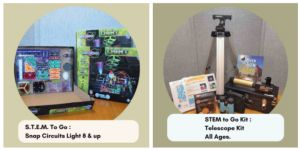
What is great is that libraries are providing spaces for kids to learn STEM without the constraints they may experience in school. The Urban Libraries Council’s (2019) article titled “Public Libraries are Teaming Up to Prepare Middle Schoolers for 21st Century Careers and Increase Access to STEM Learning Opportunities” briefly describes 10 STEM pilot programs at public libraries in the U.S. The goal of the pilot programs were “to test new approaches to engaging low-income middle school youth in science, technology, engineering and mathematics (STEM) education” (para. 1). One program mentioned in the article was the STEM kits at Algona Public Library in Iowa. This caught my eye so I decided to Google it for more information. I found a collection of STEM To Go kits at the State Library of Iowa available for checkout by librarians for STEM programs (State Library of Iowa, n.d.-a). You’ll see in the catalog record, they are titled “S.T.E.M. To Go” followed by the topic and intended audience (State Library of Iowa, n.d.-b). Two kits that sparked my interest were the “Snap Circuits Light Ages 8 & Up” and the “Telescope Kit All Ages” (State Library of Iowa, 2023a, 2023b).
My main takeaway from the infinite learning module is that libraries have the unique ability to offer the time and space for the “messy learning” that Block (2014) discusses in his article, a style of learning that our school system frequently fails to provide.
This document, presented to the Cozy Afternoons Public Library Planning Committee, serves as a strategic plan to install a makerspace in Cozy Afternoons Public Library. In this document, we will review our library’s mission, the goals of this project, along with the timeline, training, and additional details related to the implementation of this new service.
Introducing the Cozy Afternoons Makerspace!
What is a Makerspace? “A MakerSpace is considered a place where informal, collaborative learning and discovery take place through hands on creation, via use of any combination of art and technology. MakerSpaces facilitate both analog (low-tech) and digital (high tech) creation” (Velasquez, n.d., para. 1). To give some examples of the equipment in makerspace, some high tech options may include 3-D printers and sewing machines while low tech options may include general art supplies or even legos (Makerspace.com, n.d.).
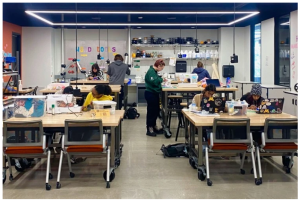
So what does a Makerspace look like? Below is an image of one of the University of Minnesota’s Makerspaces in their Health Sciences Library (University of Minnesota Libraries, n.d.-a). This is just one room of the Makerspace called the “work zone.” Notice the large tables, supplies laid out, sewing machine, and students working. This image captures the essence of a Makerspace which “facilitates creativity, experimentation, participation and play” (Velasquez, n.d., para. 4).
Credit: University of Minnesota Libraries, Health Sciences Library Makerspace https://www.lib.umn.edu/spaces/makerspaces
Our Goals and Objectives:
Meet the needs of our community by providing free space, up-to-date equipment, staff assistance, and materials to pursue creative projects
Make arts and other creative pursuits more accessible by removing financial and technological barriers
Foster community connections through shared workspaces and experiences
Our Intended Users:
The makerspace will be geared toward the young adult and adult members of our community
At Cozy Afternoons Public Library, our mission is to:
Provide services and resources that meet the needs of ALL members of our community.
Promote learning and creativity by removing barriers and providing relevant resources and services.
Provide space and experiences that foster community connections.
Credit: Veronika_Andrews at https://pixabay.com/photos/books-heart-pages-literature-5615562/v
How does a Makerspace fulfill our mission?
Stephens (2004) article titled “Technoplans vs. technolust” discusses the importance of a library technology plan that aligns with the libraries mission in order to avoid “technolust.”
So how does the Makerspace align with our mission?
We listened to our patrons and they feel there is a lack of space for their own creative pursuits in the library.
We have not stayed up to date in regard to technology to meet our patrons’ creative needs and it is important that we do. While Velasquez (n.d.) is speaking of teens in libraries, she makes an important point that can be taken into consideration for all library patrons when she states, “simply providing desktop computers and Internet (a connected box without context) does not satisfy the technology needs of teens” (para. 4).
A Makerspace would fulfill several aspects of our mission: promoting learning and creativity, removing barriers, and providing relevant resources/services
Action Brief Statement:
Convince the young adults and adults in our community that visiting our Makerspace will allow them to pursue their creative hobbies (or create new ones), learn new skills, and connect with their community because we will fulfill our mission to them to provide the necessary resources and services (space, technology, and supplies) that are based off the needs that they have communicated to us.
Mentions consulting other libraries about equipment/supplies they purchased and recommend
Arts and crafts area (scrapbooking paper, clay, calligraphy, crochet, knitting, etc.)
Ask for supply donations
Guidelines and Policy Considerations
Will we require appointments to use equipment?
How old do patrons have to be to use the equipment without parent supervision?
Will we require patrons to do training prior to using the equipment?
What are the rules for using the Makerspace?
Do we need to hire staff for the Makerspace?
Timeline
Months 1-2: User Survey
Conduct and analyze user surveys to determine what equipment/supplies patrons need
Months 3-5: Equipment Purchases
Based on user survey, purchase equipment/supplies. Gather other necessary items for room: tables, chairs, storage, etc.
Month 6: Design the Space
Install equipment, organize supplies, design room layout
Month 7-8: Staff Training
Staff equipment training. Staff should create user tutorials for patrons for each piece of high tech equipment
Months 9-12: Logistics/Policy Planning
Determine policies for the Makerspace: age requirement, appointments?, workshops? These months can also be used if other phases of the timeline took longer than expected
Month 13: Launch!
Makerspace opens at the beginning of Month 13
Timeline Notes:
We are striving for a 1 year planning timeline from start to launch. This, hopefully, will give staff enough time to prepare without extending the process for too long. In his article, “Taming Technolust: Ten Steps for Planning in a 2.0 World,” Stephens (2012) emphasizes the importance of not overthinking/overplanning every detail of launching a library technology service.
Months 1-2 include conducting user surveys. Staff should be surveyed as well. Casey and Savastinuk (2007) discuss the value of staff insight about patron needs since they are in direct contact with them.
Months 7-8 include creating user tutorials for the equipment. The University of Minnesota Libraries has an online bootcamp series for their Makerspaces (University of Minnesota Libraries, n.d.-b).
Months 9-12 mentions offering workshops. The University of Minnesota also offers a series of in-person workshops (University of Minnesota Libraries, n.d.-b).
Marketing & Promotion
A. Promotion to Staff:
Staff will receive frequent updates throughout the implementation process. Stephens (2004) explains how communication, including staff updates, helps “buy in” staff (“Buy in, not out” section).
Staff “preview” party: In her library Makerspace, Megan talks about having a “Makerspace preview event,” for teacher buy-in (School Library Talk with Megan, 2025, 2:00). A similar thing may be useful to show staff how great the space is.
B. Promotion to Patrons:
Launch party (similar to what is described in the “promotion to staff” section)
Display artworks that patrons or staff have completed in the Makerspace throughout the library. Include signage about how these creations were made.
In “The Heart of Librarianship,” Stephens mentions a Pew Research Center’s Internet & American Life Project report from 2013 that found that library patrons prefer that libraries “use the channels they use–Facebook and e-mail, specifically” (Zickuhr et al., as cited in Stephens, 2016, p. 10). We will focus on advertisement through email and social media for the Makerspace, making sure to upload many pictures of the space and completed projects.
Staff Training
Staff will need to know the equipment basics: set-up, use, troubleshooting
Useful skills: tech-savvy and good at problem-solving
Initial training will be provided by the equipment vendor. In her Makerspace tour video, Megan says she was trained on the 3-D printer by the vendor and found it useful (School Library Talk with Megan, 2025). For additional information, staff may need to consult the internet, YouTube or other online resources.
Staff do not need to know how to do every craft for which we provide supplies for (ex: we can have supplies for knitting, but staff do not need to know how to knit)
Evaluation and Looking Toward the Future
Credit: Tumisu at https://pixabay.com/illustrations/analytics-chart-drawing-colors-3268935/
To understand the impact of the Makerspace, we will evaluate:
The number of visitors and repeat visitors to the Makerspace. Casey and Savastinuk (2007) mention “door counts” as one statistic that can be used to evaluate a library service (p. 32-33).
Suggestions made through a feedback box in the Makerspace. Casey and Savastinuk (2007) mention a “customer comment card” as one way to obtain patron feedback (p. 31).
Feedback staff collected from patrons through conversation, which Casey and Savastinuk (2007) describe as a form of “indirectly solicited feedback” (p. 31).
Feedback will be compiled and analyzed by the Cozy Afternoons Public Library Planning Committee and a presentation given to Makerspace staff. Necessary changes will be made in response to feedback
Envisioning growth
If we find the Makerspace is useful to patrons, we would like to grow the space and add more staff, equipment, and supplies as needed
Cincinnati & Hamilton County Public Library. (2026, April 24). Library feature: How the MakerSpace supports workforce development and entrepreneurship [Video]. YouTube. https://www.youtube.com/watch?v=YkaWDjxB4wU