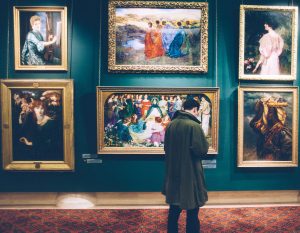
In her TedX talk, titled “Opening Up the Museum,” Nina Simon gives numerous examples of the way museums have invited visitors to be active participants (TEDx Talks, 2012). She also gives staggering statistics on how employing a participatory museum model in the Santa Cruz Museum of Art and History, more than doubled the number of visitors in one year (TEDx Talks, 2012, 8:02). If you are looking to work in museums, I highly recommend watching her TedX talk. I also think some of the ideas could be employed in libraries as well.
Nina Simon provides examples of how visitors can become active participants through the creation of art (TEDxTalks, 2012). However, the articles in the hyperlinked museums module also demonstrated how active participation is encouraged through the use of multiple senses. We are probably most familiar with using our sense of sight in a museum. We typically are only allowed to look at artifacts and artworks. The sense of touch may be another common sense employed in museums. In my experience, interactive exhibits involving touch are most common in science museums. How are museums incorporating the other three senses into their exhibits? I wanted to explore how sound, taste, and smell are being utilized in museums to create engaging exhibits.
Sound

This idea of sound in museums appeals to me because I love to listen to ambient playlists, like this one, while I study because it transports me to another world. Similarly, the Royal Museums Greenwich used the power of sound to transport visitors when they boarded the historical ship, the Cutty Sark (Charr, 2024). Visitors can experience “the sounds of the ship’s golden age, including weather conditions, the creaking of wooden decks, and the loading of tea chests” (Charr, 2024, para. 2). Sounds pretty cool to me (no pun intended).
Taste

Would you eat soil? I can’t say I would but if your answer is yes, then the Museum of Edible Earth has got you covered. Eating soil is “an ancient global practice” called geophagy and is defined as “the intentional custom of eating earth, which includes soil and earth-like substances such as clay and chalk” (The Museum of Edible Earth, n.d.-a, para. 3). Before I describe the museum in more depth, I’d like to pass along the museum’s disclaimer that “eating earth is not recommended by food authorities. Proceed at your own risk” (The Museum of Edible Earth, n.d.-a, para. 8).
The museum describes themselves as “participatory” (The Museum of Edible Earth, n.d.-a, para. 6 and 7) and that is evident by the fact that they allow you to taste the soils. However, they take this a step further by inviting visitors to contribute to the soil database by describing what they think the soil tasted like (The Museum of Edible Earth, n.d.-a). For example, if you navigate to the soil called “Green Clay Chunks,” in the catalogue, you will find a review section with people sharing their thoughts and some even sharing taste testing videos of themselves (The Museum of Edible Earth, n.d.-b).
Smell
I highly recommend the article Exhale Through the Gift Shop by Becky Ferreira. The article gives examples of museums utilizing scents in their exhibits (both pleasant and unpleasant ones) (Ferreira, 2024). The SS Great Britain Experience is one example given (Ferreira, 2024). The exhibit allows you to experience the “sights, smells and sounds of Victorian life at sea” (Bristol Dockyards, n.d., “Step Aboard the Ship” section). Some of these smells include urine and vomit (gross but accurate) (Ferreira, 2024).
I realized as I wrote this blog post that I only gave examples of unpleasant tasting experiences (soil) and unpleasant smelling experiences (vomit). Nonetheless, I hope I was able to illustrate how museums are engaging multiple senses to create a participatory museum environment.
References
Bristol Dockyards. (n.d.). SS Great Britain Experience. SS Great Britain Trust. https://www.bristoldockyards.org/ss-great-britain-experience
Charr, M. (2024, December 16). How Cutty Sark built a location-aware soundscape. MuseumNext. https://www.museumnext.com/article/immersive-soundscapes-on-the-cutty-sark-blending-technology-and-heritage/
Ferreira, B. (2024, November 3). Exhale through the gift shop. The New York Times. https://www.nytimes.com/2024/11/02/science/scent-exhibits-museum.html
The Museum of Edible Earth. (n.d.-a). About [The “About” page for the Museum of Edible Earth]. https://museumofedible.earth/about/
The Museum of Edible Earth. (n.d.-b). Green Clay Chunks [Soil in catalogue]. https://museumofedible.earth/product/french-green-clay/
TEDx Talks. (2012, November 7). Opening up the museum: Nina Simon @ TEDxSantaCruz [Video]. YouTube. https://www.youtube.com/watch?v=aIcwIH1vZ9w