
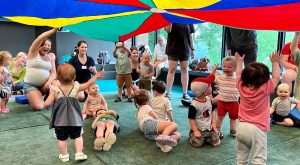
It’s not uncommon to hear the word “play” brought up within the context of childhood education, library story times, or other youth library activities. That conversation has continued to develop in both public and school libraries as the positive repercussions of play on childhood literacy, parental engagement, and curiosity-fueled learning have been discovered (Celano et al., 2018). But what about in association with adults? How often have you heard the concept of play arise during discussions about adult library services?
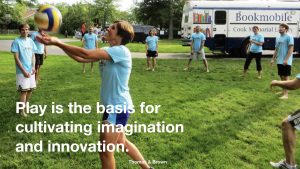
This seed of thought took root in my mind after seeing the slide in the historical hyperlinked library lecture that features a quote from Thomas and Brown’s A New Culture of Learning: “Play is the basis for cultivating imagination and innovation” (Thomas & Brown, 2011). Pictured behind the quote on this slide is a group of adults passing a volleyball. Adults, not children. Michael Stephens (@michael) urges in his narration of this slide that play is vital for libraries.
The initial images that come to my mind when envisioning play are games, movement, and creativity. However, Thomas and Brown assert a broader definition of playing: acting with freedom outside the boundaries of everyday life under a particular set of rules (Thomas & Brown, 2011). This freedom to experiment inevitably encourages creativity and innovation. Whether through learning a new skill, participating in a game, tinkering with new technology, or engaging in a creative endeavor, adults need to play just as much as children do.
Public libraries all over the world are enabling a wide variety of opportunities for adults to play everyday. One endearing example is Library Lanes, the Xbox bowling league for older adults hosted by the Brooklyn Public Library that meets weekly at the Macon Branch (Jaffe, 2017). Beyond giving these older adult patrons hands-on experience with a popular modern gaming console, this activity also facilitates community connections and provides an accessible form of exercise. The league offers these seniors an escape from their everyday lives and a safe space to engage in an imaginative activity with their peers. Some of the teams have even designed their own bowling uniforms!

Not just in our personal lives do we reap the benefits of play. Let’s go one step further and discuss the value of play within our professional lives as library workers. In The Power of Play, authors Lisa Kurt, William Kurt, and Ann Medaille argue that play should be considered a critical component within every library workplace. They describe play within this context as a “valuable outlet for experimentation to occur without fear of judgment or emphasis on outcomes or success” (Kurt et al., 2010, p. 13). All too often, fear of negative metrics or external doubt will keep us from exploring alternative avenues or piloting new programs. When we are not only allowed, but encouraged to play freely with ideas, this is where true innovation happens. Not every new pathway can be a success, but this should never stop us from trying something out. Libraries that “take an attitude of open-mindedness that encourages these flights of fancy, nurtures employees by allowing them time and space to experiment, and champions bold ideas” may be surprised by the positive waves that will ripple outwards from this change (Kurt et al., 2010, p. 20). In his essay “Are You Dreaming?,” Michael Stephens (@michael) gives a name to library employees who open themselves up entirely to new ideas: dreamers. May each and every one of us be given the chance to play, to innovate, to dream.

References
Celano, D.C., Knapczyk, J.J., & Neuman, S.B. (2018, July). Public libraries harness the power of play. Young Children, 73(3). https://www.naeyc.org/resources/pubs/yc/jul2018/public-libraries-harness-play
Israëls, J. (1860). Droomen (Dreams) [Painting]. https://en.wikipedia.org/wiki/Dreams_%28painting%29
Jaffe, I. (2017, July 4). Xbox bowling for seniors? Visit your local library. NPR. https://www.npr.org/2017/07/04/534431175/xbox-bowling-for-seniors-visit-your-local-library
Kurt, L., Kurt, W., & Medaille, A. (2010). The power of play: Fostering creativity and innovation in libraries. Journal of Library Innovation, 1(1).
L.E. Phillips Memorial Library. (n.d.). Storytime at the library [Photograph]. https://www.ecpubliclibrary.info/kids/storytime/
Stephens, M. (2010, March 2). The hyperlinked school library: engage, explore, celebrate. Tame the Web. https://tametheweb.com/2010/03/02/the-hyperlinked-school-library-engage-explore-celebrate/
Stephens, M. (2019). The hyperlinked library: Slide 23 [Photograph]. https://sjsu-ischool.hosted.panopto.com/Panopto/Pages/Viewer.aspx?id=a0569381-4d66-4e0a-a7fa-aab3010a8f3e
Stephens, M. (2019). Whole-hearted librarianship: Finding hope, inspiration, and balance. American Library Association.
Thomas, D., & Brown, J.S. (2011). A new culture of learning: Cultivating the imagination for a world of constant change. CreateSpace.