In the New Models module, we heard a lot about the Anythink Libraries of Rangeview Library district in Colorado. We saw through their Nature Library, their Treehouse Model, and even their decision to rely on urban goats to mow their grass that they do not shy away from thinking outside of the box. Their inclination to experiment in pursuit of better serving their community’s needs is what has continued to set them apart (TEDx Talks, 2013). In this blog post, I want to highlight another bold initiative from Anythink that centers their users above all else: WordThink.
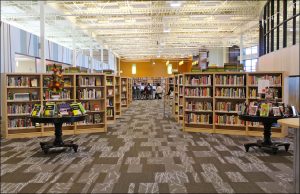
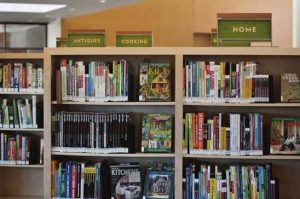
A lot of us are stuck in Dewey Decimal Land. To us library workers, this is a system that we’re used to and that we know how to make sense of. The effort it would take to upend this system and reclassify our materials under a different one can seem insurmountable to some. For just a moment, though, consider some past interactions you’ve had with your library users regarding the Dewey Decimal Classification System (DDC). How many times have you seen their eyes glaze over as you explain how it works and how to navigate it in the future? Personally, this is an unfortunately common scenario in the library where I work. DDC is not the only option, and it is possible to switch to other means of classification. One alternative method that has arisen in recent years is BISAC or genre-based classification systems that more closely resemble what you see inside of a bookstore. Before Anythink libraries even rebranded as Anythink, they developed their own genre-based classification system called WordThink and implemented it in all seven branches of the Rangeview Library District.
In WordThink, word labels on book spines display a broad category, such as “science” or “art,” as well as a narrower term for further division. Within these narrower sections, the titles are shelved alphabetically by title (Fister, 2009). For the Rangeview Library District, the decision to leave DDC in the past stemmed from years of feedback from focus groups and patrons complaining about how confusing it was to find a book. Patrons stated that they found the original organization (DDC) unclear and consistently struggled to find materials without assistance. Since WordThink went live, the libraries have received an abundance of positive feedback from their users, describing how simple it is to understand the new library organization system (Whaley, 2009). Across their library system, they saw their circulation and visitor counts quadruple. Due to the success of their classification system, they chose to draw more inspiration from bookstores and other retail models, recentering their library focus entirely on customer service and working towards creating an experience culture (Sandlian Smith, 2011).
If, as library architect Caitlin VerKuilen (2023) writes, the main objective behind library design is “understanding and providing for the needs of the communities the library serves,” shouldn’t creating a classification system that our users can navigate independently also be a top priority? We have to step outside of our library staff boxes and truly put ourselves in the shoes of our patrons if we want to construct spaces that suit them. Brian Mathews (2015) reflects that “when we appreciate and participate in our communities outside of a pre-defined role, that’s when we become partners, advisors, and consultants.” Maybe it’s time for the rest of us to take a page out of Anythink Libraries’ book and step away from Dewey Decimal too.
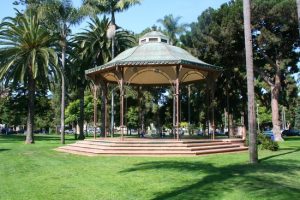
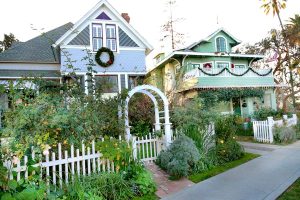
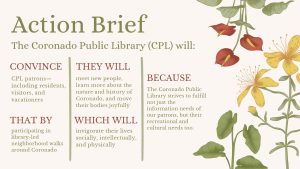
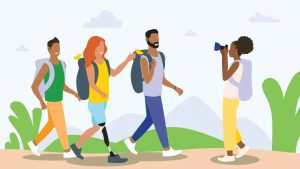
IMAGINE THIS: A group of library patrons and community members gather out front of the library once a month and set out together on a walk through the meandering streets of Coronado with a guide that points out local flora and fauna, gives informational tidbits about the town, and facilitates connections.
Guided walks are not a novel concept, but they are certainly not yet the typical fare for public library programming. I believe that they should be! Walking has been shown to boost immunity, reduce the risk of developing diseases, and promote healthy bodies and minds (Harvard Health Publishing, 2023). Movement for the sake of movement matters. Beyond this, walking offers us the opportunity to get outside in the world and to engage with our surroundings and the people in our communities.
At the Coronado Public Library, we see a lot of elderly patrons, vacationers, and families. Walking is an activity that all of these community sectors could benefit from. Elder patrons looking for low-impact exercise and accessible entertainment would find both through this program. Vacationers are always finding their way to the library building anyways; why not show them around and offer them an even more immersive introduction to the city? Lastly, families are constantly in search of new, free entertainment opportunities for the whole family to take part in, and these neighborhood walks would fit the bill perfectly.
MISSION & INSTITUTIONAL CONTEXT:
The Coronado Public Library’s mission statement declares that it aims to “meet the informational, recreational, and cultural needs of the community and to actively promote reading, life-long learning, and the pursuit of knowledge” (Coronado Public Library, 2026). The library serves a mid-size coastal community within a reasonably walkable town. Many of the regular patrons we see walk to the library already.
We have been seeing consistently good turnout at events that involve community gatherings—concerts, book clubs, instructional cooking classes, crafting sessions. We are witnessing a time in which our patrons are actively seeking events that get them out of the house, meeting new people, and stimulating their minds. Coordinated neighborhood walks would accomplish all of these goals and more. Any programming that elicits joy can enhance the library’s capacity to serve as a space of reprieve and escape from the challenges of everyday life (DuVernay, 2024).
By forming partnerships with complementary local groups to enrich these walks, we can further accommodate these patrons’ recreational and cultural needs. We can draw on our existing connection with the Bridge and Bay Garden Club in Coronado to coordinate some walks to be led by a representative from the club with extensive knowledge of local plant varieties.
INSPIRATIONAL EXAMPLES:
The San Francisco Public Library hosts neighborhood walks that introduce participants to unique architectural features (San Francisco Public Library, 2026).
The ALA Programming Librarian site recommends 9 thoughtful ways for libraries to incorporate walking into their programming and services (Lenstra, 2020).
The Los Angeles Public Library holds a monthly neighborhood nature walk (Los Angeles Public Library, 2025).
In the summer of 2019, the Tacoma Library in Washington hosted regular informational walks across the city (Tacoma Library, 2019).
The Deming Library in Washington hosted a weekly walking group in 2022 to encourage people to meet their neighbors and form a new healthy habit (Whatcom County Library System, n.d.).
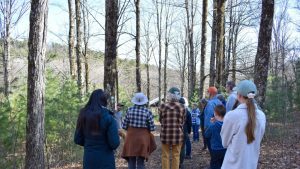
The Chatham Public Library in New York teamed up with Columbia Land Conservancy to hold a monthly walking club (Columbia Land Conservancy, n.d.).
Chatham Public Library x Columbia Land Conservancy Walking Club. Image source: Columbia Land Conservancy
GUIDELINES & POLICIES:
Individuals of all fitness levels are encouraged to attend.
Registration is not required since space is not limited. Registration only helps staff to anticipate turnout.
Walks will follow wheelchair-accessible routes in order to make the gatherings open to differently-abled participants. If anyone wishing to participate requires specific accommodations not mentioned in the event listing, they will be invited to reach out prior to the event so that we can make adjustments to accommodate their needs.
Participants should wear breathable, comfortable clothing and shoes. They are also encouraged to bring a personal water bottle.
IMPLEMENTATION TIMELINE: 8 WEEKS
Weeks 1–2: Obtain approval from Library Director for the program. Plan out potential dates and walking routes.
Weeks 3–4: Once approved, communicate with Bridge and Bay Garden Club to coordinate a mutually beneficial partnership. Develop marketing materials (virtual and physical flyers, public-facing program information).
Weeks 5–6: Distribute flyers throughout the library and to neighboring community organizations (Spreckels Center, Coronado Community Center, etc.). Send digital flyer and event information to local schools, senior centers, and businesses.
Week 7: First neighborhood walk! Remain open to participant feedback and suggestions for future iterations.
Week 8: Conduct evaluation of the first walk—what went well and what could be improved? The first walk is only the beginning of the program, essentially a beta test of what’s to come. As discussed in Taming Technolust: Ten Steps for Planning in a 2.0 World, beta versions of new programs or services should be our friends (Stephens, 2012). In embracing the bugs and flaws that come with any first showing of something, we open ourselves up to feedback that can shape the service into what it should look like for this library’s specific community.
MARKETING & PROMOTION:
Digital and physical flyers will be created to promote the monthly neighborhood walks. The digital flyers will be sent out to local schools, businesses, and senior centers in order to spread the word to interested parties. The physical flyers will be displayed at the circulation desk, reference desk, children’s desk, and in the teen section of the library. The digital flyer and additional information will be posted across the library’s existing social media channels on Instagram and Facebook. We should also aim to create a few humorous, reel-style videos promoting the walks to be posted on these platforms to increase engagement. We want to send the message that these monthly neighborhood walks will serve as a positive force in the lives of those who participate, allowing them a closer connection with their community, natural surroundings, and personal wellbeing.
STAFF TRAINING & READINESS:
All staff will be brought up to speed with the objectives of the program, and interest will be gauged for participation. We have a number of exercise and nature enthusiasts on staff who would likely love the opportunity to be involved in this project and already possess an impressive amount of knowledge regarding local flora and fauna and routes around the town. Since not every walk will necessarily be hosted by an external guide, some might feature staff leaders who would like the chance to host. For staff not directly involved in the program, we should work to ensure that they are at least familiar enough with its details to convey helpful information when prompted. A thorough email detailing all relevant information about the program will be sent out to all staff.
In addition to the anecdotal feedback gathered throughout the first walk, a post-walk virtual survey will be distributed to any participants who registered online for the event. This survey will help us understand what worked for the participants, what didn’t, and what types of things they might like to see in future walks. In this way, we can work on developing a shared meaning of what success looks like for this program with the users. This format of community-led planning will shift the power back into the hands of the community, allowing them to directly shape the future of this program (Lenstra & Barbakoff, 2024). Any staff that were involved in the first walk will also be solicited for their honest feedback. In requesting these personal opinions and stories from both staff and users, we can measure the progress of the program over time by comparing these responses (Casey & Stephens, 2008).
If the initial walks are received well by the community, we could look to expand partnerships in the future to further diversify the walks. We could potentially reach out to San Diego Audubon Society, Sierra Club San Diego, San Diego Natural History Museum, and the Coronado Historical Association.
Here’s what I personally would love to see transpire within these walks: intergenerational conversation, budding connections, and above all, joy—joyous movement, joyous kinship, and joyous programming.
When I clicked onto the article titled This Library Was Just Named the Best in the World in the Hyperlinked Environments module, I was not expecting to see a library I visited just two months ago. That being said, I am not at all surprised that it was selected by the International Federation of Library Associations and Institutions (IFLA) as the best public library in the world in 2021. Stepping into Deichman Bjørvika in Oslo, Norway was like stepping through a portal to another world. I wish I could say that I had known before visiting Oslo that it laid claim to an internationally acclaimed library. The reality is that I bumbled into Deichman Bjørvika through a serendipitous series of events, and for that, I feel lucky beyond measure.
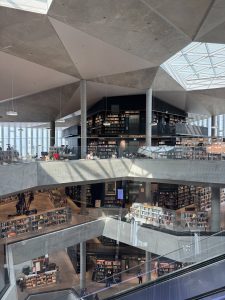
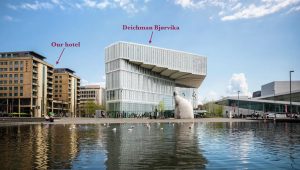
View from the escalator [Photo mine]As my partner and I were waiting in line to check in to our hotel next to the train station in Oslo, I found myself staring out the window at the building across the street. It was a massive, irregularly shaped six-story structure surrounded by floor-to-ceiling windows on all sides, and through those windows, I saw bookshelves. I opened up Google Maps to zoom in on the building; lo and behold, we had inadvertently chosen the hotel directly across the street from Oslo’s public library.
Original image source: Visit Norway. Edits added by me.
In her article covering Deichman Bjørvika following the announcement of its top-of-the-world status in 2021, Morgane Croissant praised the astonishing diversity of needs that this library accommodates through its wide assortment of community spaces (Croissant, 2021). Having walked through all six floors of the library, I can attest to the impressive flexibility of this building. The first floor alone is home to a cafe, restaurant, and library shop. The basement boasts an in-house cinema and auditorium.
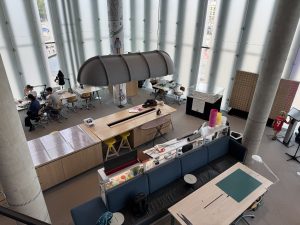
Book-shaped erasers in the Library Shop [Photo mine]The second floor houses event spaces as well as a bustling, imaginative children’s section. The highlight of the third floor is the workshop, a robust makerspace dedicated to providing the tools and resources for artists, makers, and hobbyists alike.
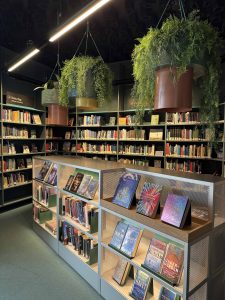
The 3rd-floor workshop [Photo mine]The 4th and 5th floors contain the most impressive assortment of study rooms, work stations, comfortable seating areas, and reservable zones I have personally ever seen in a library. I found a room designated for phone calls, several lecture rooms, and around half a dozen collaboration rooms—just to give you an idea of the dizzying variety of spaces available in this building. Every corner I turned, I was enchanted by something new and unexpected. A peek through one of the glass walls in the back revealed an almighty automatic book sorting machine. As you browse the print collections, some of the subject areas are even themed to coordinate with their corresponding topics; for instance, hanging plants adorn the natural sciences alcove.
Natural sciences alcove at Deichman Bjørvika [Photo mine]In his article Moving Beyond the “Third Place,” Phil Morehart delves into the vision and ideas that fed the creation of the Dokk1 Library in Aarhus. One of the goals that was discussed was for that library to serve as a sort of living room for the community that was “less focused on books and more focused on human needs, providing space for performances, meetings, children’s activities, art installations, and general public gatherings” (Morehart, 2016). A community living room is the perfect way to describe what Deichman Bjørvika felt like. These Scandinavian libraries are truly setting a stunning example of how to show up for our cities in all the ways that matter. In them, we see what it looks like when a library is valued by its patrons, when a library is truly viewed as a haven (Lauersen, 2021).
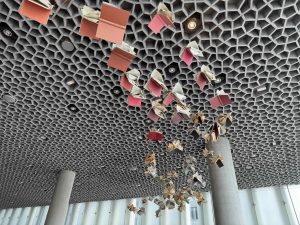
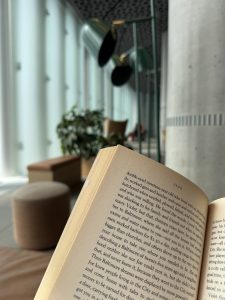
Flying books in Deichman Bjørvika [Photo mine]Before catching our train from Oslo to Bergen, we had around three hours of extra time. We’d already seen all the sights that we set out to see in the city. We were drawn into Deichman Bjørvika like moths to a flame. In those walls, I felt peaceful. I was able to simply exist in this place for the space of a few hours, reading, surrounded by people browsing, working, studying, exploring, crafting, innovating, reflecting, meeting one another, taking full advantage of their brilliant library.
While navigating the Hyperlinked Communities module resources, one of the themes that remained top-of-mind for me was that of libraries investing in their patrons’ mental health through programming focused on overall wellbeing, whether through meditation, mindfulness practices, or other techniques. In the Hyperlinked Communities lecture video, @michael recounted his personal experience attending a library meditation program that instructed participants to find their own mantra to meditate on within the library materials (Stephens, 2025). Serving our communities means paying attention to all of their needs: not just identifying their intellectual interests or helping them find information, but also striving to be a space of calm, peace, and respite in the context of their busy lives.
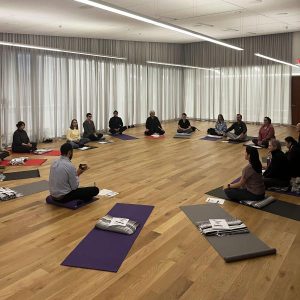
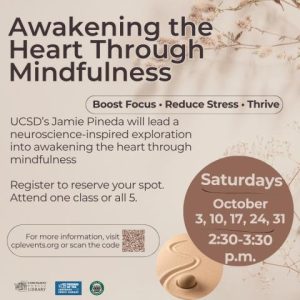
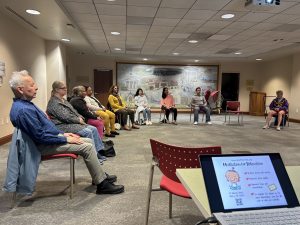
Around the same time that I was making my way through this module, I began hearing questions from patrons at the library where I work about a workshop series we’re hosting called Awakening the Heart Through Mindfulness. After the first phone call I answered concerning the event, I reviewed the program information and found it to be completely lovely: a series of five classes led by neuroscientist and mindfulness guru Jaime Pineda of UCSD intended to serve as an introduction to implementing mindfulness rituals into our everyday lives (Coronado Public Library, 2026). That call came a few weeks prior to the first class, and at that time, that patron was one of the first to register for the event. As the weeks went by, I continued to field questions about the series. The day before the first class, I answered another call in which someone wanted to register for the program and found that the registration list was not only full, but had already amassed a sizable waitlist! I was pleasantly surprised to see how eager the community was to participate in events like this one. Clearly, the demand for wellness programming is alive and well (haha).
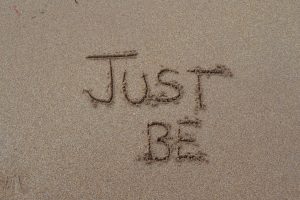
All too often, mental healthcare can seem just out of reach. Professional therapy or counseling is not readily available or financially accessible to many people. Yet, the constant stressors of life do reach us all. As Angela Savage, CEO of Public Libraries Victoria, points out, libraries are uniquely equipped to assist in bridging this gap in wellness services with the resources that they already possess (Hasan, 2022). Beyond having the connections, means, and motivation to aid in this endeavor, libraries already inhabit the role of an open, welcoming place for so many. According to surveys conducted by Public Libraries Victoria and State Library Victoria, an overwhelming majority of people view public libraries as safe spaces that make them feel better (Hasan, 2022). This sentiment is echoed in Ciara Eastell’s TED Talk, where she describes the library as a place where “you cease to be a consumer; you’re here as a citizen, free to be yourself and to pursue your personal interests, safe in the knowledge that no one is going to ask you to pay. You can just be” (TEDx Talks, 2019).
As the participants of the first session of the mindfulness workshop were funneling out of the library last Saturday with contented looks on their faces, I was sitting at the nearby reference desk and wondering about the strategies they might have learned. My coworker Rebekah (who does not work on Saturdays) walked past at this moment. We got to talking, and I learned that she had come in on her day off just to attend the workshop—a program needed by patrons and staff alike! I can’t think of a better place to learn to just be—one of the core tenets of mindfulness—than at the library.