Everyone has a story, a talent, a special skill, a passion that brings them joy, satisfaction, or a sense of achievement. Our communities are filled with subject matter experts in a variety of endeavors. One of the interesting parts of working with the public is getting to know our patrons and, in time, becoming privy to their creative knowledge and pursuits. According to a Danish study on the impact of public libraries on individuals and the community, libraries are a source of inspiration that motivate people to create, explore, or learn a new skill. Further, through both visiting and using the library as well as attending programs and events, public libraries foster, encourage, and deepen bonds within a community (Lauersen, 2021a; Seismonaut and Roskilde Central Library, 2021).
In the spirit of connecting with our communities and encouraging community-led initiatives, what better way to strengthen those ties by letting creative pursuits shine?
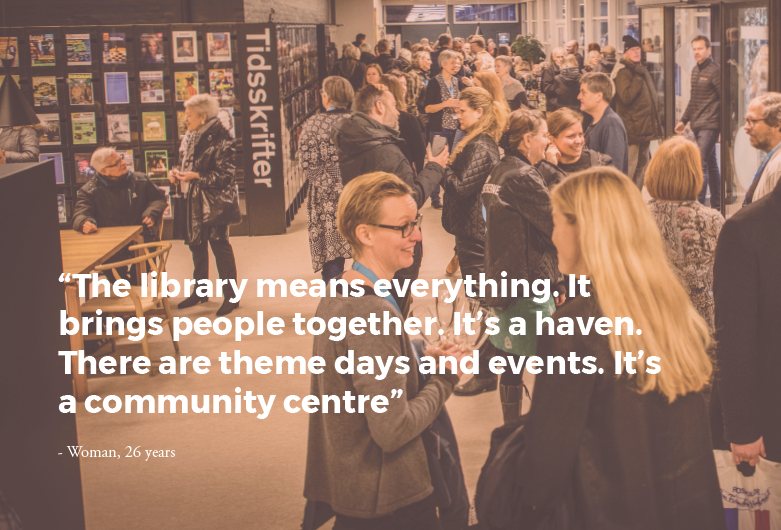
Image attribution: Lauersen, 2021
Community-led programming
The community-led programming model puts the power (and empowerment) in the hands of the community to propose, develop, and organize a program. While library staff is still involved for guidance and support, the responsibility is ultimately in the hands of the individual or organization running the event. This approach follows a similar model to library-led programming design, development, and evaluation: 1) perform community assessment e.g. ABCD; 2) determine community’s needs; 3) design and organize service, event, or program; 4) execute the service, event, or program; 5) evaluate results and feedback. One notable difference is in how the evaluation stage unfolds. For example, libraries typically rely on attendance counts or circulation data to determine effectiveness. With community-led programming, effectiveness may be determined by examining how the program met identified community needs, or there may be other measures of success that are relevant to the community (Lenstra & Barbakoff, 2024).
Useful evaluation questions may include the following:
- How did patrons respond to the service, event, or program?
- Did it fulfill a need or address a gap in the community?
- Does the community want more of this service, event, or program?
- What similar programming can be brought in and shared with the community?
- Are there other individuals or organizations within the community that could help grow the service, event, or program?
The chart below provides a good overview and better understanding of the engagement process with the community for community-led programming. My favorite step is EMPOWER and specifically the impact behind it, both on the individual or organization running the program and the community using the knowledge, skills, or information received from the program. What a fantastic way to build trust between the community and the library as well as among the community as a whole!
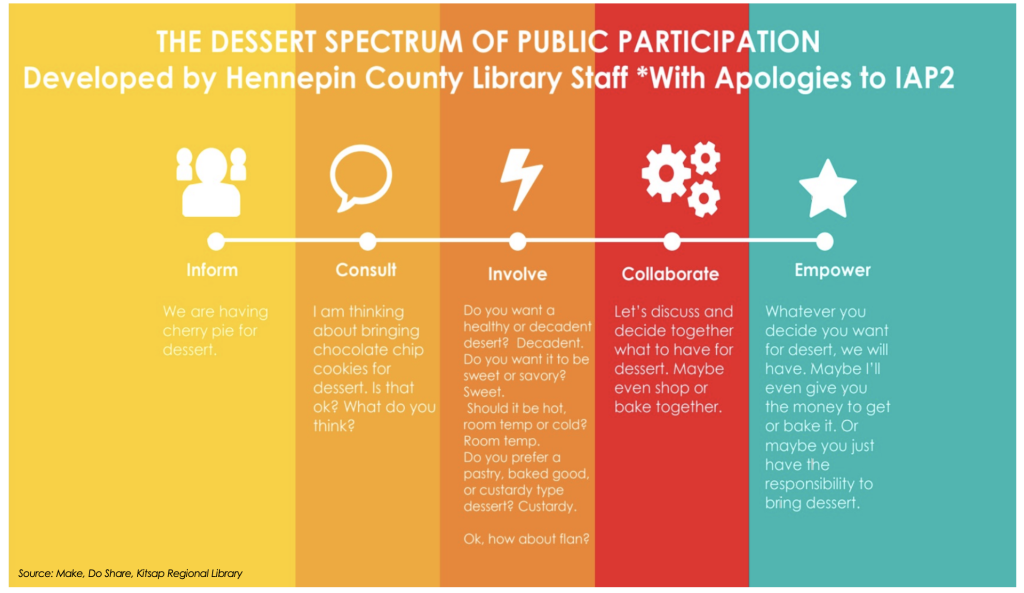
Image attribution: Barbakoff (2023)
An identified need…almost met
In my neck of the woods, handicrafts seem to be very popular: knitting, crochet, and quilt-making specifically. Of course, this is anecdotal data as we have not formally assessed this need or interest. However, demographically, our population tends to skew older: there is a high population of senior citizens, for example. We recently had a member of the community start a “learn to crochet and knit” group at our library, which quickly gained interest. Sadly, the organizer did not continue running it despite high interest (many patrons inquired about the program during its short time running and after it fell off). This was an example discovering there was actually a need and interest in the community, but the organizer could not sustain it on her own. Further, it did not run long enough to forge a connection with attendees, of which there could have been a stronger collaboration for organization and facilitating the group. I share this as an example of a creative venture that sparked community interest and excitement—identifying a need! Despite the group not continuing, I still see this as a success in observing how the community responded to the program and its goal. There is still potential if we engage our community regarding this need.
Libraries engaging their communities’ creatives
Let’s dive deeper into some libraries that are directly engaging their communities not only to empower individuals to share their passions and knowledge, but to examine and inform future programming by determining the community’s actual needs and interests.
Library Takeovers at Madison Public Library (Madison, WI)
Since 2018, the Madison Public Library (MPL) has opened their programming doors to the community via their “Library Takeover” initiative. Individuals or organizations may apply to hold a program at the library; those accepted receive an event budget to organize and run the event. Recent programs that were accepted feature an array of topics: “Mindful Day the Indian Way”, “Full Circle Food Usage”, “Latino Women and Trauma”, and “Pop-Up Portrait Studio” (Madison Public Library, n.d.; Urban Libraries Council, 2018).
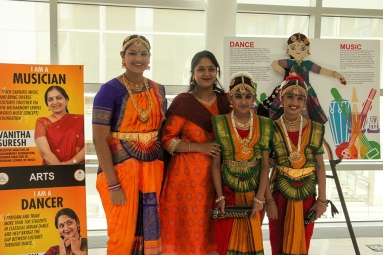
Image attribution: Urban Libraries Council, 2018
Teen-driven programs at Waltham Public Library (Waltham, MA)
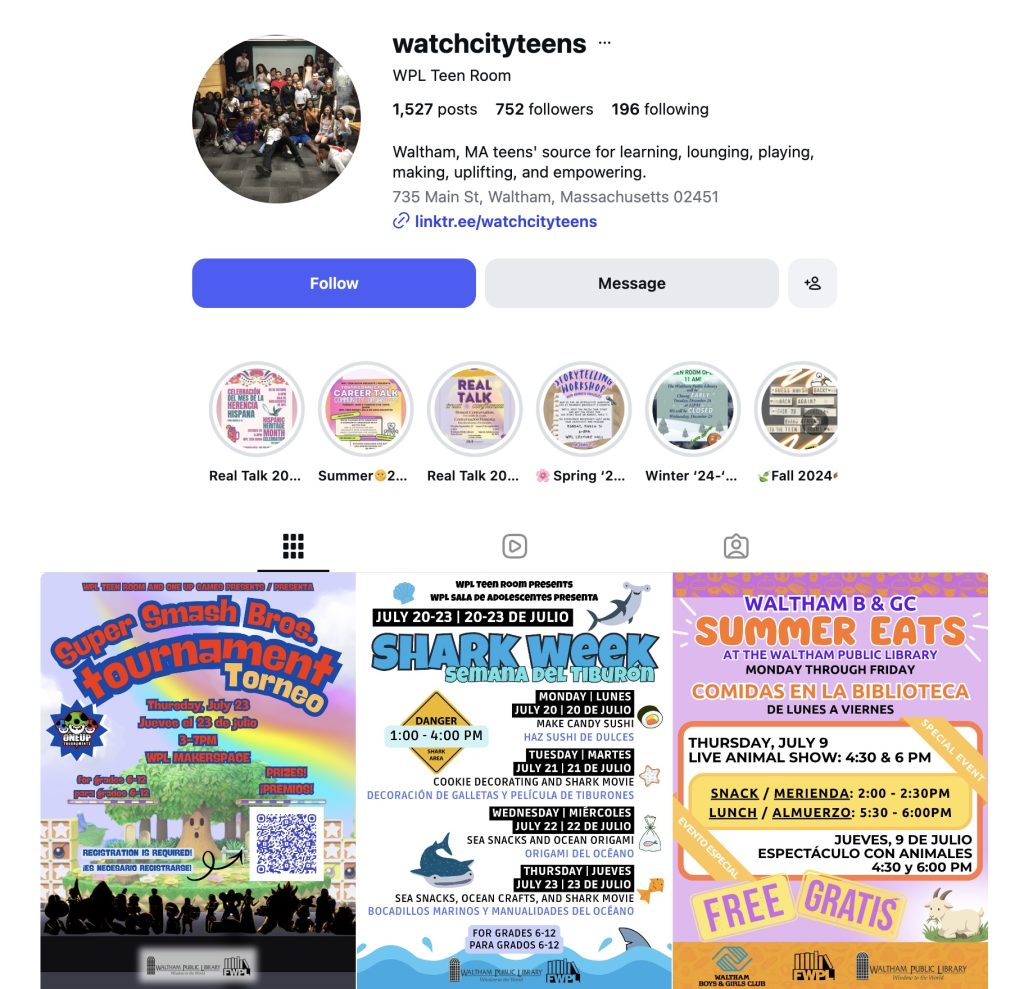
The Waltham Public Library was highlighted in American Libraries back in 2020 for its “teen-driven” services. Their focus was to allow teens to be directly involved in the decision-making of programming and making their ideas a reality. What further sets them apart (“teen-driven” vs. “teen-centered”) is the empowerment granted on the library’s teen community to take risks (make and learn from mistakes), grow meaningful relationships with library staff (the teens’ source of support and guidance), and having the teens determine what success is (vs. traditional library statistics) (Braun, 2020). Their approach definitely has the hallmarks of community-led planning. They even run their own Instagram to connect with other young adults and communicate programs and events.
Creative Aging (Fisher Center for Alzheimers Research Foundation)
This organization has rolled out a program to now over 18 public libraries in New York, Boston, Dallas, and Miami to support lifelong learning, creativity, and social connection for individuals over 55 years old. These programs bring in experts in a variety of artistic disciplines to provide a wealth of options for older adults to continue learning, staying engaged with their interests, or otherwise learning new skills. The overwhelmingly positive response from the community has propelled the program’s expansion, demonstrating that an identified need has been successfully met and embraced by the community. Further, the program utilizes creatives from within and around these communities to share their skills and knowledge (Fisher Center for Alzheimers Research Foundation, n.d.).
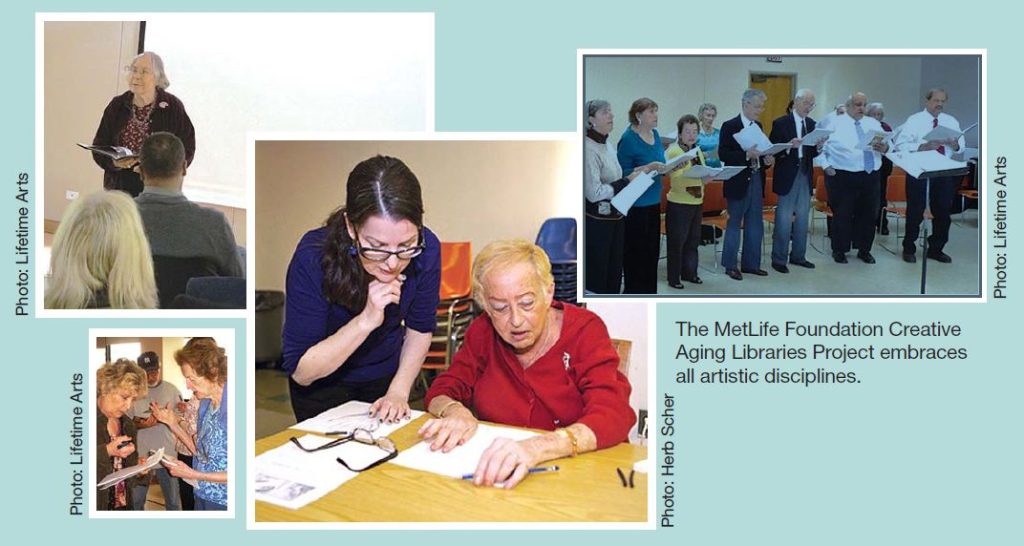
Image attribution: Fisher Center for Alzheimers Research Foundation, n.d.
Local artist exhibitions at San Diego Public Library (San Diego, CA)
This ongoing program at the San Diego Public Library promotes the work of local artists in order to broaden and deepen connections to the city’s rich artistic and cultural community. These exhibitions give San Diego artists a chance to not only showcase but talk about their work during designated panels. I love that community members not only can view these works, but also interact with their creators (City of San Diego, n.d.)! Here are some current and upcoming examples of local art exhibitions at the SDPL:
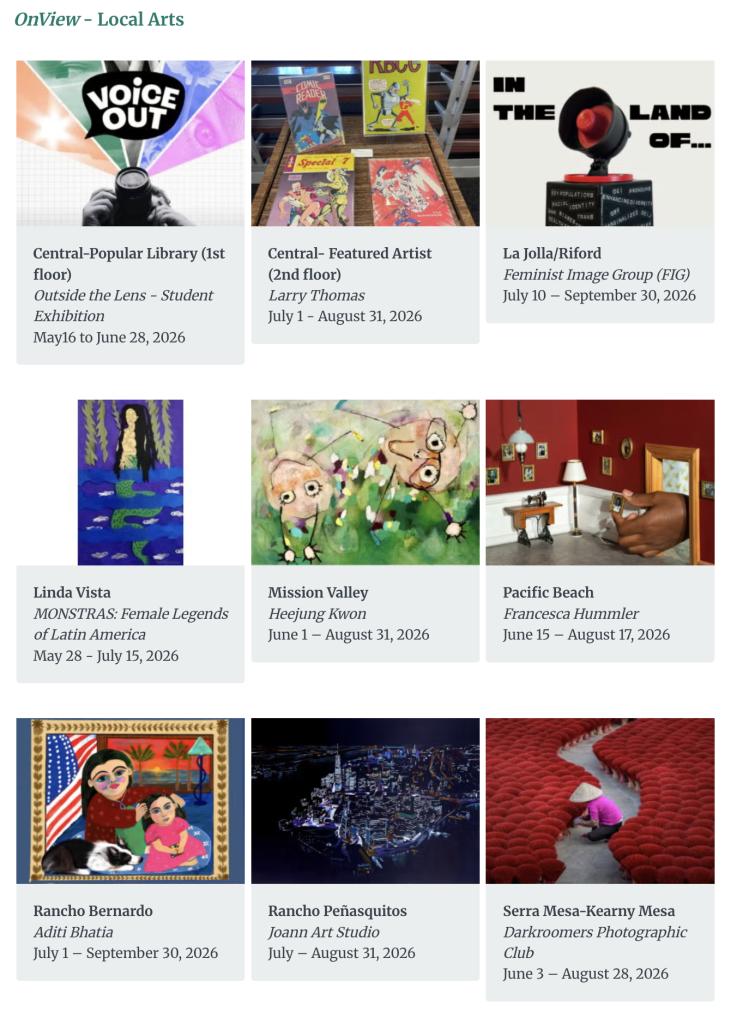
Image attribution: City of San Diego, n.d.
References
Barbakoff, A. (2023, February). The dessert spectrum of public participation [Image]. Co/Lab Capacity for Connecticut State Library. https://libguides.ctstatelibrary.org/ld.php?content_id=70615597
Braun, L. (2020, March 1). Give teens the lead: How to move from teen-centered to teen-driven services. American Libraries. https://americanlibrariesmagazine.org/2020/05/01/give-teens-the-lead-teen-driven-services/
City of San Diego. (n.d.). Public library: Art and culture exhibitions. https://www.sandiego.gov/public-library/visualarts
Fisher Center for Alzheimers Research Foundation. (n.d.) Creative aging library project expands. https://www.alzinfo.org/pym/long-term-planning/creative-aging-libraries-project-expands/
Lauersen, C. (2021a, April 19). A haven in our community: The impact and value of public libraries. The Library Lab. https://christianlauersen.net/2021/04/19/a-haven-in-our-community-the-impact-and-value-of-public-libraries/
Lauersen, C. (2021b, April 19). Photo and quote [Image]. The Library Lab. https://christianlauersen.net/2021/04/19/a-haven-in-our-community-the-impact-and-value-of-public-libraries/
Lenstra, N., & Barbakoff, A. (2024, March 1). Working hand in hand: How to conduct community-led planning. American Libraries. https://americanlibrariesmagazine.org/2024/03/01/working-hand-in-hand/
Madison Public Library. (n.d.). Library takeover. https://www.madisonpubliclibrary.org/engagement/library-takeover
Seismonaut and Roskilde Central Library. (2021). The impact of public libraries in Denmark: A haven in our community [Report]. https://www.roskildebib.dk/sites/default/files/2024-10/roskildebib_folkebibliotekets_betydning_for_borgerne_i_danmark_eng_final_0.pdf
Skjørten, E. (2020). Creativity – an activity or a mindset? [Image]. Global EdTech. https://global-edtech.com/creativity-an-activity-or-a-mindset/
Urban Libraries Council. (2018). Library takeover: Community led programming. https://www.urbanlibraries.org/innovations/library-takeover-community-led-programming
Featured image attribution: Skjørten, 2020
Liz – I really enjoyed this clearinghouse of your thoughts and reflections as well as all of the amazing examples of community-led programming. I have followed Lenstra’s work for some time. I especially appreciate the article devoted to encouraging teens to create programming, etc that makes so much sense to me.