My inspiration report focuses on a blend of power of stories and infinite learning through a participatory program that encourages and promotes the arts and creative expression of adolescents. In addition to learning and honing an artistic skill or talent, engaging in the arts has a psychological benefit, as well. Further, teens are empowered to have their voices heard by sharing their creative endeavors with their peers and the community at large.
The Teen Space Transformation project seeks to refresh and revitalize an under-utilized teen space in a small town library. Through direct collaboration with tweens and teens, the goal is to create a welcoming “Third Place” for our community’s young adults that meets their unique developmental, educational, and technological needs.
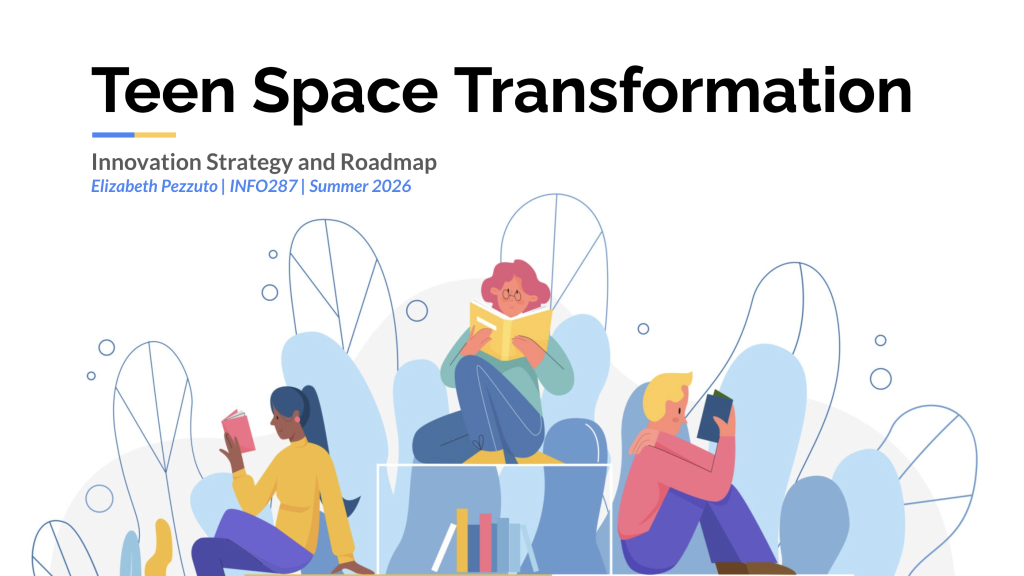
Please click on the image below to access the PDF version of my Innovation Roadmap presentation “TEEN SPACE TRANSFORMATION”.
As I embarked on this semester’s course materials, one of the themes that stood out was the idea of “third place” as well as the broader implications of libraries as places made for people…not books. I wanted to explore the idea of third place to better understand its benefit—ultimately, its necessity—to society as a whole, particularly in light of today’s over-reliance of (and dare I say, addiction to) technology and how that has impacted general human social connection.
In my small town library, which is adjacent to the middle school, I see our humble teen area go mostly unused and underdeveloped. Worse, adults infiltrate the space before school ends which further deters students from using it when they arrive. Though it is a small space, it is still a designated area that could have so much more life to it—something that feels more welcoming and cozy for students who hang out in the library after school. Being “only” a circulation aide at this point, there seems to be little meaningful effect I can make at this time. Thus, this topic not only resonates with me, but remains top of mind in my work as well. It is so critical for that age group to have a safe place where they can hang out, connect with each other, and—hopefully—build a connection with the library as well.
What is the third place?
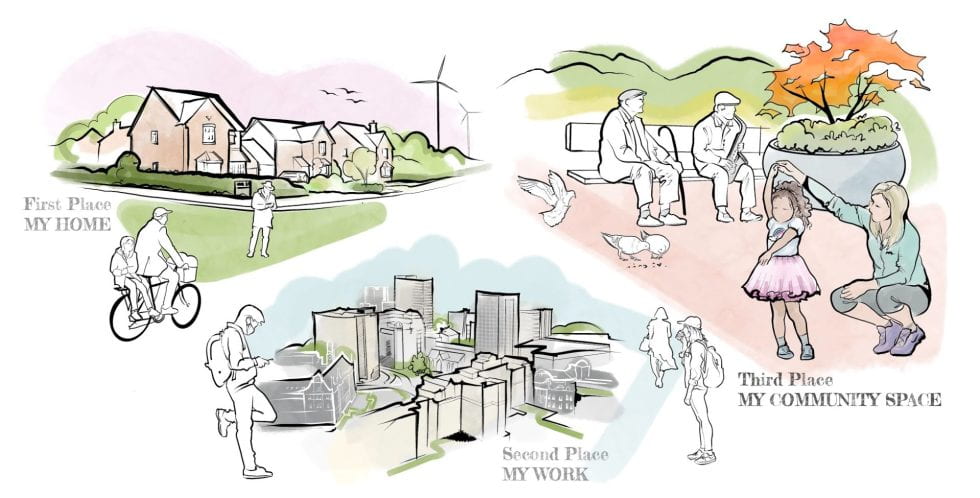
Sociologist Ray Oldenburg coined the phrase “third place”—a freely accessible space where individuals gather to connect socially and foster a sense of community (Leferink, 2018; Roberts-Ganim, 2023). This third place is distinctly different from the home (“first place”) and work or school (“second place”) (Project for Public Spaces, n.d.; Roberts-Ganim, 2023). The primary characteristics of third places are: 1) they are neutral spaces that foster social equity; 2) the main activity is conversation; 3) they are welcoming to strangers but regulars also have deep attachments; and 4) they provide warm spaces rife with a sense of a belonging (Project for Public Spaces, n.d.). Libraries, bars, restaurants, parks, barber shops, and cafes are just a few examples of third places where people can gather and built community (Oldenburg & Christensen, 2025; Roberts-Ganim, 2023).
"When the COVID-19 lockdowns started, a Boston reporter asked if we thought third places would ever come back. We answered with a resounding “Yes!”: we knew that Zoom meetings and happy hours would never replace face-to-face interaction."— Oldenburg & Christensen (2025)
Social connection and the loneliness epidemic
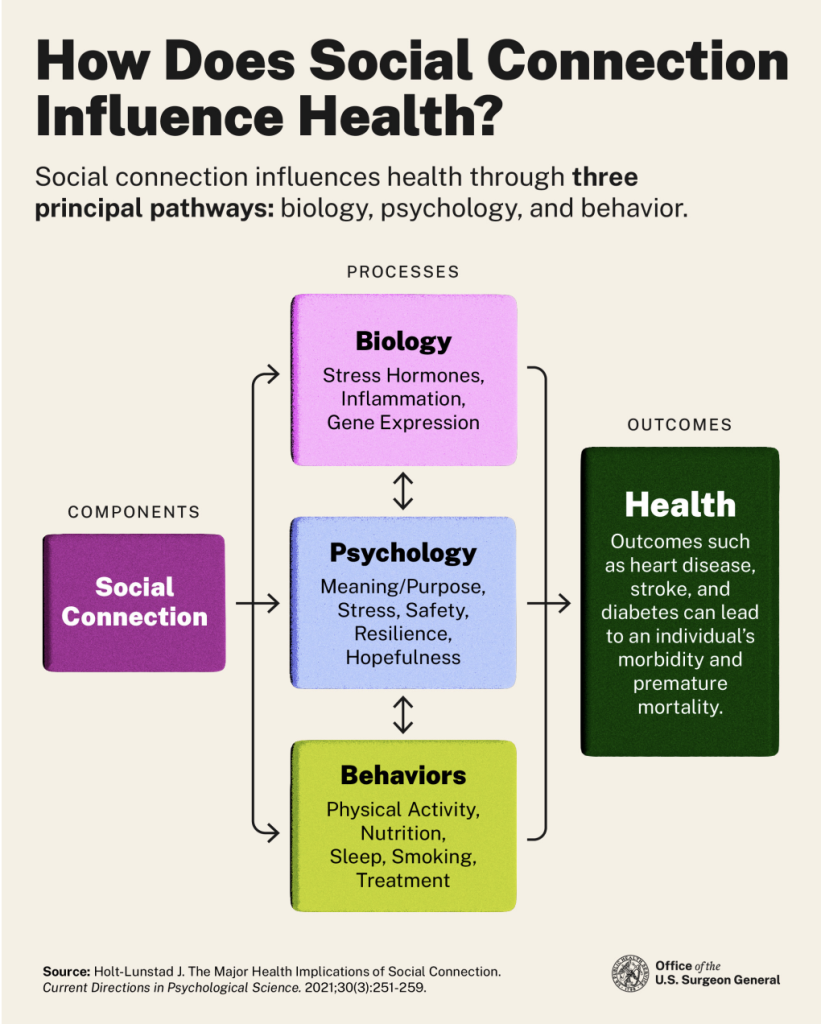
The concept of third places is perhaps more important and relevant than ever. In an age of marked technological reliance and the addictive pull of social media, we are in the firm clutches of a “loneliness epidemic”. Physical and mental health issues, modern conveniences and technology, and the COVID-19 pandemic have all contributed to increased loneliness and social isolation in the United States (Rodriguez, 2024). Social media connections and followers may feel plentiful and fill a temporary void, but are not likely the people to turn to in the event of a crisis or other life-altering event. Further, loneliness has very real and damaging effects on individuals’ health, longevity, and well-being (Office of the Surgeon General, 2023; Rodriguez, 2024). Figure 1 details how level of social connection influences health: decreased social connection leads to increased negative health outcomes (see Office of the Surgeon General, 2023).
Figure 1: How does social connection influence health? (Office of the Surgeon General, 2023).
Communities with greater social connections have better health outcomes, are better prepared for large-scale events such as natural disasters, have lower levels of violence, demonstrate stronger economic prosperity, and tend to be more active in local government (Office of the Surgeon General, 2023). Another important finding to highlight is that more diverse social networks increase empathy, which is a critical hallmark of altruism and understanding (Office of the Surgeon General, 2023). However, especially in this tech-focused era, it is apparent that finding, building, and fostering in-person social connections has become more difficult for many (Roberts-Ganim, 2023). For some, it is the decrease in third places that exist in their community. Others are unable to access third places due to economic or transportation challenges. Thus, social—human—connections must be nurtured with purpose: ultimately, we must work harder to fight the temptation to simply “stay home” (Oldenburg & Christensen, 2025; Roberts-Ganim, 2023; see also Office of the Surgeon General, 2023).
"We have to be intentional about building socials connections in our life."
— U.S. Surgeon General Dr. Vivek Murthy (Rodriguez, 2024)
Our role
As information professionals serving a variety of communities, it is important to be aware of how individuals within those communities may be affected by loneliness and isolation. Further, this knowledge should color our approach to programming, outreach, inclusion, and even simply how the third place is embodied and fostered within our libraries. Stephens (2019) discussed the necessity to remember our physical spaces in the library and identified a variety of “zones” that represent different purposes (e.g. creativity, community, curiosity, etc.). Not only should we consider a variety of spaces, but the development of those spaces should always involve the end users (Leferink, 2018; Stephens, 2018). Involving patrons and soliciting input ensures we act on and provide for their needs. And let’s face it: being a welcoming and effective third place that chips away at the loneliness epidemic gripping our country seems like a pretty good way to serve our communities!
Inspiring libraries as third place
As this is an area that resonates with me, I sought out examples outside of the course materials of how other libraries are creating communal spaces with purpose. Below are four videos demonstrating some fantastic spaces and ideas to meet community needs. These spaces were developed to bring people together for different reasons (such as specific needs, activities, programs, etc.) that in turn encourages communication, conversation, and connection.
Teen spaces at the Monroe County Public Library (Indiana)
As I discussed regarding our small library above, I can only dream of having a space like this for our teens. However, what most resonates here is the care the librarians of Monroe County have taken in developing a welcoming spaces for teens to hang out, socialize, learn, create, and play. Size and space limitations can be circumvented by using what you have creatively and efficiently. And, of course, we must make sure we are meeting the needs of our particular community’s teens.
Dementia-friendly spaces at Corner Brook Public Library (Newfoundland, Canada)
I love the consideration taken here at the Corner Brook Public Library. As you will see in the video, these are not major or overwhelming changes, but rather thoughtful additions to the space (such as special signing, quiet areas), collection (activities and games), and health and informational resources. They identified a group with particular needs and limitations (dementia and Alzheimer’s patients) and implemented effective ways to make the library welcoming and accessible to them.
Tai Chi for homeless patrons in Salt Lake City
Libraries are often a refuge for the homeless population in various communities. The Salt Lake City Public Library sends a strong message to these patrons that they are truly welcome within their doors by giving them a space to relax, breathe, and connect with others who are struggling with similar challenges. I found this very inspiring as a way to further bridge the gap to this population which in turn can better connect them to the resources and assistance they need.
A variety of spaces across several Massachusetts libraries
I have a soft spot for this video as it showcases libraries from my home state. The long-running New England television show Chronicle explored interesting spaces found in Massachusetts libraries, including a fully-functioning kitchen classroom as well as live plants and experimental growth projects accessible to all patrons.
I would love to know of more libraries embracing their third place identity. Share in the comments any other examples you may have come across in your travels. Or, share what your library has done to meet the needs of your community.