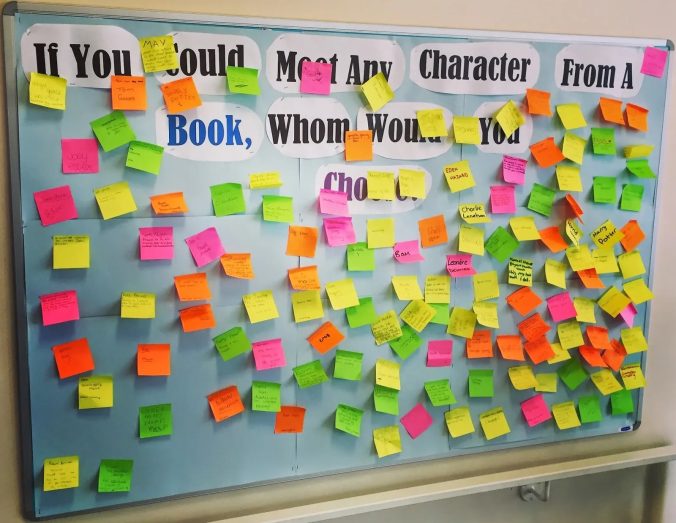
Libraries have evolved over the years to serve their communities’ needs in the context of changing times. Further, they have a unique position in which to explore, experiment, and attempt new things in order to meet those needs (see Greenwalt, 2013). And while it is necessary to understand our community, our patrons, and the specific needs of our locales (and to approach new initiatives with care and planning), I believe there is more than enough room to also embrace the fun in all that we do!
Patrons are already noticing shifts in how libraries operate and feel. Recently, the IMLS (2025) reported that library visits, circulation, and programming have all increased—particularly rebounding in the wake of the pandemic—demonstrating that libraries continue to fulfill a societal need. Gen-Z and Millennials are visiting libraries at higher rates than older generations, and 23% of Gen-Z and Millennials who visited a library at least once within a one-year period did not even identify as readers (Berens & Noorda, 2023; see also Sakey, 2026). That alone indicates that libraries are offering services and resources beyond “just books” that are desired, needed, and utilized; for the younger, digitally-inclined generations, this speaks volumes (see Berens & Noorda, 2023). Further, libraries offer a simple but critical service of being a safe place to hang out, socialize, and build community in a time of growing social isolation (see Sakey, 2026).
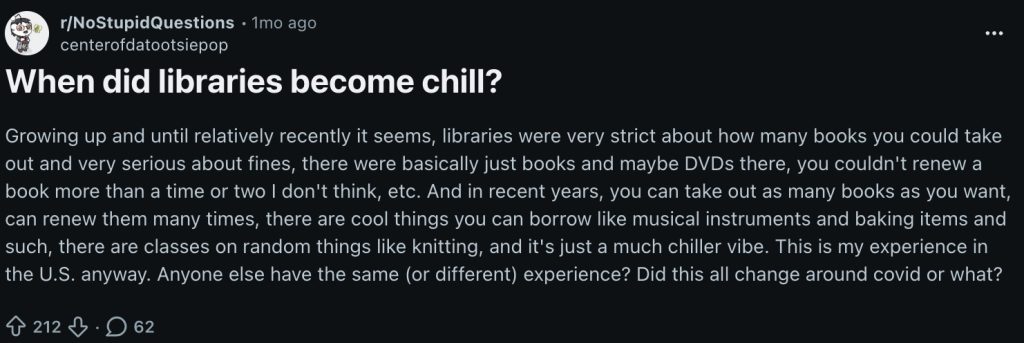
Image source: Reddit (centerofdatootsiepop, 2026)
Learning through experiences
Since 2013, the Oak Park Public Library in Chicago has provided a designated area within the library’s entrance called the Idea Box. This space provides a participatory experience for patrons entering the building; for example, a large wall of magnetic poetry. But the intention here was not a dedicated space of one single activity, but rather to experiment with new ideas, themes, and approaches for patrons to quickly see and engage in should they choose to do so. These ideas could potentially spark bigger initiatives depending on the response and engagement. But most of all, the Idea Box provided a space that invoked fun, curiosity, creativity, and social connection (Greenwalt, 2013).
Experimenting with participatory experiences and programming can also provide insight into our communities’ needs and interests. The concept of “Fun Palaces” originated in the U.K., coming to fruition in libraries in 2014, in which an institution would open its doors for a day or two and offer a wide variety of experiences for patrons to try: for example, musical instruments, ballet, Dungeons and Dragons, paper crafts, painting, exercise, and more. The most popular activities are a good hint as to what patrons are interested in. It can also be a great way to involve community experts knowledge in various skills to volunteer and lead the different experiences, offering further chances for social connection and community bonding. Not only do we as library professionals gain valuable insight, but patrons benefit by having a fun day at the library and perhaps discovering a new skill or hobby to pursue (Lenstra, 2018).
There are endless possibilities limited only by our imagination. As librarians, we are “always in beta” as we try new things and continue to evolve (see Stephens, 2014). Escape rooms, murder mystery nights, story walks, clubs and workshops, performances, and even virtual reality are just a few examples of fun and engaging experiences that can happen at the library. Other passive experiences may include bulletin boards, walls, or other designated areas that prompt visitors with a question or activity that they can interact with and, in some cases, leave behind a piece of themselves for others to see, such as a written note, a drawing, or a contribution to an on-going puzzle. Big or small, these experiences encourage patrons to not only engage with their library, but to engage with others within their community—directly or indirectly. When we bring people together, we learn more about ourselves and each other.
"Look for ways to encourage the creativity of your users. Have some space to repurpose? Unleash ideas. Open minds. We are so much more than a book warehouse or Wi-Fi access point or a place that rents movies."
— Stephens, 2016
Inspirational libraries embracing the fun
I hope to have the chance to implement some of my own ideas in my library. I tend to come up with a lot of ideas and would love a chance to experiment and see what works. I think that mindset is so important when working with our communities. Not only to try our own ideas, but to bring to life those of our patrons as well. And if something doesn’t work, that is okay! After all, we as librarians are always learning through everything that we do.
Below are a series of interesting and engaging ideas that encourage learning, socializing, creativity, and above all, fun!
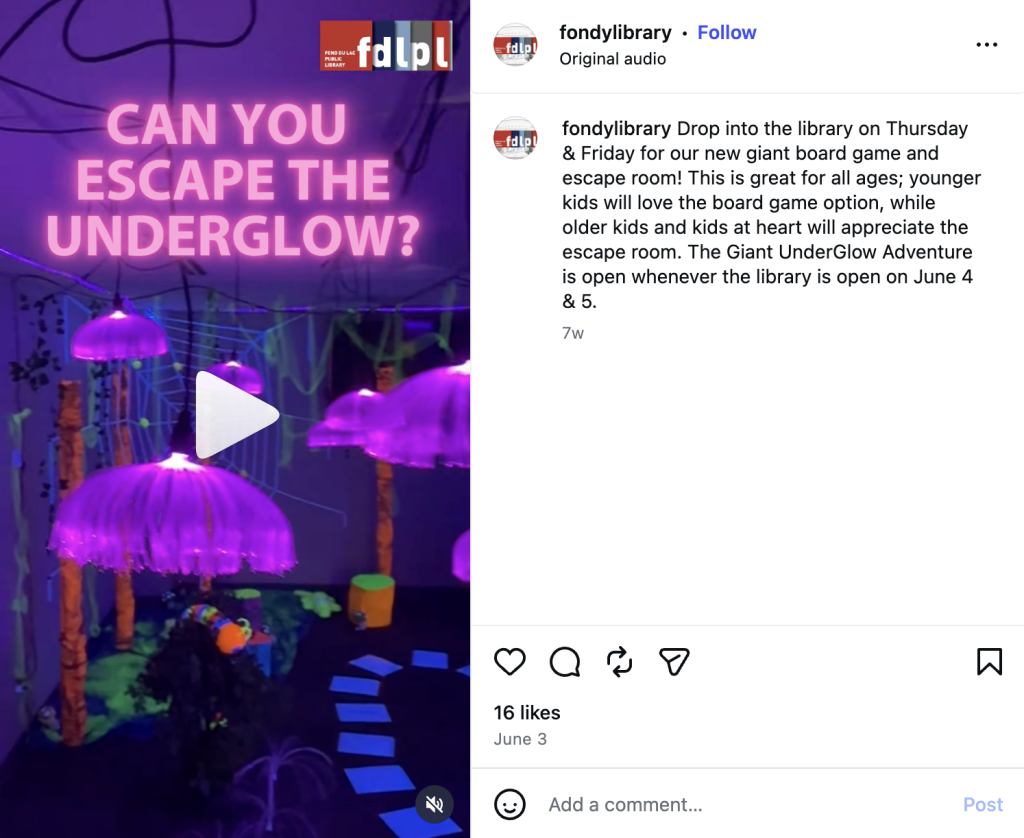
Glowing escape room — Fond du Lac Public Library (Fond du Lac, WI)
Talk about an immersive experience! This fun-for-all-ages escape room at the Fond du Lac Public Library challenges patrons critical thinking skills within a creative—and glowing!—environment. Click the picture to view the video.
I Spy Tank by @favorite.librarian (TikTok)
I absolutely loved the I Spy books as a child, so what a fun way to bring the books to life by creating an I Spy Tank. School librarian @favorite.librarian shares one of her most popular passive experiences for children visiting the library. The I Spy books and similar activities such as scavenger hunts build critical thinking and problem solving skills as well as strengthen working memory while also encouraging exploration and discovery (see LaChance, 2016; Paul, 2025; Rodriguez, 2019).
@favorite.librarian Elementary library I spy passive programming. #ispy #librarytiktok #schoollibrarianlife #passiveprogramming
Spaces for creatives — Los Angeles Public Library (Los Angeles, CA)
In the TikTok below, a photographer shares her experience utilizing the studio space and editing software at the LAPL that she would otherwise not be able to afford or acquire at this stage in her career. These resources allow creatives to not only produce but learn more about the tools, equipment, software, and technology made available to them—ultimately improving their craft, experience, and knowledge.
@lapubliclibrary The Octavia Lab is a do-it-yourself makerspace located inside of Central Library. Octavia Lab provides library cardholders free and unlimited access to state-of-the-art design, fabrication, preservation, and story-telling technologies. Whether you need a photo studio and editing tools, podcast equipment, sewing machines and more, Octavia Lab has something for everyone. #lapubliclibrary #librarytiktok #librarytok
Interactive exploration for kids at the Ipswich Library (Ipswich, Australia)
The Ipswich Library has a ton of fun experiences for children that promote exploration and curiosity. I don’t think I have ever seen anything like that scarf in the tube contraption before (especially in a library!), but I can imagine that has to be a lot of fun for children watching it flow through the tubes and trying to catch it at the other end. The library also has reading nooks for children to curl up in to read when they need a break from the action. According to the video, the library regularly changes the various interactive activities, suggesting that the staff here is invested in trying new things for their young patrons while keeping a sense of fun at the forefront.
@thingstodoinipswich 📚✨ Looking for free fun for your little ones? Discover a world of adventure at the Ipswich Children’s Library! Located in the vibrant Nicholas Street Precinct, this unique library is designed specifically for children aged 0-12 years. With over 35,000 books tailored for young readers and exciting multi-reality interactive experiences, children can explore, learn, and play in an environment made just for them! The library offers a variety of free activities that are perfect for stimulating young minds. From Story Time sessions that enhance language through songs and stories to interactive and educational games, there is something to captivate every child for hours. Highlights include life-sized dinosaur models and an immersive butterfly screen that bring narratives and learning to life! 🌟 Dive into a haven of books or participate in the engaging craft activities available. Visit the Ipswich Children’s Library to see why it’s a beloved destination for families in Ipswich! For more information on activities and opening hours, check out the library’s website or drop by to experience the magic firsthand! 🌈📖 #discoveripswich #thingstodoinipswich #ipswichchildrenslibrary #nicholasstprecinct #freethingstodoinipswich @Discover Ipswich @Nicholasstreet
♬ vlog, chill out, calm daily life(1370843) – SUNNY HOOD STUDIO
References
Berens, K. I., & Noorda, R. (2023). Gen Z and Millennials: How they use public libraries and identify through media use [Report]. American Library Association. https://www.ala.org/sites/default/files/advocacy/content/tools/Gen-Z-and-Millennials-Report%20%281%29.pdf
centerofdatootsiepop [Username]. (2026, June 15). When did libraries become chill? [Online forum post]. Reddit. https://www.reddit.com/r/NoStupidQuestions/comments/1u72a93/when_did_libraries_become_chill/
Greenwalt, R. T. (2013, February 21). Embracing the long game. Public Libraries Online. https://publiclibrariesonline.org/2013/02/embracing/
IMLS. (2025, September 2). Increased public library usage shown by IMLS survey data. https://content.govdelivery.com/accounts/USIMLS/bulletins/3f09e4a
LaChance, N. (2016, May 24). Benefits of scavenger hunts. Institute for Educational Advancement. https://educationaladvancement.org/blog-benefits-scavenger-hunts/
Lenstra, N. (2018, September 4).“I didn’t expect to see that at the library”: Fun Palace engages community. Public Libraries Online. https://publiclibrariesonline.org/2018/09/i-didnt-expect-to-see-that-at-the-library-fun-palace-engages-community/
Maxwell, L. (2026, June 6). Bulleting board with sticky notes [Image]. Book Riot. https://bookriot.com/passive-programming-in-school-libraries/
Paul, D. (2025, March 26). Scavenger hunts: A perfect learning exercise. Teaching Times. https://www.teachingtimes.com/scavenger-hunts-a-perfect-learning-exercise/
Rodriguez, J. (2019, May 20). Here’s exactly how I Spy boosts memory & visual learning. Scholastic. https://www.scholastic.com/parents/books-and-reading/raise-a-reader-blog/i-spy-books-benefits.html
Sakey, P. (2026, July 13). America needs libraries more than ever: Gen Z is showing us the way. Boston Public Library Fund. https://bplfund.org/america-needs-libraries-more-than-ever-gen-z-is-showing-us-why/
Stephens, M. (2014, November 26). YLibrary? Making the case for the library as space for infinite learning. State Library of Queensland YLibrary Project. https://www.dropbox.com/scl/fi/4zt1yliwb2ffzr8euix2p/YLibraryInfiniteLearning.pdf?rlkey=m0v6lkd43ufilkp5aktawhlpr&e=2&dl=0
Stephens, M. (2016). The heart of librarianship: Attentive, positive, and purposeful change. ALA Editions.
Featured image attribution: Lucas Maxwell (Maxwell, 2026)
Hi Liz – Great post! Thank you for sharing all these programming examples. Libraries are doing such cool events! I am not one at all who uses social media. So, thank you for sharing the accompanying videos. It is interesting to see how different libraries are so creative with their online marketing. I also wanted to say I got excited to see you highlighted the Fond du Lac Public Library. I live about 30 miles away from there!