
Reflecting on this week’s module as well as the other modules we looked at so far, libraries have increasingly expanded from spaces that solely provided research tools to spaces that invite community participation, provide community resources, and create inclusive safe spaces.
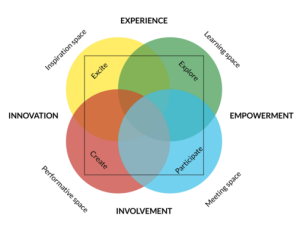
In turn, the transformation of public library spaces fulfill Skot-Hansen’s (2017) four-space model, where libraries divide their service amongst 4 different areas: the inspiration space, the learning space, the meeting space and the performative space. In turn, libraries become a unique space that promotes education and literacy through collaboration, socialization, and inspiration. We can see these principles in action throughout multiple public library systems throughout the country. 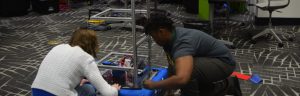
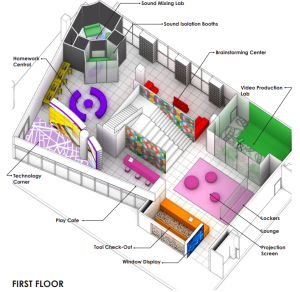
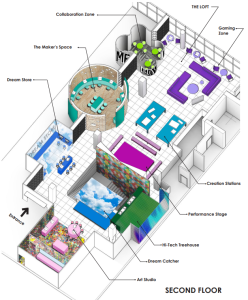
Spring boarding from the article talking about the innovative Memphis Public Library, public libraries in the 21st century have progressively started to invest in and provide working spaces and technology access to their patrons. Public libraries today have transformed beyond providing physical media to providing spaces where individuals can create, collaborate and innovate. While many cities have cut funding for public libraries, Memphis, Tennessee decided to heavily invest in their public library system, and were able to create a bustling community space that sees continual attendance from all community members. (Grant, 2021) One of these investments is Cloud901, a 8,300 square foot technology lab where teens ages 13-18 can develop collaborative, critical thinking and problem solving skills while utilizing new technology. (Memphis Public Libraries, n.d.) The inclusion of Cloud901 shows the library’s plans of investing in their community, especially their youth. Additionally, Cloud901 promotes everything stated by the 4-space model by providing an inspiration and performative space for teens by providing sound mixing labs, video production labs, performance stages and maker spaces, while also providing learning and meeting spaces by including collaboration zones, gaming zones, homework areas and brainstorming centers for teens to utilize.
From what I’ve gathered, I resonated deeply with a quote from the article, “How Memphis Created the Nation’s Most Innovative Public Library”, stated by former Public Library Association President, Ramiro Salazar, as they assert that “[public libraries] exist for the betterment of communities. We support literacy and learning. We want all our resources to be free and everyone to feel welcome.” (Grant, 2021). Public libraries now, especially in the 2020s are becoming spaces to provide enrichment for a community. At my public library, we struggle to have designated spaces for teens to use for a variety of reasons such as, staffing, space, and budget requirements. If more cities are willing to invest resources into their local libraries, then I hope that many more libraries can provide the same resources that the Memphis library provides for their patrons, especially their creative teen patrons who frequent the library.
References:
Grant, R. (2021). How Memphis created the nation’s most innovative public library. Smithsonian Magazine. https://www.smithsonianmag.com/innovation/memphis-created-nations-innovative-public-library-180978844/?fbclid=IwAR1KhgGc_cXHfCduhqGtJ1Wi5Y2jRho1yW1Q62QjCNC5o2Qs9eLeGnzqqIM
Memphis Public Library. (n.d.) What is CLOUD901? City of Memphis. Retrieved October 11, 2026, from https://www.memphislibrary.org/cloud901/what-is-cloud901/
Skot-Hansen, D. (2017). Library Development: From collection to collection. University of Copenhagen. https://287.hyperlib.sjsu.edu/wp-content/uploads/2025/02/4-Spaces-Model-from-Univ-Copoenhagen.pdf
@aldya I love the connections you made between the Fourspace model and what Memphis is doing and what it looks like to engage with the community around creativity and dreaming to pull a word from those super cool floor plans that you shared. We will see “dreaming” again this semester.