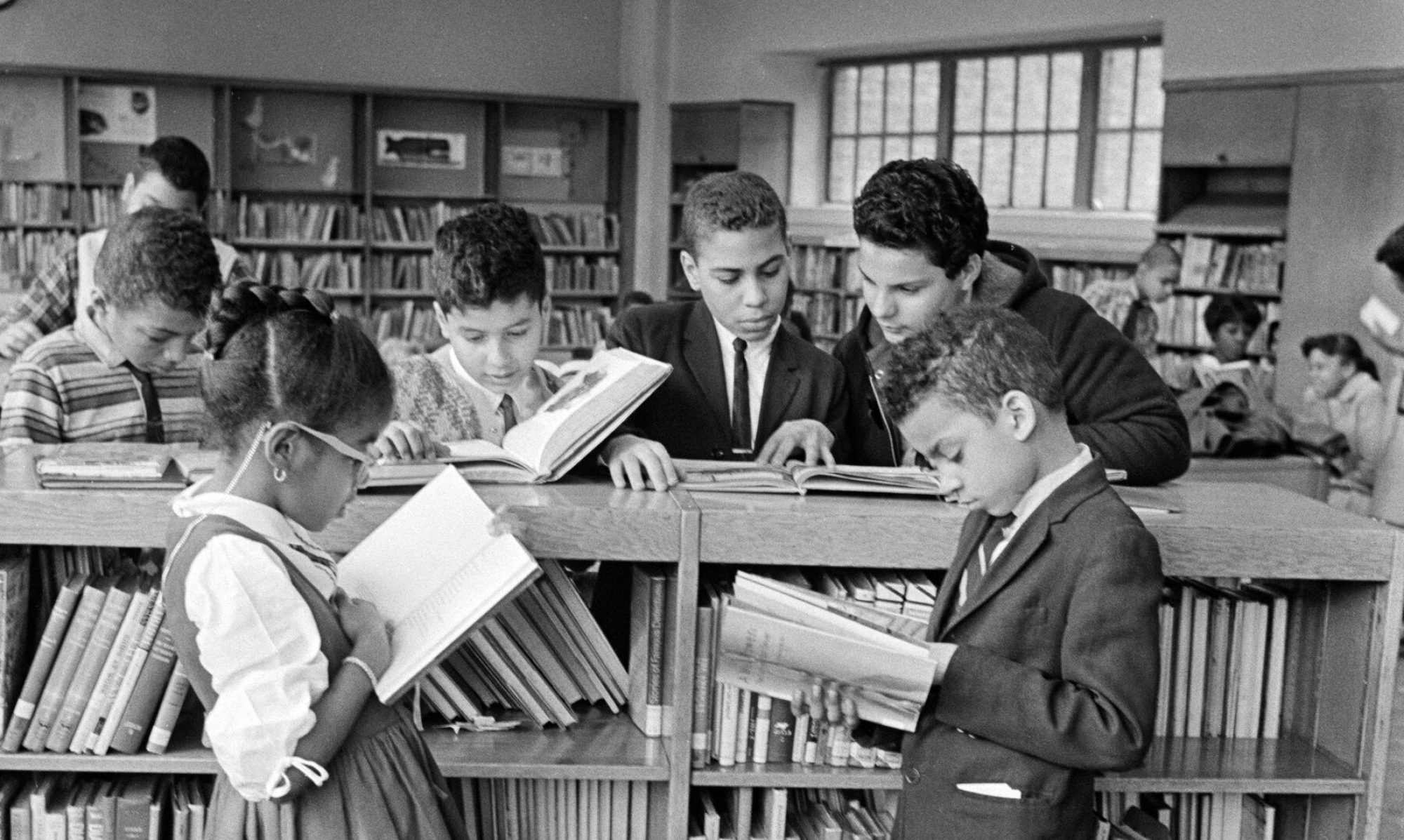
It’s difficult to summarize the myriad changes taking place in American public libraries, but one thing is certain. Libraries are no longer hushed repositories of books. Here at the Central branch in Memphis, ukulele flash mobs materialize and seniors dance the fox trot in upstairs rooms.
-Richard Grant
(I was going to cut off that quote at “Libraries are no longer hushed repositories of books,” but I loved the imagery of the last sentence about ukulele mobs and fox-trotting old folks too much to exclude it.)
“This is a library!”
For the CYOA module on Hyperlinked Environments, I chose the adventure: The Hyperlinked Public Library. One theme I noticed in many of the resources in that portion was the library being a space for innovation, inspiration, and…noises! The library can indeed be a place for loud noises—musical noises, expressive noises of excitement, enthusiastic children, let’s make some noise.

I recently began volunteering at my local library and most of my time there has been spent re-shelving books. This puts me in a great spot to overhear a lot of hilarious things said by children. My favorite was a little boy (probably three or four years old) and his mother who had been walking and browsing around the library for probably half an hour when all of a sudden, the little boy stopped in his tracks and very loudly exclaimed, as if it had finally dawned on him, “MOM! This is a library!”
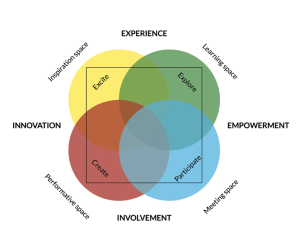
Four Spaces Model
The Four Spaces Model from Dorte Skot-Hansen, LIS professor at University of Copenhagen, is particularly inspiring and supports this idea. Skot-Hansen describes a library model for the future that has four overlapping physical and digital spaces: the inspiration space (access to the arts), the learning space (access to educational resources), the meeting space (access to community engagement), and the performative space (access to creative tools and activities).
Music in the Library
Focusing on the last one, the performative space, I’ve loved seeing so many resources about the library being a space for people to explore recording and performing music. I was struck, in the best way, several years ago when I saw this punk rock band The Linda Lindas performing one of their songs at the LA Public Library.
Richard Grant’s article in the Smithsonian Magazine highlighted, among many, many other incredible things at the Benjamin L. Hooks Central Library in Memphis, TN, the unique opportunities teenage users have to create and perform music at their Cloud901 facility. As Grant writes, “it contains a state-of-the-art recording studio staffed by a professional audio engineer.” How amazing is that? In a similar vein, the Chattanooga Public Library has the Noise Closet, which is described on their website as a “rock instrument library for ages 10-17 with guitars, drum kits, keyboard, and amps you can check out for up to 1 month.”
Conclusion
As a lover of music and something of a musician (using that word very liberally) myself, I love seeing how libraries are democratizing access to top-of-the-line musical equipment. Those things can be insanely expensive, which can, of course, be a huge barrier for many children to access them. It makes me happy to think of the talent that is being unearthed and refined as a result of some of those barriers being broken down. More art and creativity in the world = a better world for everyone. More generally, I love to see libraries moving far away from the stereotype of a quiet, buttoned-up place to a place in which people can express themselves, even if that’s through some loud noises.

References
Chattanooga Public Library – Noise Closet. https://chattlibrary.org/noise-closet/
Grant, Richard – How Memphis Created the Nation’s Most Innovative Public Library. https://www.smithsonianmag.com/innovation/memphis-created-nations-innovative-public-library-180978844/?fbclid=IwAR1KhgGc_cXHfCduhqGtJ1Wi5Y2jRho1yW1Q62QjCNC5o2Qs9eLeGnzqqIM
The Linda Lindas – Racist, Sexist Boy (Live at LA Public Library). https://www.youtube.com/watch?v=J5AhU5Q7vH0
Skot-Hansen, Dorte – Library Development: From Collection to Connection. https://287.hyperlib.sjsu.edu/wp-content/uploads/2025/02/4-Spaces-Model-from-Univ-Copoenhagen.pdf