Innovation Strategy & Roadmap: Birding Club and Bird Walks in Riverside

Proposed Idea & Objectives

While the Riverside Public Library system offers outdoor adventure packs, which include binoculars, a compass, a birds guide, and other nature guides and equipment, there is currently no birding club or library-facilitated bird walks. My proposal is to 1) start a birding club that meets once a month, and 2) invite local naturalists, scientists, Audubon society members, birding enthusiasts, or artists to, in partnership with library staff, lead at least six library-facilitated and sponsored bird walks annually in parks and nature preserves in the Riverside area.

Objectives:

    • Inspire Riverside community members (not just library users) to deepen their appreciation for and awareness of our local environments and to become lifelong learners
    • Create meaningful connections between library staff and community members
    • Facilitate intergenerational connections and community building
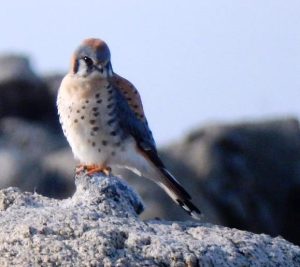
American Kestrel. Source.

Birding is an accessible hobby, as it requires no equipment or prior experience, just a curiosity about birds. Additionally, birding, and interacting with nature generally, has proven mental health benefits, such as a reduced sense of isolation and loneliness and increased feelings of calm and mindfulness. Our Riverside community members would be greatly benefitted from participation in these programs through improved mental health and connection with fellow community members.

Aligning with Riverside Public Library’s Mission & Opportunities in Riverside Area

As the Riverside Public Library’s mission statement says, we want to “be the cultural and learning center for the community” and “encourag[e]…the power of lifelong learning.” Encouraging community members to engage in birding, and do so in a library-facilitated environment, is an invitation aligned with both of those aspects of the mission statement.

Why birding? A recent survey (2024) from the U.S. Fish & Wildlife Service found that “96 million people (or 3 out of 10 Americans) engaged in birding, making up 37% of the population aged 16 or older.” Participants identifying as birders meant they had spent either time or money to observe birds—e.g., traveling to go see birds, buying a bird feeder for their backyard, etc. That is a startling amount of the adult population! Surely, many birders are in our area and would delight in the opportunity to flock (pun absolutely intended) with fellow birders.

The library has ample meeting space for a monthly meeting, and there are many local and state parks and nature centers, ideal spots for birding, near each branch in the system. According to the popular birding platform, eBird, there are nearly 200 species of bird observed at UC Riverside’s Botanic Gardens (about 15 minutes away from the Main Library) alone.
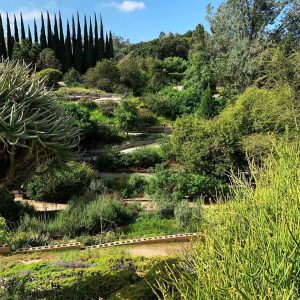
UCR Botanic Gardens. Source.

Inspiration

ELPL Birders Club Logo. Source.

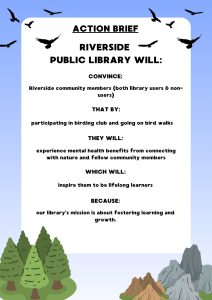
Action Brief

Guidelines & Policies

    • Birding club meetings will take place once a month at the library. No registration is required and people of all ages can attend. Preferably, these will be on Saturdays.
    • Birding club meetings will be led by a rotating group of staff members.
    • We will try to feature a guest presenter at each birding club meeting.
    • There will be six bird walks annually.
    • Bird walks will be facilitated and supported by library staff and led by either a library staff member or a local naturalist, scientist, Audubon society member, experienced birder, or artist.
    • For bird walks, encourage participants to dress for the weather and bring water.
    • For bird walks, choose parks and walking trails that are easy to walk, nothing strenuous.
    • For bird walks, encourage participants to bring their own binoculars if they have them, but we will have at least 15 library-owned pairs to give out to participants who don’t have them.
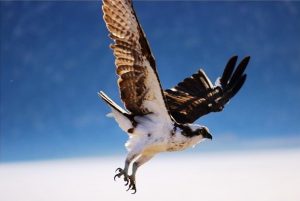
      Osprey. Source.

Timeline for Implementation (2.5 Months)

  • Weeks 1-3
    • Orient staff on the new program and gauge interest for/establish staff members who’d like to lead birding clubs and bird walks.
    • Finalize regular meeting dates for birding club and dates for bird walks.
    • Begin creating promotional materials (physical and digital).
  • Weeks 4-6
    • Outreach to local naturalists, scientists, Audubon society members, passionate birders, and artists to begin scheduling for guest presentations and bird walks.
    • Publish meeting dates on library website and across social media, put up flyers around the library, and distribute birding club bookmarks at checkout with QR codes to scan for more info.
  • Weeks 7-8
    • Continue promotional efforts.
    • Host first birding club meeting.
    • Evaluation of first birding club meeting.
  • Weeks 9-10
    • Continue promotional efforts.
    • Host first bird walk.
    • Evaluation of first bird walk.

Marketing & Promotion

Internal

The first few weeks of the timeline for implementation will be dedicated to promoting these programs within the organization. We will present the idea to staff, gauge interest for staff members that would be interested in taking the lead at meetings and walks, and invite feedback and ideas from staff—per Dr. Michael Stephens, “Hands-on experience equals…a path toward buy in,” so we want staff to be active participants to influence how this club is run. Dr. Eric Berling’s video on starting a birding club at the library can be disseminated to staff and/or clips from that video used during the initial presentation meeting. We will also utilize the creativity of staff members to create the promotional materials and multimedia resources for the program.

External

As referenced in the timeline, we will use all available communication channels—the library newsletter, Instagram, Facebook, TikTok, the library website, and spaces in the library itself—to reach our audience. In addition to flyers around the library, we will design bookmarks advertising the birding club (with a QR code that takes users to an information page on the library website) to pass out/will be free to grab when patrons come into the library. Once dates are finalized, they will be added to the calendar of events on the library website. We want to emphasize that all are welcome and that this club is a great way to reconnect with our local environments.
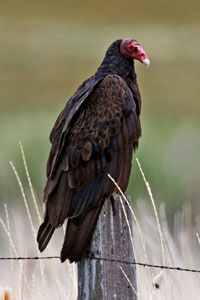
Turkey vulture. Source.

Staff Training & Readiness

Staff do not need to be bird experts or experienced birders to participate and/or lead these meetings and outings. They will be encouraged to watch Dr. Berling’s video, check out all the examples in the Inspiration section, and provide feedback and ideas. I will take the lead on the initial presentation to all staff, and then department heads will gauge interest and identify and select members of their teams to be the support staff for the club. Those selected staff will be under my supervision for all activities pertaining to the birding club.

Evaluation & Future Expansion

We will track attendance at both birding club meetings and bird walks, so we can monitor our progress over time. Per Dr. Stephens and Michael Casey, one effective way to measure progress is to “Engage staff and users by asking them for anecdotal evidence on how a new service is working.” This is in line with one of the program’s objectives: Create meaningful connections between library staff and community members. Staff can mingle with users before, during, and after programs, and as they connect with them, they will obtain anecdotal evidence for how well the club is working.

We hope to attract users of all ages and foster intergenerational connections. We want to see people of all ages interacting with each other and forming a little community/communities. If the program is popular enough, perhaps we can consider more frequent meetings and/or bird walks. We would love to get to a place where regular club members feel confident enough to lead certain parts of the monthly club meetings.

The beauty of a birding club is it’s inexpensive, uncomplicated, and doesn’t need to be perfect to start. Once again borrowing from Dr. Stephens, we can “Let [our] users help [us] work out the bugs” and “Admit openly…[that] there may be a few kinks.” Our primary focus should be to connect with our community members, help them connect with each other, and together share in the beauty and awesomeness of the natural world.


References

Adams, Jill U. – Birding With Benefits: How Nature Improves Our Mental Mindsets, 2019.

Alameda County Library – Lake Elizabeth Bird Walk.

Andrews, Jennifer G., Ammirati, Rachel J., & Andrews, Caleb J. M.  – Birding Benefits: A Review of Mental Health, Cognitive, Social, and Conservation Impacts, 2024.

Casey, Michael & Stephens, Michael – Measuring Progress, 2008.

Cincinnati Public Library – Bird Nerds.

eBird – UC Riverside Botanic Gardens.

East Lansing Public Library – ELPL Birding Club.

Free Library of Philadelphia – Experience Nature in the City at Your Library, 2025.

Los Angeles Public Library – Storytime and Family Bird Walk at the Audubon Center.

Missoula Public Library – Beginner Bird Walk with the Feminist Bird Club.

Riverside Public Library – Mission & Vision.

Rochester Hills Public Library – Experience Birding with RHPL.

Sacramento Public Library – Bilingual Bird Watching – Sol Collective.

STAR Net, Eric Berling – Running a Birding Club at YOUR Library: How to Launch and Sustain a Successful Program (Video), 2026.

Stephens, Michael – Taming Technolust: Ten Steps for Planning in a 2.0 World, 2012.

Wetzel, Rosalie – Birding is Soaring in Popularity with Sky-High Impact, 2024.

Reflection Blog on Hyperlinked Environments (The Hyperlinked Public Library): Let’s Make Some Noise!

It’s difficult to summarize the myriad changes taking place in American public libraries, but one thing is certain. Libraries are no longer hushed repositories of books. Here at the Central branch in Memphis, ukulele flash mobs materialize and seniors dance the fox trot in upstairs rooms.

-Richard Grant

(I was going to cut off that quote at “Libraries are no longer hushed repositories of books,” but I loved the imagery of the last sentence about ukulele mobs and fox-trotting old folks too much to exclude it.)

“This is a library!”

For the CYOA module on Hyperlinked Environments, I chose the adventure: The Hyperlinked Public Library. One theme I noticed in many of the resources in that portion was the library being a space for innovation, inspiration, and…noises! The library can indeed be a place for loud noises—musical noises, expressive noises of excitement, enthusiastic children, let’s make some noise.

Loud Noises GIFs | Tenor

I recently began volunteering at my local library and most of my time there has been spent re-shelving books. This puts me in a great spot to overhear a lot of hilarious things said by children. My favorite was a little boy (probably three or four years old) and his mother who had been walking and browsing around the library for probably half an hour when all of a sudden, the little boy stopped in his tracks and very loudly exclaimed, as if it had finally dawned on him, “MOM! This is a library!”

Four Spaces Model

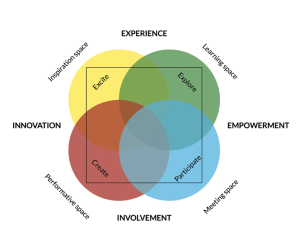
The Four Spaces Model from Dorte Skot-Hansen, LIS professor at University of Copenhagen, is particularly inspiring and supports this idea. Skot-Hansen describes a library model for the future that has four overlapping physical and digital spaces: the inspiration space (access to the arts), the learning space (access to educational resources), the meeting space (access to community engagement), and the performative space (access to creative tools and activities).

Dorte Skot-Hansen’s Four Spaces Model for libraries.

Music in the Library

Focusing on the last one, the performative space, I’ve loved seeing so many resources about the library being a space for people to explore recording and performing music. I was struck, in the best way, several years ago when I saw this punk rock band The Linda Lindas performing one of their songs at the LA Public Library.

Richard Grant’s article in the Smithsonian Magazine highlighted, among many, many other incredible things at the Benjamin L. Hooks Central Library in Memphis, TN, the unique opportunities teenage users have to create and perform music at their Cloud901 facility. As Grant writes, “it contains a state-of-the-art recording studio staffed by a professional audio engineer.” How amazing is that? In a similar vein, the Chattanooga Public Library has the Noise Closet, which is described on their website as a “rock instrument library for ages 10-17 with guitars, drum kits, keyboard, and amps you can check out for up to 1 month.”

Conclusion

As a lover of music and something of a musician (using that word very liberally) myself, I love seeing how libraries are democratizing access to top-of-the-line musical equipment. Those things can be insanely expensive, which can, of course, be a huge barrier for many children to access them. It makes me happy to think of the talent that is being unearthed and refined as a result of some of those barriers being broken down. More art and creativity in the world = a better world for everyone. More generally, I love to see libraries moving far away from the stereotype of a quiet, buttoned-up place to a place in which people can express themselves, even if that’s through some loud noises.

11 - GIF - Imgur


References

Chattanooga Public Library – Noise Closet. https://chattlibrary.org/noise-closet/

Grant, Richard – How Memphis Created the Nation’s Most Innovative Public Library. https://www.smithsonianmag.com/innovation/memphis-created-nations-innovative-public-library-180978844/?fbclid=IwAR1KhgGc_cXHfCduhqGtJ1Wi5Y2jRho1yW1Q62QjCNC5o2Qs9eLeGnzqqIM

The Linda Lindas – Racist, Sexist Boy (Live at LA Public Library). https://www.youtube.com/watch?v=J5AhU5Q7vH0

Skot-Hansen, Dorte – Library Development: From Collection to Connection. https://287.hyperlib.sjsu.edu/wp-content/uploads/2025/02/4-Spaces-Model-from-Univ-Copoenhagen.pdf

Reflection Blog on Hyperlinked Communities: Finding Community, Finding Joy

We all need a little (or a lot) more joy in our lives… People may not feel joyful in the workplace, the world, or even in their homes, but library programs can supplement a sense of joy and lightheartedness in everyday life.

-Jina DuVernay

We Need More Joy…Stat!

This quote from Jina DuVernay from her article about joyous library programming in Module 5 deeply resonated with me. It pairs well with Dr. Stephens’s writing about reaching all users in The Heart of Librarianship. As Dr. Stephens asks, “Are we reaching everyone we can? Are we giving them services they want to use? Are we giving them a reason to depend on us?”

How do we do that? I’d argue one incredibly effective way is to help people experience the joy of finding a community. Like DuVernay said, we all need a lot of joy in our lives, and discovering a community helps us do that. DuVernay adds that when new people come to programs she “especially enjoy[s] telling them they are among like-minded people and encouraging them to get to know one another.”

Community Through Common Interests

We all have something we’re passionate about, and I don’t know about you, but when I’m passionate about something I really, really want to talk about it with other people who share that passion (even if you don’t share that passion, I’ll probably still find a way to bring it up), whether that be through face-to-face or online interaction.

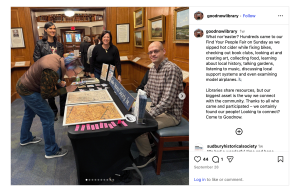
I loved this post from Goodnow Library in Sudbury, MA, about an event they held recently, and it all revolved around uniting people with similar interests. These people were able to shelter from the storm (the literal one and all the metaphorical ones currently raging in our lives) together and talk about what they love.

Link to post

A Final Word

Love’s in need of love today.

-Stevie Wonder

This year is the 50th anniversary of Stevie Wonder’s Songs in the Key of Life album (an all-time favorite of mine). These are the album’s opening words, and they feel so relevant in this moment. In order for feelings of love and joy to prevail in our communities, we have to have some intentionality in doing things that feed those feelings.

We in the library-verse have a massive opportunity to do that. When people show up to programs, we should take some time to ask them about their lives, to get to know them. We should celebrate them being there. We should have fun with them, laugh with them, and show them that there is joy in our work. Their day should be better because they came to the library.

I’ll leave with this question: How do we create and administer programs in such a way that more and more people feel like there is a place where they belong and are welcome in this world that is too often cruel and unforgiving to too many of us? I’d love to hear anyone’s thoughts and ideas.


References

DuVernay, Jina – There is Joy for All: Tips for Joyous Library Programming. https://programminglibrarian.org/articles/there-joy-all-tips-joyous-library-programming

Stephens, Michael – The Heart of Librarianship: Attentive, Positive, and Purposeful Change, 2016. ISBN: 978-0-8389-1454-0.

Assignment X: Tell Me Your Story

“All the things that are wrong in the world seem conquered by a library’s simple unspoken promise: Here I am, please tell me your story; here is my story, please listen.”

-Susan Orlean, The Library Book


The Power of Storytelling

In our lectures and readings, there have been multiple references to an amazing mantra from library consultant Erik Boekesteijn: libraries should keep stories, share stories, and make stories. Like many, I’m a voracious consumer of stories. I love a good yarn, wherever I can find it, and I believe, with every ounce of feeling I can muster, in the power of story. Stories are how we understand the world around us. Our participation in keeping, sharing, and making stories imbues us with powerful, quite-literally-world-changing feelings of empathy and shared humanity. I’m excited by the opportunities libraries have to follow Boekesteijn’s directive.

Storytelling in Programming

When we think of this idea, we might first imagine a librarian reading a story to a group of young children. However, I’ve come to realize storytelling lies at the heart of so much of the services and programming libraries provide to users of all ages. In researching the connection between libraries and storytelling, I found this great passage from LIS scholar Dr. Janice M. Del Negro:

“Storytelling in its most essential manifestation is at the core of many library programs and lends itself to a dizzying array of effective programming opportunities: young adult storytelling programs include active participation by teens in the telling; local history programs collect community stories from seniors; movie programs for adults capitalize on the modern fascination with fairy tales and contemporary media. Storytelling not only creates community from a group of disparate participants, it also acts as a unifying focus.”

I particularly love that last bit: storytelling acts as a unifying focus. Telling and listening to stories binds us in a way that transcends our differences. Borrowing from Charles Dickens, it helps us see and think of each other as “fellow-passengers to the grave, and not another race of creatures bound on other journeys.”

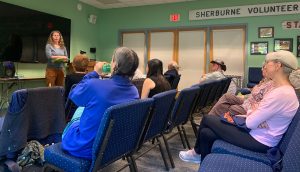
Participants at Sherburne Memorial Library’s storytelling event in May, 2026.

Earlier this year, Sherburne Memorial Library in Killington, Vermont (surely, someone has written a slasher horror story set in this city, right?), hosted a storytelling event where adults could get up and share a brief personal story with the audience. The stories ranged from an afternoon with Katharine Hepburn to solo hiking the Pacific Crest Trail, and the participants felt uplifted by the experience. This is the concept of participatory service in action—an example of, as Dr. Stephens has written about, welcoming guests in and making them feel like hosts.

Storytelling in Marketing and Communications

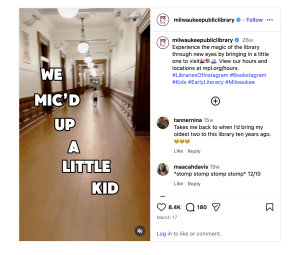
Posting on social media is a simple, practical way libraries can incorporate elements of storytelling in their marketing. Dr. Stephens has highlighted “the importance of [organizations] tapping into the collective voice of [their] communities” and this video, made by the Milwaukee Public Library, does just that. Who doesn’t love experiencing the joy of the library through the eyes of a little kid?

Link to post 

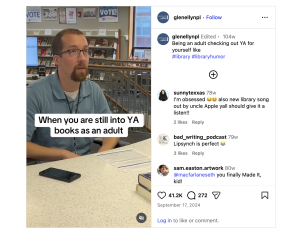
I love the humor libraries incorporate in their social media presence. I think it helps erase outdated stereotypes of libraries being serious and formal settings, replacing them with an aura that’s more approachable and welcoming. Here’s a great example from the Glen Ellyn Public Library (and a reminder that libraries should be a non-judgmental space for users):

Link to post

Moving Forward

I love the ending of the movie Be Kind Rewind. Upon learning their neighborhood’s beloved, rundown video rental store is scheduled for demolition, members of the community and the store’s staff decide to give it a proper sendoff. They pool their creative talents to make and star in a shoestring-budget documentary film about the life of local jazz legend Fats Waller, to be screened on the last day of the store’s life. The finished product is chaotic and riddled with imperfections, but it’s also precious and endearing; and the neighborhood loves it, because it’s art about their little place in the world that they made together.

Whatever the feeling is at the end of that film, that’s what I’d like to pursue as I explore how to utilize the power of storytelling in library spaces, both physical and digital. There are likely many people who don’t see themselves as storytellers, artists, or creators, and I think the library can invite people to engage with story, to make something—no matter how imperfect or messy the final product is—that will be meaningful to them, maybe even share it with others, and experience the healing power of storytelling for themselves.


References

Del Negro, Janice M. – The Whole Story, The Whole Library: Storytelling As A Driving Force, 2015.

Dickens, Charles – A Christmas Carol, 1843.

Mountain Times – Sherburne Library Moth Storytelling event inspires honest Conversations, 2026.

Orlean, Susan – The Library Book, 2018. ISBN: 978-1476740195.

Stephens, Michael – The Heart of Librarianship: Attentive, Positive, and Purposeful Change, 2016. ISBN: 978-0-8389-1454-0.

Stephens, Michael – Wholehearted Librarianship: Finding Hope, Inspiration, and Balance, 2019. ISBN: 978-0-8389-1906-4.

Introducing Me

Hey, everyone!

Hey, everyone! My name is Liam Larkin and I live in Riverside, California. I’ve been here for the last few years, but I’ve lived in several states. I mostly grew up in Nebraska and Michigan. Though I don’t currently work in information services, I worked at my local library in Michigan several years ago and loved that job, so I hope to return to that world and pursue a career in public librarianship. Outside of work and school, some things I enjoy are reading (currently reading London Falling by Patrick Radden Keefe), watching my favorite teams (Go Celtics!), and spending time with my lovely girlfriend, Serena (usually spent going to the movies or watching movies and TV at home).

One reason I chose to take this class is because of how much I loved Dr. Stephens’s lectures in INFO 200. His passion for library services is infectious and reminds me of what I love so much about this field. Libraries are incredible resources for strengthening our sense of community and shared humanity. I’m so excited to soak up all that this course has to offer and hope to find some real inspiration here.

Here is one of my favorite pictures from the California road trip my girlfriend and I took earlier this summer–this is in Redwood National and State Parks.