Proposed Idea & Objectives
While the Riverside Public Library system offers outdoor adventure packs, which include binoculars, a compass, a birds guide, and other nature guides and equipment, there is currently no birding club or library-facilitated bird walks. My proposal is to 1) start a birding club that meets once a month, and 2) invite local naturalists, scientists, Audubon society members, birding enthusiasts, or artists to, in partnership with library staff, lead at least six library-facilitated and sponsored bird walks annually in parks and nature preserves in the Riverside area.
Objectives:
-
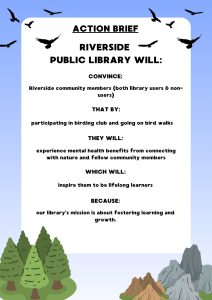
- Inspire Riverside community members (not just library users) to deepen their appreciation for and awareness of our local environments and to become lifelong learners
- Create meaningful connections between library staff and community members
- Facilitate intergenerational connections and community building
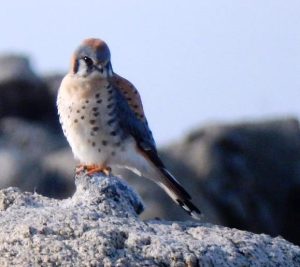
Birding is an accessible hobby, as it requires no equipment or prior experience, just a curiosity about birds. Additionally, birding, and interacting with nature generally, has proven mental health benefits, such as a reduced sense of isolation and loneliness and increased feelings of calm and mindfulness. Our Riverside community members would be greatly benefitted from participation in these programs through improved mental health and connection with fellow community members.
Aligning with Riverside Public Library’s Mission & Opportunities in Riverside Area
As the Riverside Public Library’s mission statement says, we want to “be the cultural and learning center for the community” and “encourag[e]…the power of lifelong learning.” Encouraging community members to engage in birding, and do so in a library-facilitated environment, is an invitation aligned with both of those aspects of the mission statement.
Why birding? A recent survey (2024) from the U.S. Fish & Wildlife Service found that “96 million people (or 3 out of 10 Americans) engaged in birding, making up 37% of the population aged 16 or older.” Participants identifying as birders meant they had spent either time or money to observe birds—e.g., traveling to go see birds, buying a bird feeder for their backyard, etc. That is a startling amount of the adult population! Surely, many birders are in our area and would delight in the opportunity to flock (pun absolutely intended) with fellow birders.
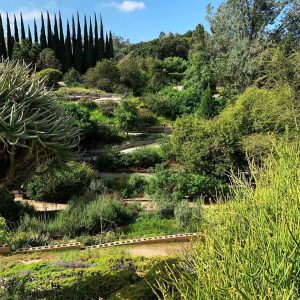
The library has ample meeting space for a monthly meeting, and there are many local and state parks and nature centers, ideal spots for birding, near each branch in the system. According to the popular birding platform, eBird, there are nearly 200 species of bird observed at UC Riverside’s Botanic Gardens (about 15 minutes away from the Main Library) alone.
Inspiration
-
- Alameda County Library – Lake Elizabeth Bird Walk
- Cincinnati Public Library – Bird Nerds
- East Lansing Public Library – ELPL Birding Club (Note: this club is especially inspiring, and the STEAM educator who runs it at the ELPL, Eric Berling, gave a virtual presentation that was a massive inspiration for this strategy outline: Running a Birding Club at YOUR Library: How to Launch and Sustain a Successful Program. Great resource for us to refer back to, especially for ideas for activities in monthly meetings.)
- Free Library of Philadelphia – Experience Nature in the City at Your Library
- Los Angeles Public Library – Storytime and Family Bird Walk at the Audubon Center
- Missoula Public Library – Beginner Bird Walk with the Feminist Bird Club
- Rochester Hills Public Library – Experience Birding with RHPL
- Sacramento Public Library – Bilingual Bird Watching – Sol Collective
Action Brief
Guidelines & Policies
-
- Birding club meetings will take place once a month at the library. No registration is required and people of all ages can attend. Preferably, these will be on Saturdays.
- Birding club meetings will be led by a rotating group of staff members.
- We will try to feature a guest presenter at each birding club meeting.
- There will be six bird walks annually.
- Bird walks will be facilitated and supported by library staff and led by either a library staff member or a local naturalist, scientist, Audubon society member, experienced birder, or artist.
- For bird walks, encourage participants to dress for the weather and bring water.
- For bird walks, choose parks and walking trails that are easy to walk, nothing strenuous.
- For bird walks, encourage participants to bring their own binoculars if they have them, but we will have at least 15 library-owned pairs to give out to participants who don’t have them.
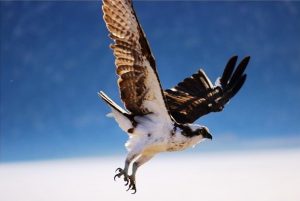
Osprey. Source.
Timeline for Implementation (2.5 Months)
- Weeks 1-3
- Orient staff on the new program and gauge interest for/establish staff members who’d like to lead birding clubs and bird walks.
- Finalize regular meeting dates for birding club and dates for bird walks.
- Begin creating promotional materials (physical and digital).
- Weeks 4-6
- Outreach to local naturalists, scientists, Audubon society members, passionate birders, and artists to begin scheduling for guest presentations and bird walks.
- Publish meeting dates on library website and across social media, put up flyers around the library, and distribute birding club bookmarks at checkout with QR codes to scan for more info.
- Weeks 7-8
- Continue promotional efforts.
- Host first birding club meeting.
- Evaluation of first birding club meeting.
- Weeks 9-10
- Continue promotional efforts.
- Host first bird walk.
- Evaluation of first bird walk.
Marketing & Promotion
Internal
The first few weeks of the timeline for implementation will be dedicated to promoting these programs within the organization. We will present the idea to staff, gauge interest for staff members that would be interested in taking the lead at meetings and walks, and invite feedback and ideas from staff—per Dr. Michael Stephens, “Hands-on experience equals…a path toward buy in,” so we want staff to be active participants to influence how this club is run. Dr. Eric Berling’s video on starting a birding club at the library can be disseminated to staff and/or clips from that video used during the initial presentation meeting. We will also utilize the creativity of staff members to create the promotional materials and multimedia resources for the program.
External
As referenced in the timeline, we will use all available communication channels—the library newsletter, Instagram, Facebook, TikTok, the library website, and spaces in the library itself—to reach our audience. In addition to flyers around the library, we will design bookmarks advertising the birding club (with a QR code that takes users to an information page on the library website) to pass out/will be free to grab when patrons come into the library. Once dates are finalized, they will be added to the calendar of events on the library website. We want to emphasize that all are welcome and that this club is a great way to reconnect with our local environments.
Staff Training & Readiness
Staff do not need to be bird experts or experienced birders to participate and/or lead these meetings and outings. They will be encouraged to watch Dr. Berling’s video, check out all the examples in the Inspiration section, and provide feedback and ideas. I will take the lead on the initial presentation to all staff, and then department heads will gauge interest and identify and select members of their teams to be the support staff for the club. Those selected staff will be under my supervision for all activities pertaining to the birding club.
Evaluation & Future Expansion
We will track attendance at both birding club meetings and bird walks, so we can monitor our progress over time. Per Dr. Stephens and Michael Casey, one effective way to measure progress is to “Engage staff and users by asking them for anecdotal evidence on how a new service is working.” This is in line with one of the program’s objectives: Create meaningful connections between library staff and community members. Staff can mingle with users before, during, and after programs, and as they connect with them, they will obtain anecdotal evidence for how well the club is working.
We hope to attract users of all ages and foster intergenerational connections. We want to see people of all ages interacting with each other and forming a little community/communities. If the program is popular enough, perhaps we can consider more frequent meetings and/or bird walks. We would love to get to a place where regular club members feel confident enough to lead certain parts of the monthly club meetings.
The beauty of a birding club is it’s inexpensive, uncomplicated, and doesn’t need to be perfect to start. Once again borrowing from Dr. Stephens, we can “Let [our] users help [us] work out the bugs” and “Admit openly…[that] there may be a few kinks.” Our primary focus should be to connect with our community members, help them connect with each other, and together share in the beauty and awesomeness of the natural world.
References
Adams, Jill U. – Birding With Benefits: How Nature Improves Our Mental Mindsets, 2019.
Alameda County Library – Lake Elizabeth Bird Walk.
Andrews, Jennifer G., Ammirati, Rachel J., & Andrews, Caleb J. M. – Birding Benefits: A Review of Mental Health, Cognitive, Social, and Conservation Impacts, 2024.
Casey, Michael & Stephens, Michael – Measuring Progress, 2008.
Cincinnati Public Library – Bird Nerds.
eBird – UC Riverside Botanic Gardens.
East Lansing Public Library – ELPL Birding Club.
Free Library of Philadelphia – Experience Nature in the City at Your Library, 2025.
Los Angeles Public Library – Storytime and Family Bird Walk at the Audubon Center.
Missoula Public Library – Beginner Bird Walk with the Feminist Bird Club.
Riverside Public Library – Mission & Vision.
Rochester Hills Public Library – Experience Birding with RHPL.
Sacramento Public Library – Bilingual Bird Watching – Sol Collective.
STAR Net, Eric Berling – Running a Birding Club at YOUR Library: How to Launch and Sustain a Successful Program (Video), 2026.
Stephens, Michael – Taming Technolust: Ten Steps for Planning in a 2.0 World, 2012.
Wetzel, Rosalie – Birding is Soaring in Popularity with Sky-High Impact, 2024.