
…libraries have become a crucial part of the safety net, the educational system, and the local democracy as well. If you’re a child, a parent, or a caretaker, you probably use the library to promote early reading and meet other people in your situation. If you’re homeless, you’re likely to go to the library when the shelter closes, because it’s safe, reliable, welcoming, and warm. The same is true if you’re mentally ill, or old, or unemployed and looking for work. It’s true if you’re an immigrant looking for a place to learn English or study for a citizenship test. It’s true if you’re a teacher looking for a place where your students can do research or borrow books. It’s true if you can’t afford a computer, or internet access. It’s true if you’re a teenager in search of a quiet place to study, or a social place to play video games because it’s better than being home alone or in the streets.
-Eric Klinenberg
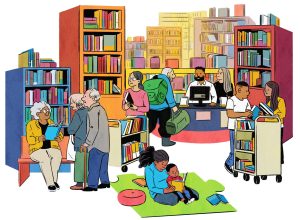
In my 6th grade English class, I was assigned to read the book Seedfolks by Paul Fleischman. Told from the perspectives of 13 residents in a diverse community in Cleveland, it is the story of the first year of a community garden that ends up uniting them. Despite their differences—in age, race, background, life circumstances—a sense of community grows as they interact and share in the joy of tending their garden. The feeling I had while reading that book as an 11-year-old has stayed with me, and that quote from Eric Klinenberg reminded me of it. The library is an important piece of social infrastructure that brings people, from all walks of life, into contact with each other. I thought the “Get To Know Your Neighbor” video from the Anythink Libraries was a beautiful illustration of this.
As I read Klinenberg’s Q&A and about the concept of hygge (a sense of sanctuary, community, living in the present, and celebrating everyday life, as Joe Pickard describes in his quote in @michael’s book, Wholehearted Librarianship), I began to think of the library as shelter from the noise and struggles of daily life. I also loved this quote from @michael’s book: “Perhaps promoting comfort , a sense of belonging, quiet, and coziness for our users will serve as an equalizer of sorts, balancing our “living out loud” times with a bit of warm and fuzzy.”
I discovered online that a branch of my county’s library system does something called Cozy Hobby Club, where people can come and share their games, art projects, crafts, or just share in everyone’s company while they read, work, or do their own thing. That kind of human connection is, as @michael described, a great counterbalance to the loud and chaotic online spaces where so many of us spend so much of our time.
Sometimes I feel like people just need even the smallest excuse/reason to gather and enjoy each other’s company. The library is a great excuse to gather and simply be with each other, even if we’re not doing, reading, or working on the same things. When I worked at a public library several years ago, in the thick of the pandemic, one of my biggest takeaways is how starved for connection and basic acknowledgement so many of us are. I loved being able to provide and receive some of that at the circulation desk, even if just for a brief moment—those small interactions were as, if not more, beneficial to me than as they were to those patrons during that time.
I follow a subreddit titled r/CozyInScaryOut, and it’s dedicated to artwork that gives people that cozy, hygge-type feeling. Maybe it sounds a little childish, but I think that could potentially be a great motto for new models of library service: we want to bring the cozy in and keep the scary out. Reflecting on this module made me want to keep thinking of creative ways to make sanctuary spaces in the library, and to promote programming that gives people a sense of belonging.

References
Gaetani, Mike – Q&A with Eric Klinenberg, 2018.
Riverside County Library System – Cozy Hobby Club.
Stephens, Michael – Wholehearted Librarianship: Finding Hope, Inspiration, and Balance, 2019. ISBN: 978-0-8389-1906-4.
@lclarkin99 I agree with you about the idea of CozyIn-ScaryOut fitting into the dialogue of what new library models can strive to create for their communities. This means approachability, safety, and a sense of comfort when you walk through the space- where you can lay down anxiety and the “scary”- and enter into the cozy head space of being in a place where you feel you belong.
Thank you for your thoughts!
Hey, @collectingtjp. Thanks for saying that! I loved that quote from @michael about promoting a sense of comfort, quiet, and belonging as an “equalizer” to balance out the more loud, chaotic parts of our lives–which, these days, seems to be ever-expanding and ever-increasing in volume. It’s such a relief to have spaces where there is no pressure to do anything, you can just simply be.
@lclarkin99 Hi Liam, I really enjoyed your post and your blog writing style. It’s very engaging. The small interactions you describe at the circulation desk are so important. I’ve found a kind comment or a brief conversation with a stranger can have a really positive influence on my day.
Hey, @littlelibrarian. Thanks for the kind words about my writing, I really appreciate that. And I’ve definitely noticed the same. I think a little can go a long way to help people feel comfortable and welcome.
@lclarkin99 I really love the idea of the cozy hobby club. Thank you for sharing this. It it’s like programming that is super easy to put on. My goodness. And I appreciated that subreddit that you shared as well. I think you really tapped into something about that feeling that people want, like warm spaces and cold weather, or feeling they belong to something. It’s so interesting, and thank you for quoting me.
Thanks, @michael! I think having those kind of spaces for people is so important. The stuff Eric Klinenberg talked about in the interview about his book on social infrastructure resonated deeply with me. Programming like cozy hobby club goes to show that you can instill that feeling of coziness even without major renovations or really expensive changes. Like you said, it’s so doable.
@lclarkin99 Excellent thought!