| This visual represents the ideas that had the greatest impact on my learning throughout the semester. My blog posts emphasized the importance of listening, storytelling, and community. My Inspiration Report demonstrated how global library innovations can inspire meaningful local change, and my Innovation Roadmap challenged me to apply these concepts to a real community need. Together, these experiences shaped my understanding of the Hyperlinked Library. I learned that it is not simply about adopting new or innovative technologies, but about creating meaningful library experiences with and for the community. Libraries should do more than provide access to information. They should create spaces where people connect, belong, and engage in learning experiences that extend beyond the library walls.
This visual is an original synthesis of my learning in INFO 287, drawing from my course blog reflections, Inspiration Report, and Innovation Strategy & Roadmap (Feltis, 2026). |
Category: Uncategorized
A major takeaway from Infinite Learning was that learning is everywhere and should include play. “Libraries create and facilitate learning.” These ideas are central to the Hyperlinked Library model. One example of this is the idea of offering “Adulting 101” skills through a library. These are often skills that get overlooked until someone is a struggling adult and demonstrate how we all still have something to learn. It is also a perfect example of how libraries can better serve the needs of their communities (Stephens, 2025).
I think my own philosophy in life aligns well with the idea that learning can happen everywhere. I believe we are never truly done learning, and one of the ideals I would like to instill in my students is the idea that each of us should strive to be lifelong learners. I also believe that we can all learn from each other. We can all be teachers or mentors who help one another navigate this constantly evolving world.
Furthermore, I think an “Idea Box,” in which patrons can add their thoughts and the knowledge they have, would help the community see themselves as important and knowledgeable community members (Kenney, 2013). It also shows that the library is a place for learning and that those who work there value patrons’ ideas. We do not live in a silo, and the more the community can be part of how libraries evolve, the more sustainable libraries will be. It can help create a positive and welcoming environment.
Next, sensory space is also a great addition to a library because it shows that the library values learning in multiple forms. It is a huge benefit to young children, but I would even go a step further and say we should not limit sensory spaces to children. There are many benefits to sensory learning for people of all ages. Creating spaces that recognize different learning needs allows libraries to become more inclusive and welcoming places for everyone (State Library of Queensland, 2018).
I also think it is amazing to view the library as a “gateway to learning” (Digital Promise, 2016). If it is a major philosophy of the Hyperlinked Library to encourage learning everywhere, then the library should be a central component of new learning experiences. I think it is exciting when we can give patrons or students experiences beyond the traditional classroom or workplace. Technology can be expensive, and when libraries are able to provide access to new and interactive technology experiences, it benefits student learning and growth while allowing patrons to gain skills that can support them in other areas of their lives.
Lastly, I think it is becoming increasingly important that we remind students and patrons that learning is fun. This can easily be done through library events, participatory experiences, discovery technology, and, of course, play. When libraries create opportunities for curiosity and exploration, they help people develop a lifelong love of learning (McKenzie, 2015).
Ultimately, the more libraries encourage curiosity, play, and shared learning experiences, the more they remind us that learning is not something we finish, but something we continue throughout our lives.
References
Digital Promise. (2016, January 28). Chicago Public Library: The library as a gateway to 21st-century skills. https://digitalpromise.org/2016/01/28/chicago-public-library-the-library-as-a-gateway-to-21st-century-skills/
Kenney, B. (2013, February 1). Embracing user-generated content. Public Libraries Online. https://publiclibrariesonline.org/2013/02/embracing/
McKenzie, L. (2015, April 22). 8 awesome ways libraries make learning fun. HuffPost. https://www.huffpost.com/entry/8-awesome-ways-libraries_b_7157462
State Library of Queensland. (2018, September 6). Check out Marsden Library’s sensory space. https://plconnect.slq.qld.gov.au/blog/plconnect/2018/09/06/check-out-marsden-librarys-sensory-space
Stephens, M. (2025). Hyperlinked Library: Learning everywhere [Panopto lecture]. San José State University School of Information. https://sjsu-ischool.hosted.panopto.com/Panopto/Pages/Viewer.aspx?id=012f4ddc-7161-407c-b277-af34011b768c
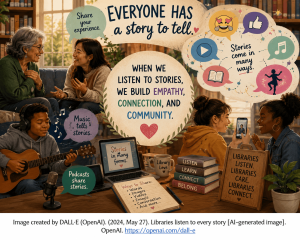
When reading and learning about narrative inquiry, I liked the idea of asking more personal and meaningful questions. Furthermore, I agree that if you ask patrons what they think of the library, they will often tell you what they want or provide overly critical feedback that is not always the most useful. Instead, asking about their personal experiences invites deeper conversations and helps uncover the stories behind their needs.
Interestingly, I have found that when I ask my students more open-ended, reflective questions, many of them struggle to answer. They often want the “right” answer instead of sharing what they genuinely think or feel. That observation makes me think that reflection is a skill we need to intentionally develop, especially with young people. We should be helping students learn how to tell their own stories because those stories shape who they are and how they connect with others. Stephens (2019) emphasizes the importance of creating spaces where people feel heard and valued. In this week’s lecture, Stephens also discussed how storytelling builds empathy, creates connections, and helps libraries better understand the communities they serve (Stephens, 2026). Likewise, Mairn and Terrana’s (2022) concept of a Listening Lab extends this idea by reminding us that stories take many forms. They are not simply written narratives but can also be shared through music, podcasts, videos, and more. Libraries should take the time to truly listen to their patrons and help them communicate their stories in ways that make sense to them. This not only supports each individual but also builds a stronger sense of community.
Continuing with this idea, storytelling does not always have to involve writing. I love the idea that people can communicate their stories in different ways, especially those who struggle to find the right words. Emojis are very relatable and allow unspoken communication. It is unfortunate that there still is not an emoji for the library, at least not on my phone. I checked! It is interesting to think about how emojis continue to evolve and change, just as language does. TikTok videos also make storytelling more accessible by allowing people to share short narratives through dance, music, memes, humor, or other creative formats. Stephens (2019) suggests that “student work could someday evolve to be more visual and image-based, a blend of text, ideograms, pictures, and other media” (p. 91). I could definitely see this happening. Students are becoming increasingly disengaged with traditional learning, yet many become excited when they are given opportunities to create projects or experiment with technology in new ways. These different forms of storytelling allow more people to participate and communicate in ways that feel authentic to them.
Ultimately, this module reminded me that libraries are not just places that provide information, but also places that encourage and amplify human stories. Whether those stories are told through books, podcasts, videos, emojis, conversations, or forms of communication we have not even imagined yet, each one has value. To me, that is one of the central messages of this module: listening to people’s stories is one of the most meaningful ways libraries can build community and create a sense of belonging.
References
Mairn, C., & Terrana, J. (2022). A Library’s Listening Lab. Public Libraries.
Stephens, M. (2019). Wholehearted librarianship: Finding meaning, purpose, and passion in your library career. ALA Editions.
Stephens, M. (2026). Module 10: The power of stories [Course lecture]. INFO 287: The Hyperlinked Library, San José State University School of Information.
|
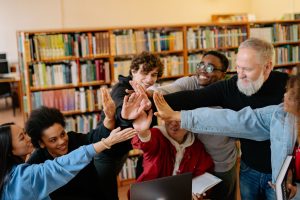
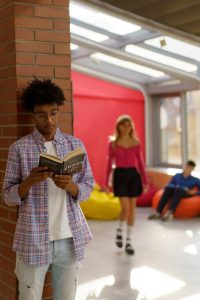

There are a lot of ways in which libraries can help people, but even more importantly, they provide a place to “pursue happiness.” How cool would it be to have a safe space to hang out with friends? I remember feeling like I could use a space to go away from home sometimes. The teen space at the Monroe County Library (Monroe County Library, 2019) really made me think about this. I also feel like my middle school students are often seeking spaces for themselves and ways to express themselves. The library can create that space for them.
I also found it very interesting that I just finished the fiction book Happier Here with You, which has themes of family and connection. It also discussed hygge, describing it as more than just “coziness,” but a feeling someone gets in a place. The library should elicit that feeling. It should encourage the same ideas of connection that the book does, including connections with history and helping when a community member is in need.
The story of the boy and the puppet show in Pam Sandlian Smith’s TEDxMileHigh talk really resonated with me because we might not know what people are going through, but with kindness and openness, we will make a difference. One yes can change someone’s life. Libraries need to listen to their patrons because they have great ideas that reveal needs within a community and show how willing people are to help.
One question I kept thinking about throughout the module was how libraries can provide all of the services that communities need. There were numerous videos highlighting the various ways libraries are helping people. The video about providing dementia resources reminded me that many library branches operate within a larger system, which can be a real advantage when offering specialized services across an entire region. It made me realize that communication between libraries is just as important as communication with the community.
Social infrastructure is hugely important to a functioning community. I agree that we need leaders who can see that schools and libraries contribute to the overall well-being of people within each community (Gaetani, 2018). As a teacher, I really appreciate how libraries are now providing spaces for multiple types of learning. Many people need to be able to talk and do in order to learn. Sometimes I feel like this goes too far in our jam-packed classrooms, and I am unable to provide all of the needed learning spaces. Having a quiet space is still just as important. I am glad libraries are providing a variety of learning environments. I also like the idea that a library can be a place to create, not just a place to learn.
References
Gaetani, M. (2018). Libraries and social infrastructure. Public Libraries Online. https://publiclibrariesonline.org/2018/10/libraries-social-infrastructure/
Monroe County Library. (2019, August 29). Teen space: Ground floor [Video]. YouTube.
Smith, P. S. (2016, September). The human library: Creating places people love [TEDx Talk]. TEDxMileHigh. https://www.ted.com/tedx
Stephens, M. (2019). Wholehearted librarianship: Finding hope, inspiration, and balance. ALA Editions.

Image by Myriams-Fotos from Pixabay
With the hyperlinked environment readings this week being a “choose-your-own-adventure experience”, I, of course, was first drawn to looking at the school library resources. Although as I started to read and explore the different articles, I found that much of what I read overlapped with other classes or previously learned in this class. Ideas like learning commons, participatory spaces, collaboration, and community. This is validating, since it means I already have a strong understanding of what a Hyperlinked Library is, because a Hyperlinked Library is a good library that embraces strong, user-centered practices and continually evolves to meet the changing needs of its community.
From there, I found myself exploring more of the technology piece of Hyperlinked Environments. I find that we can never fully have enough knowledge and understanding of current technology because it continues to change so quickly. This affects learning, communication, and perhaps most importantly, how people are accessing information. As I read it also reminded me how important data is. The numerous Pew Research studies included in this module use data to illustrate changing technology habits, including the growth of artificial intelligence awareness (Kennedy et al., 2023), evolving social media use (Vogels & Gelles-Watnick, 2023), and the ways people consume news and information (Shearer et al., 2023). These trends provide valuable insight into how libraries can anticipate and respond to the changing needs of their communities.
This should be a cornerstone practice of every library. Rather than making decisions based on what was previously done or simply following the latest trend, libraries should regularly look at what the data says about both their community and their own services. It would help build a better understanding of who is using the library, what resources are in demand, and how the world is changing. It would also help to discover where gaps in access exist, allowing libraries to make informed decisions that truly benefit their users. Data should help drive innovation.
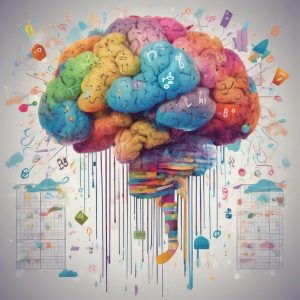
Image by AiCanvas from Pixabay
One example of this is Kennedy et al.’s (2023) report on public awareness of artificial intelligence. With AI becoming increasingly integrated into search engines, productivity tools, and education, I was surprised that many people were unaware of how often they were already interacting with AI in their everyday lives. As a sixth-grade teacher, I see how quickly students have adopted AI tools, often without fully understanding how they work or recognizing their limitations. In fact, my school district recently blocked Google’s Gemini AI summaries because many students were reading only the AI-generated overview instead of exploring the actual websites or sources. While AI can be an incredibly useful tool, this experience highlighted the importance of teaching students to think critically about the information they consume rather than accepting the first answer they see. Libraries can help users understand how AI generates information, recognize its limitations and potential biases, and use these tools responsibly as part of the research process rather than as a replacement for it. Digital literacy has become more important than ever.
Lastly, I could not help but make a connection between Formula 1 racing and Hyperlinked Environments. Every Formula 1 team starts with data and continues to collect and analyze it. Every lap, every practice session, and every race generates information that engineers use to improve performance. It is about continually evaluating data, making thoughtful adjustments, and always looking ahead to the next innovation. In Formula 1, even the smallest changes can win a championship or move a team ahead of its competitors. I think libraries should adopt that same mindset. They cannot afford to stand still while technology and community needs continue to evolve. Instead, they should continually assess, adapt, and innovate while keeping equitable access and user needs at the center of every decision.

BAHRAIN, BAHRAIN – MARCH 02: Christian Horner of Great Britain and Red Bull Racing on the Pit Wall during the F1 Grand Prix of Bahrain at Bahrain International Circuit on March 02, 2024 in Bahrain, Bahrain. (Photo by Peter Fox – Formula 1/Formula 1 via Getty Images)
For me, that is what the future of the Hyperlinked Library looks like. It is innovative without chasing every trend, technologically advanced without losing sight of its purpose, and guided by evidence rather than assumptions. The technology will continue to change, but the goal remains the same: To help every member of the community access information, develop digital literacy, and confidently navigate an increasingly connected world.
References
Kennedy, B., Tyson, A., & Saks, E. (2023). Public awareness of artificial intelligence in everyday activities. Pew Research Center.
Lu, K. (2017). Growth in mobile news use driven by older adults. Pew Research Center.
Shearer, E., et al. (2023). How Americans use podcasts to get news and information. Pew Research Center.
Smith, A., & Anderson, M. (2018). Social media use in 2018: Demographics and statistics. Pew Research Center.
Vogels, E. A., & Gelles-Watnick, R. (2023). Teens and social media: Key findings from Pew Research. Pew Research Center.
Inclusion has been a hot topic in education over the last decade, and, honestly, throughout the rest of the world as well. Lauersen’s presentation on inclusion discussed how inclusion for the sake of saying you’ve done inclusion is not effective unless you look at the community being represented and learn what they need. (Lauersen, 2018). In “The Heart of Librarianship,” Stephens (2016) explains that reaching all users begins by asking who is currently benefiting from the library, being transparent throughout the process, and finding a balance between services and projects to ensure a program meets all users’ needs. That is how the process of inclusion should begin, with asking the hard questions and finding accountability.
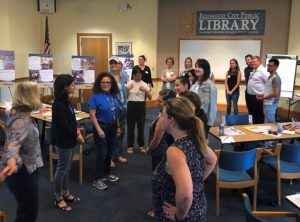
CK Group, n.d. [Photograph of inclusive library programming and community engagement]
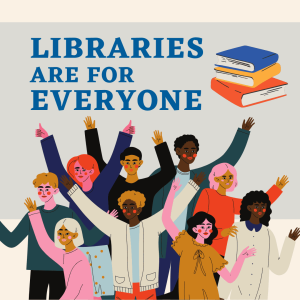
Atlanta-Fulton Public Library Foundation. (n.d.). Inclusion at your library.
It has been reiterated time after time that the library is for everyone. It’s for the young and the old, the majority populations, and, perhaps even more importantly, the minority populations within a community. This also includes providing technology support because, to all because as Stephens (2019) reminds us in Wholehearted Librarianship, technology is no longer just an add-on to library services. Technology is a skill that helps people learn and live. That is a big part of inclusion.
Overall, I have found that the Hyperlinked Library is all about creating meaningful and innovative ways to support the whole community. Not just offering the new hip thing or doing things the way they have always been done, but instead it is about listening to the community and building connections so that all are truly welcome.
References
Greenwood, C. (2022). Healthy library, healthy life. Public Libraries Online. https://publiclibrariesonline.org/2022/02/healthy-library-healthy-life/
Hasan, T. N. (2022, November 30). ‘Free, non-judgemental, accessible’: How your local library is a sanctuary of health and wellness. SBS News. https://www.sbs.com.au/news/article/free-non-judgemental-accessible-how-your-local-library-is-a-sanctuary-of-health-and-wellness/3v3p3frh0
Lauersen, C. (2018). Do you want to dance? Inclusion and belonging in libraries and beyond. https://christianlauersen.net/2018/06/07/do-you-want-to-dance-inclusion-and-belonging-in-libraries-and-beyond/
Ralph, S. (2021, October). The magic of libraries [Video]. TED Conferences. https://www.ted.com/talks/stephanie_ralph_the_magic_of_libraries
Stephens, M. (2016). The heart of librarianship. ALA Editions.
Stephens, M. (2019). Wholehearted librarianship. ALA Editions.
Williams, A. (2021, March 17). Libraries are bridging the digital divide. Internet Society. https://www.internetsociety.org/blog/2021/03/libraries-are-bridging-the-digital-divide/
Much of the coursework so far has focused on public libraries, but I can’t help making numerous connections to teaching and school libraries. Asking myself what this might look like within public education, and how my students can benefit from the ideas I learn?
Overwhelmingly, a major theme of the Hyperlinked Library is connection to people, information, and community. A well-functioning library meets the needs of the community and is a place for people to connect. It is the same in the classroom. To gain buy-in from students, there needs to be connections between teachers and students and learning. I don’t know how many times I have heard about the importance of “building a relationship”, and I see that emphasized in the Hyperlinked Library, as well.
Just as OPACs and formats do not build relationships, neither does curriculum. People create connections. Technology, however, can help strengthen and expand those connections. I have looked at many public library websites, and my impressions shape what I think about a library before I ever visit it. The same is true for school websites, teachers’ Google Classrooms, and library webpages. Schneider (2006) argues that when users struggle to access services, the problem is often not the user but the design itself. Students and patrons should not have to work hard to find the information or resources they need.
Impressions matter, and so do users’ abilities to find what they need and connect within the community. live in Los Angeles County and feel like their website is coherent, simple in a sophisticated way, and always allows patrons to find out what is happening within the community.
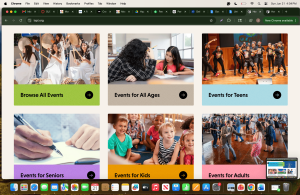
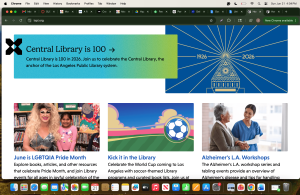
Screenshots of the Los Angeles County Library homepage (Los Angeles County Library, 2026). https://www.lapl.org/
Visibility is also important. Fons (2016) argues that libraries must be visible where their users already spend time online. A few weeks ago, a public library’s TikTok appeared on my feed. I cannot remember which library it was, but I remember the positive impression it left. The library seemed like a fun and approachable place. In a world filled with information and misinformation, libraries and schools must remain visible, trustworthy, and connected to their communities.
My district has one teacher librarian serving eight schools, making it difficult to meet every need. Yet technology allows her to stay connected through emails, updates, and communication with the school community and staff. Technology allows people to connect on a mass scale. I can reach out for feedback as a teacher to 150+ students using technology, rather than just connecting 1:1.
Furthermore, it allows the community and staff to be aware of the resources available to them. I have watched thousands of dollars’ worth of makerspace technology wasted due to a lack of people. How can the school community work together to make the library a better space? Students are constantly looking for places to connect, especially in middle school. One of the most effective approaches I have seen is just to have open hours. Having students connect within a safe space can be very effective and can transform a space into a connection.
The idea of participatory service is imperative because it offers a way to strengthen these connections. Casey (2011) argues that participatory service begins by listening to community members and involving them in shaping services. Students are constantly looking for places where they feel valued and can connect. By inviting students, families, and staff to share ideas and help shape library programs, school libraries can become true community hubs. The Hyperlinked Library reminds us that libraries are not just about information, but more importantly, they are about people.
References
Casey, M. (2011). Revisiting participatory service in trying times – A TTW guest post by Michael Casey. Tame the Web. https://tametheweb.com
Casey, M. E., & Savastinuk, L. C. (2007). Library 2.0: A guide to participatory library service. Information Today.
Fons, T. (2016). Making libraries visible on the web. Tame the Web. https://tametheweb.com
Schneider, K. G. (2006). The user is not broken. Free Range Librarian. https://freerangelibrarian.com
Stephens, M. (2016). Participatory service [Course lecture]. San José State University School of Information. https://sjsu-ischool.hosted.panopto.com/Panopto/Pages/Viewer.aspx?id=2a19a4b6-e945-4d2e-abf1-aef3014172a5
Stephens, M. (2016). The heart of librarianship: Attentive, positive, and purposeful change. ALA Editions.
Stephens, M. ( 2019). Wholehearted librarianship: Finding hope, inspiration, and balance. ALA Editions.
My name is Jana Feltis, and I am located in Southern California. I am currently working toward both my Teacher Librarian Credential and my MLIS. Originally, I had selected a different elective, but after reading the course description for it, I realized it wasn’t something I was excited about. So I went looking for another course, and I find myself drawn more to the technology based coures. I am looking forward to learning more about the Hyperlinked Library and how technology can help libraries better connect with their communities.
I am currently a sixth-grade teacher at a middle school, though I have spent much of my ten-year teaching career working in elementary education. This coming school year, I will be teaching Language and Literature as well as Ancient Civilizations while I complete the MLIS program. As for what comes after, that is up in the air, but I hope to find a role where I can combine my passion for teaching with the knowledge and skills I am gaining through librarianship.
Outside of school and work, I enjoy AquaZumba, strength training, and traveling whenever I can. My husband and I are also avid Formula 1 fans and rarely miss a race weekend. I also have two dogs named Millie. My husband and I each had a dog named Millie before we met. We affectionately call them Big Millie and Little Millie now.
I’m excited to begin this journey with all of you and to explore new ideas about technology, innovation, and the future of libraries.