Month: June 2026

Blog Reflection: Hyperlinked Communities and Inclusion in Libraries

Inclusion has been a hot topic in education over the last decade, and, honestly, throughout the rest of the world as well. Lauersen’s presentation on inclusion discussed how inclusion for the sake of saying you’ve done inclusion is not effective unless you look at the community being represented and learn what they need. (Lauersen, 2018). In “The Heart of Librarianship,” Stephens (2016) explains that reaching all users begins by asking who is currently benefiting from the library, being transparent throughout the process, and finding a balance between services and projects to ensure a program meets all users’ needs. That is how the process of inclusion should begin, with asking the hard questions and finding accountability. 
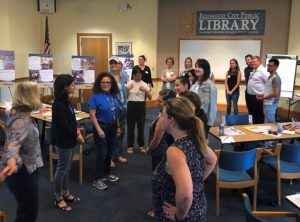
CK Group, n.d. [Photograph of inclusive library programming and community engagement]
The TEDx Talk, The Magic of Libraries, reminds us that the library is a remarkable place and that the best libraries are the ones that adapt and respond.  I think this means responding to the times, to current events as they happen, and, most importantly, to the patrons they serve. Several of this week’s readings discussed an aging population, increasing loneliness, and dealing with fake news (Greenwood, 2022; Hasan, 2022; Williams, 2021). These are all prevalent community issues in which libraries should be helping support. 

Atlanta-Fulton Public Library Foundation. (n.d.). Inclusion at your library.

It has been reiterated time after time that the library is for everyone. It’s for the young and the old, the majority populations, and, perhaps even more importantly, the minority populations within a community. This also includes providing technology support because, to all because as Stephens (2019) reminds us in Wholehearted Librarianship,  technology is no longer just an add-on to library services. Technology is a skill that helps people learn and live. That is a big part of inclusion. 

Overall, I have found that the Hyperlinked Library is all about creating meaningful and innovative ways to support the whole community. Not just offering the new hip thing or doing things the way they have always been done, but instead it is about listening to the community and building connections so that all are truly welcome.

References

Greenwood, C. (2022). Healthy library, healthy life. Public Libraries Online. https://publiclibrariesonline.org/2022/02/healthy-library-healthy-life/

Hasan, T. N. (2022, November 30). ‘Free, non-judgemental, accessible’: How your local library is a sanctuary of health and wellness. SBS News. https://www.sbs.com.au/news/article/free-non-judgemental-accessible-how-your-local-library-is-a-sanctuary-of-health-and-wellness/3v3p3frh0

Lauersen, C. (2018). Do you want to dance? Inclusion and belonging in libraries and beyond. https://christianlauersen.net/2018/06/07/do-you-want-to-dance-inclusion-and-belonging-in-libraries-and-beyond/

Ralph, S. (2021, October). The magic of libraries [Video]. TED Conferences. https://www.ted.com/talks/stephanie_ralph_the_magic_of_libraries

Stephens, M. (2016). The heart of librarianship. ALA Editions.

Stephens, M. (2019). Wholehearted librarianship. ALA Editions.

Williams, A. (2021, March 17). Libraries are bridging the digital divide. Internet Society. https://www.internetsociety.org/blog/2021/03/libraries-are-bridging-the-digital-divide/
Assignment X: Connections, People, & the Hyperlinked Library

Much of the coursework so far has focused on public libraries, but I can’t help making numerous connections to teaching and school libraries. Asking myself what this might look like within public education, and how my students can benefit from the ideas I learn?

Overwhelmingly, a major theme of the Hyperlinked Library is connection to people, information, and community. A well-functioning library meets the needs of the community and is a place for people to connect. It is the same in the classroom. To gain buy-in from students, there needs to be connections between teachers and students and learning. I don’t know how many times I have heard about the importance of  “building a relationship”, and I see that emphasized in the Hyperlinked Library, as well. 

Just as OPACs and formats do not build relationships, neither does curriculum. People create connections. Technology, however, can help strengthen and expand those connections. I have looked at many public library websites, and my impressions shape what I think about a library before I ever visit it. The same is true for school websites, teachers’ Google Classrooms, and library webpages. Schneider (2006) argues that when users struggle to access services, the problem is often not the user but the design itself. Students and patrons should not have to work hard to find the information or resources they need.

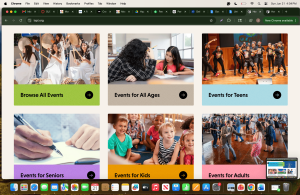
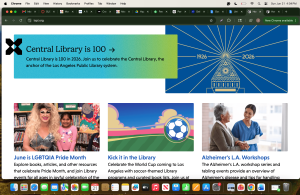
Impressions matter, and so do users’ abilities to find what they need and connect within the community.  live in Los Angeles County and feel like their website is coherent, simple in a sophisticated way, and always allows patrons to find out what is happening within the community. 

Screenshots of the Los Angeles County Library homepage (Los Angeles County Library, 2026). https://www.lapl.org/

Visibility is also important. Fons (2016) argues that libraries must be visible where their users already spend time online. A few weeks ago, a public library’s TikTok appeared on my feed. I cannot remember which library it was, but I remember the positive impression it left. The library seemed like a fun and approachable place.  In a world filled with information and misinformation, libraries and schools must remain visible, trustworthy, and connected to their communities.

My district has one teacher librarian serving eight schools, making it difficult to meet every need. Yet technology allows her to stay connected through emails, updates, and communication with the school community and staff. Technology allows people to connect on a mass scale. I can reach out for feedback as a teacher to 150+ students using technology, rather than just connecting 1:1.

Furthermore, it allows the community and staff to be aware of the resources available to them.  I have watched thousands of dollars’ worth of makerspace technology wasted due to a lack of people. How can the school community work together to make the library a better space? Students are constantly looking for places to connect, especially in middle school. One of the most effective approaches I have seen is just to have open hours. Having students connect within a safe space can be very effective and can transform a space into a connection. 

The idea of participatory service is imperative because it offers a way to strengthen these connections. Casey (2011) argues that participatory service begins by listening to community members and involving them in shaping services. Students are constantly looking for places where they feel valued and can connect. By inviting students, families, and staff to share ideas and help shape library programs, school libraries can become true community hubs. The Hyperlinked Library reminds us that libraries are not just about information, but more importantly, they are about people. 

References

Casey, M. (2011). Revisiting participatory service in trying times – A TTW guest post by Michael Casey. Tame the Web. https://tametheweb.com

Casey, M. E., & Savastinuk, L. C. (2007). Library 2.0: A guide to participatory library service. Information Today.

Fons, T. (2016). Making libraries visible on the web. Tame the Web. https://tametheweb.com

Schneider, K. G. (2006). The user is not broken. Free Range Librarian. https://freerangelibrarian.com

Stephens, M. (2016). Participatory service [Course lecture]. San José State University School of Information. https://sjsu-ischool.hosted.panopto.com/Panopto/Pages/Viewer.aspx?id=2a19a4b6-e945-4d2e-abf1-aef3014172a5

Stephens, M. (2016). The heart of librarianship: Attentive, positive, and purposeful change. ALA Editions.

Stephens, M. (  2019). Wholehearted librarianship: Finding hope, inspiration, and balance. ALA Editions.

Hello Everyone!

My name is Jana Feltis, and I am located in Southern California. I am currently working toward both my Teacher Librarian Credential and my MLIS. Originally, I had selected a different elective, but after reading the course description for it, I realized it wasn’t something I was excited about.  So I went looking for another course, and I find myself drawn more to the technology based coures. I am looking forward to learning more about the Hyperlinked Library and how technology can help libraries better connect with their communities.

I am currently a sixth-grade teacher at a middle school, though I have spent much of my ten-year teaching career working in elementary education. This coming school year, I will be teaching Language and Literature as well as Ancient Civilizations while I complete the MLIS program. As for what comes after, that is up in the air, but I hope to find a role where I can combine my passion for teaching with the knowledge and skills I am gaining through librarianship.

Outside of school and work, I enjoy AquaZumba, strength training, and traveling whenever I can. My husband and I are also avid Formula 1 fans and rarely miss a race weekend. I also have two dogs named Millie. My husband and I each had a dog named Millie before we met. We affectionately call them Big Millie and Little Millie now.

I’m excited to begin this journey with all of you and to explore new ideas about technology, innovation, and the future of libraries.

© 2026 A Hyperlink in Time

Theme by Anders NorenUp ↑