Much of the coursework so far has focused on public libraries, but I can’t help making numerous connections to teaching and school libraries. Asking myself what this might look like within public education, and how my students can benefit from the ideas I learn?
Overwhelmingly, a major theme of the Hyperlinked Library is connection to people, information, and community. A well-functioning library meets the needs of the community and is a place for people to connect. It is the same in the classroom. To gain buy-in from students, there needs to be connections between teachers and students and learning. I don’t know how many times I have heard about the importance of “building a relationship”, and I see that emphasized in the Hyperlinked Library, as well.
Just as OPACs and formats do not build relationships, neither does curriculum. People create connections. Technology, however, can help strengthen and expand those connections. I have looked at many public library websites, and my impressions shape what I think about a library before I ever visit it. The same is true for school websites, teachers’ Google Classrooms, and library webpages. Schneider (2006) argues that when users struggle to access services, the problem is often not the user but the design itself. Students and patrons should not have to work hard to find the information or resources they need.
Impressions matter, and so do users’ abilities to find what they need and connect within the community. live in Los Angeles County and feel like their website is coherent, simple in a sophisticated way, and always allows patrons to find out what is happening within the community.
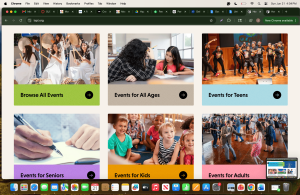
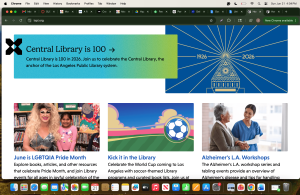
Screenshots of the Los Angeles County Library homepage (Los Angeles County Library, 2026). https://www.lapl.org/
Visibility is also important. Fons (2016) argues that libraries must be visible where their users already spend time online. A few weeks ago, a public library’s TikTok appeared on my feed. I cannot remember which library it was, but I remember the positive impression it left. The library seemed like a fun and approachable place. In a world filled with information and misinformation, libraries and schools must remain visible, trustworthy, and connected to their communities.
My district has one teacher librarian serving eight schools, making it difficult to meet every need. Yet technology allows her to stay connected through emails, updates, and communication with the school community and staff. Technology allows people to connect on a mass scale. I can reach out for feedback as a teacher to 150+ students using technology, rather than just connecting 1:1.
Furthermore, it allows the community and staff to be aware of the resources available to them. I have watched thousands of dollars’ worth of makerspace technology wasted due to a lack of people. How can the school community work together to make the library a better space? Students are constantly looking for places to connect, especially in middle school. One of the most effective approaches I have seen is just to have open hours. Having students connect within a safe space can be very effective and can transform a space into a connection.
The idea of participatory service is imperative because it offers a way to strengthen these connections. Casey (2011) argues that participatory service begins by listening to community members and involving them in shaping services. Students are constantly looking for places where they feel valued and can connect. By inviting students, families, and staff to share ideas and help shape library programs, school libraries can become true community hubs. The Hyperlinked Library reminds us that libraries are not just about information, but more importantly, they are about people.
References
Casey, M. (2011). Revisiting participatory service in trying times – A TTW guest post by Michael Casey. Tame the Web. https://tametheweb.com
Casey, M. E., & Savastinuk, L. C. (2007). Library 2.0: A guide to participatory library service. Information Today.
Fons, T. (2016). Making libraries visible on the web. Tame the Web. https://tametheweb.com
Schneider, K. G. (2006). The user is not broken. Free Range Librarian. https://freerangelibrarian.com
Stephens, M. (2016). Participatory service [Course lecture]. San José State University School of Information. https://sjsu-ischool.hosted.panopto.com/Panopto/Pages/Viewer.aspx?id=2a19a4b6-e945-4d2e-abf1-aef3014172a5
Stephens, M. (2016). The heart of librarianship: Attentive, positive, and purposeful change. ALA Editions.
Stephens, M. ( 2019). Wholehearted librarianship: Finding hope, inspiration, and balance. ALA Editions.
Jana, I think all these connections that you wrote about are vital for libraries. It’s these relationships that foster innovation, creativity, and meet the various needs of the users of the library. Like you alluded to in your post, it applies to teaching as well. Students don’t get much out of a class unless they are vested in the subject. It’s the job of the teacher to help make those connections that keep the students coming back. Being an adjunct teacher myself, I see this all the time at the collegiate level because you know those students enjoy the classes they can make those kinds of connections whether in person or online.
I also believe that the digital realm is an extension of your library, so making it just as inviting and useful is very important. Again, users want to have a good experience using the library website and making it simple yet functional that appeals to the general population is essential as well as providing a service where they can get not only information, but other resources, especially public libraries where they can be somewhat of the “pulse” of the community. This also extends to social media pages where they put out content that vibes with the viewers and their content is shared because someone found it useful and meaningful and therefore spread the word.