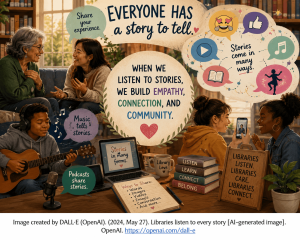
A major takeaway from Infinite Learning was that learning is everywhere and should include play. “Libraries create and facilitate learning.” These ideas are central to the Hyperlinked Library model. One example of this is the idea of offering “Adulting 101” skills through a library. These are often skills that get overlooked until someone is a struggling adult and demonstrate how we all still have something to learn. It is also a perfect example of how libraries can better serve the needs of their communities (Stephens, 2025).
I think my own philosophy in life aligns well with the idea that learning can happen everywhere. I believe we are never truly done learning, and one of the ideals I would like to instill in my students is the idea that each of us should strive to be lifelong learners. I also believe that we can all learn from each other. We can all be teachers or mentors who help one another navigate this constantly evolving world.
Furthermore, I think an “Idea Box,” in which patrons can add their thoughts and the knowledge they have, would help the community see themselves as important and knowledgeable community members (Kenney, 2013). It also shows that the library is a place for learning and that those who work there value patrons’ ideas. We do not live in a silo, and the more the community can be part of how libraries evolve, the more sustainable libraries will be. It can help create a positive and welcoming environment.
Next, sensory space is also a great addition to a library because it shows that the library values learning in multiple forms. It is a huge benefit to young children, but I would even go a step further and say we should not limit sensory spaces to children. There are many benefits to sensory learning for people of all ages. Creating spaces that recognize different learning needs allows libraries to become more inclusive and welcoming places for everyone (State Library of Queensland, 2018).
I also think it is amazing to view the library as a “gateway to learning” (Digital Promise, 2016). If it is a major philosophy of the Hyperlinked Library to encourage learning everywhere, then the library should be a central component of new learning experiences. I think it is exciting when we can give patrons or students experiences beyond the traditional classroom or workplace. Technology can be expensive, and when libraries are able to provide access to new and interactive technology experiences, it benefits student learning and growth while allowing patrons to gain skills that can support them in other areas of their lives.
Lastly, I think it is becoming increasingly important that we remind students and patrons that learning is fun. This can easily be done through library events, participatory experiences, discovery technology, and, of course, play. When libraries create opportunities for curiosity and exploration, they help people develop a lifelong love of learning (McKenzie, 2015).
Ultimately, the more libraries encourage curiosity, play, and shared learning experiences, the more they remind us that learning is not something we finish, but something we continue throughout our lives.
References
Digital Promise. (2016, January 28). Chicago Public Library: The library as a gateway to 21st-century skills. https://digitalpromise.org/2016/01/28/chicago-public-library-the-library-as-a-gateway-to-21st-century-skills/
Kenney, B. (2013, February 1). Embracing user-generated content. Public Libraries Online. https://publiclibrariesonline.org/2013/02/embracing/
McKenzie, L. (2015, April 22). 8 awesome ways libraries make learning fun. HuffPost. https://www.huffpost.com/entry/8-awesome-ways-libraries_b_7157462
State Library of Queensland. (2018, September 6). Check out Marsden Library’s sensory space. https://plconnect.slq.qld.gov.au/blog/plconnect/2018/09/06/check-out-marsden-librarys-sensory-space
Stephens, M. (2025). Hyperlinked Library: Learning everywhere [Panopto lecture]. San José State University School of Information. https://sjsu-ischool.hosted.panopto.com/Panopto/Pages/Viewer.aspx?id=012f4ddc-7161-407c-b277-af34011b768c