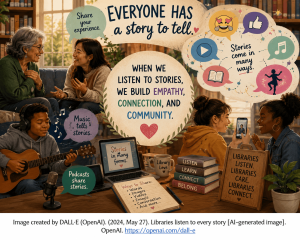
When reading and learning about narrative inquiry, I liked the idea of asking more personal and meaningful questions. Furthermore, I agree that if you ask patrons what they think of the library, they will often tell you what they want or provide overly critical feedback that is not always the most useful. Instead, asking about their personal experiences invites deeper conversations and helps uncover the stories behind their needs.
Interestingly, I have found that when I ask my students more open-ended, reflective questions, many of them struggle to answer. They often want the “right” answer instead of sharing what they genuinely think or feel. That observation makes me think that reflection is a skill we need to intentionally develop, especially with young people. We should be helping students learn how to tell their own stories because those stories shape who they are and how they connect with others. Stephens (2019) emphasizes the importance of creating spaces where people feel heard and valued. In this week’s lecture, Stephens also discussed how storytelling builds empathy, creates connections, and helps libraries better understand the communities they serve (Stephens, 2026). Likewise, Mairn and Terrana’s (2022) concept of a Listening Lab extends this idea by reminding us that stories take many forms. They are not simply written narratives but can also be shared through music, podcasts, videos, and more. Libraries should take the time to truly listen to their patrons and help them communicate their stories in ways that make sense to them. This not only supports each individual but also builds a stronger sense of community.
Continuing with this idea, storytelling does not always have to involve writing. I love the idea that people can communicate their stories in different ways, especially those who struggle to find the right words. Emojis are very relatable and allow unspoken communication. It is unfortunate that there still is not an emoji for the library, at least not on my phone. I checked! It is interesting to think about how emojis continue to evolve and change, just as language does. TikTok videos also make storytelling more accessible by allowing people to share short narratives through dance, music, memes, humor, or other creative formats. Stephens (2019) suggests that “student work could someday evolve to be more visual and image-based, a blend of text, ideograms, pictures, and other media” (p. 91). I could definitely see this happening. Students are becoming increasingly disengaged with traditional learning, yet many become excited when they are given opportunities to create projects or experiment with technology in new ways. These different forms of storytelling allow more people to participate and communicate in ways that feel authentic to them.
Ultimately, this module reminded me that libraries are not just places that provide information, but also places that encourage and amplify human stories. Whether those stories are told through books, podcasts, videos, emojis, conversations, or forms of communication we have not even imagined yet, each one has value. To me, that is one of the central messages of this module: listening to people’s stories is one of the most meaningful ways libraries can build community and create a sense of belonging.
References
Mairn, C., & Terrana, J. (2022). A Library’s Listening Lab. Public Libraries.
Stephens, M. (2019). Wholehearted librarianship: Finding meaning, purpose, and passion in your library career. ALA Editions.
Stephens, M. (2026). Module 10: The power of stories [Course lecture]. INFO 287: The Hyperlinked Library, San José State University School of Information.
I completely agree with your blog on stories. There are so many ways that people can convey their stories than just by the written word. I love the fact that it takes so many different forms so that it appeals to a wider audience. When thinking about this topic, I started thinking about the Un-Essay project that I have my Iowa History students complete for their final project. They choose the topic and the medium in which they want to display the topic and then give a 10 minute presentation on their selected topic. This is not only story telling, but giving them creative license to make something interpretive that they can share with the rest of the class. Also a part of the presentation the class gets to give them one thing they learned and one question they had about the project, making it interactive. The students have surprised me over the semesters with the various formats they have come up with. Just to list a few: Song, children’s book, welded art, pow-wow costume, American Gothic in Lego, and the list goes on.