
Category Archives: Reflection Blog

Blogging: New Models, New Experiences

People who are “surprised” that libraries are still around, obviously haven’t made their way into a library lately.  Maybe past experiences shaped in their head of what a library is – book depository with stern librarians ready to shush them at any point- but happily these notions are wrong. A successful library should be doing so much more than serving books to the community.  Yes, we have wi-fi and computers, no, not everybody has access to the internet or a computer at home.  Yes, we offer a safe place free of the environmental elements that surround you.  Yes, we have restrooms. But we offer so much more.

The “New Models” modules offered a lot of examples of library service that you can find throughout the world.  In Canada, you can find kits aimed for the use by dementia community members. At the Berkeley Public Library, you can have an easy access library card which doesn’t require you to have a home address.  At Salt Lake City’s library you can join a tai chi class.  These are examples of some of the innovative and imaginative ways librarians are facilitating connections within their communities.

Image courtesy of Anythink Library

Not only do libraries offer you things and services, but they offer the opportunity of connection in a safe place where it may not happen otherwise.  One simple but impactful program I watched during this module was Anythink Library’s “Get to Know Your Neighbor.”  This takes a simple idea and connects community members by having “neighbors” ask questions which in turn causes a natural conversation and connection between two people who may not have otherwise connected.  Questions are created and placed in a fishbowl then a question is randomly selected and a conversation ensues.  This is a very simple idea but the connections formed are incredible.  Different people of different ages and backgrounds get to start a conversation with a single question.  Sharing their answers leads to a human exchange of ideas, stories, and a feeling of connection.  I don’t know about you, but having human to human interactions are becoming less frequent.  Want to have groceries delivered to you? Use InstantCart.  Want to buy brand new curtains? Use Amazon.  Want to have your favorite dish at your favorite restaurant without leaving your house? Use DoorDash.  Technology like Waymo is even transporting people in self-driving vehicles.  You can go a day without conversing with a human easily today.  That starts stripping away those social skills we learned as children and young adults.  Pretty soon, you find out that it just feels uncomfortable to socialize.  But “Get to Know Your Neighbor” takes that pressure off.  You sit on a couch with another person and you select a question.  You are given the opportunity to talk and to listen.  You cannot put a price on that kind of opportunity.

Photo courtesy of Entertainment Earth

As a society we are moving towards technology and convenience and there is nothing wrong with that but as humans we seek and crave connections.  Maybe you’re a little rusty?  Come to the library and you are sure to find a program that will give you the opportunity to connect with your neighbors.
Reflection Blog: Hyperlinked Environments

In order to support the hyperlinked library, designing a hyperlinked environment is necessary.  Traditional library set-ups do not entirely support a hyperlinked library.  To be sure the stacks and rows of computers will still be a component of the library for now but there are important tools that a hyperlinked environment can offer to ensure that the library remains a vital community resource.  There are plenty of examples of hyperlinked libraries developing new areas in their libraries for different kinds of makerspaces such as stem labs, recording studios, and even growing into different buildings that don’t resemble a traditional library at all.  As a public librarian, I’m most interested in learning about public libraries and finding out how they are answering the call of the hyperlinked library.  What is most fascinating is that no matter the budget you have, there are steps you can take to start developing a hyperlinked environment right now.

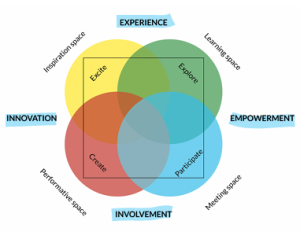
You can think of a hyperlinked environment as a transition from an environment focused on collections to one that is focused on connections. One way of looking at your library environment is through examining the “four space model.” These four spaces are defined as “excite” which is a space that offers inspiration to patrons; “explore” instills learning; “participate” offers a space that encourages meeting and socializing; and “create,” a space that allows performance (Skot-Hansen, 2017).  These spaces don’t live in a vacuum, instead they interact with each other allowing for experience, empowerment, involvement, and innovation (Skot-Hansen, 2017). 

Think of your library, does it offer spaces like that described in the four space model?  Can you think of how you can create and support these kinds of spaces in your library?  It can be overwhelming to think of what others have done and how you can’t possibly do that; but, what can you do?

Dokk1 is a great example of how having this kind of environment can foster a hyperlinked library.  You may not be able to design your own building to make this environment but what you can take away from Dokk1 is inspiration on  how you can connect to your community.  Maybe you can weed out outdated reference materials and move a bay of shelves to offer an area that can be used for meetings or a small maker space.  Maybe you can begin to draw inspiration from programs and events that hyperlinked libraries offer in order to build a  community that realizes their potential to reach their goals together through fostering connections that would otherwise not be possible.  There is a lot of inspiration out there.  Go out there and make those connections to your community and find out what they are looking for, then see how you can transform your environment into a place that can help meet those needs. Maybe it’s time to start using the “four space model” to guide you on your journey as you start creating a hyperlinked environment to support your hyperlinked library.  I know I will.  


Works Cited


Skot-Hansen, D. (2017, August). Library development: From collection to connection. University of Copenhagen Faculty of Humanities. https://287.hyperlib.sjsu.edu/wp-content/uploads/2025/02/4-Spaces-Model-from-Univ-Copoenhagen.pdf


Reflection Blog: Hyperlinked Communities

Libraries are much more than the books on the shelves, the displays on the tables, the technology available, and the digital resources they offer.  Libraries have the unique ability to serve their communities in ways that other kinds of organizations simply can’t.  A library is only as successful as its community and this relationship needs to be continually fostered and explored.  This dialog between the library and the community is mutually beneficial and necessary to keep libraries as a cornerstone institution.

In my professional librarian career, I’ve only worked within one public library system.  The system is a county entity and sometimes the ways that county business is conducted doesn’t really fit with the ways libraries should work.  Hyperlinked libraries should inspire connections between themselves and their community members.  To do this the hyperlinked library needs to foster communication with their community which can include surveys, focus groups, community analysis, etc. (Stephens, 2016, p. 43).  Unfortunately, I’m not seeing that kind of communication in my system but I think that can change.  It’s ok to realize our limitations due to processes and rules that we are beholden to.  You may be running into the same wall that I am with your own organization.  It’s difficult to sometimes look beyond the constraints, but there are ways we can make positive movements to start that kind of communication with our communities.  

San Jose Public Library has a wonderful community engagement effort that places the library out in the community where they are and engages in dialog with their community.  According to their website, the community engagement program meets community members where they are and asks them about their aspirations, what kind of community they want to live in, what concerns do they have, and what kind of services would be great to have at the library (San Jose Public Library, 2026).  Based on the information gathered during these outreaches, the library provides a quarterly blog that reports on their findings. This dialog allows the library to make an impact and gives them an opportunity to reach out to not only their current patrons but to people who don’t go to the library. In addition to going out to community events, San Jose Public Library also provides a survey link on their website for people to complete when it’s convenient for them.

Perhaps bringing up San Jose Public Library’s community engagement program to my supervisors can help our library grow for our community.  San Jose is doing a great job of reaching out and listening to their community.  They are transparent with the results of this outreach and with this transparency they show that they respect and hear what their community needs.  I think this kind of engagement is something my system could easily begin doing without having to go through county red tape which tends to slow things down.  We already do outreach events but to be honest these outreaches seem static in that people approach our table and grab a calendar and/or an incentive and off they go.  They also tend to take place at the same places repeatedly which isn’t necessarily a bad thing but just imagine who we could reach at a busy coffee house for example. Maybe changing outreach into having conversations with people could be a wonderful step forward.  Maybe changing venues for outreach could connect us to other community members we may not be reaching. Maybe these kinds of suggestions would help your organization too.

The goal of changing the way we do outreaches would give us information that we wouldn’t otherwise have. This wonderful insight could then help the library to meet those needs that the community has and help the library system I work for to turn a corner. How about we make more out of the time we have in the community by asking for some input from community members that use our libraries and those who don’t?  How about we use our website to post about our findings and allow comments which will allow a larger dialog?  What if just a slight change could make the biggest difference?  I think it’s time to try, how about you?


Works Cited

San Jose Public Library. (2026). Community engagement: Your voice matters. https://www.sjpl.org/community-engagement/

Stephens, M. (2016).  The heart of librarianship: Attentive, positive, and purposeful change.  ALA Editions.