AI image generated using Google Gemini
The books found in the stacks of your library are not the only stories you can find if you look hard enough. Too many times, we don’t take the time to find out the stories that are all around us. There are many reasons for this. As a society the United States has a mindset that you must always be in a rush, and you are always in a time crunch. But what if we were to stop and truly find out about the people who are around us?
As librarians, we are naturally curious individuals. Don’t get me wrong, we are also usually very stretched in our daily work but maybe it’s time to really look at the power of our stories as well as the stories around us. A Hyperlinked Library creates relationships with its community and to do that there needs to be open communication between both the library and the people it serves. A way to start this bond is through the use of narrative inquiry. Ask community members, what’s your story? Those stories can be eye opening and allow you to see what members of the community need as well as become familiar with struggles you may not have realized. This should guide you in making strides to meet those needs.
I was really touched by the different ways that libraries found ways to capture stories of their community and create programming that aims to touch lives. The Human Library Organisation gives people the opportunity to “unjudge someone” by allowing patrons to “check-out” a person in order to hear the human book’s story and ask questions. Many times, these human books are people whose voices have not always been heard or part of a community that has historically been judged harshly. These conversations allow for people to relate and understand one another creating empathy and compassion. How amazing would it be to offer a program like this at your library?
The Yarra Libraries in Australia offers a “Sensitive Santa” experience for children with sensory
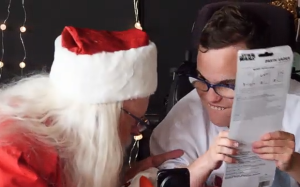
Sensitive Santa at Yarra Libraries
needs. It allows children and their families to come in at a booked time to meet Santa in a quiet and controlled environment. It’s all free too. Can you imagine how much that must mean to those families to be able to have their children meet Santa in a safe and quiet environment? The program also provides families with free photos as well to commemorate the occasion. It’s a thoughtful event that was only possible by listening to the stories that the community shared.
StoryCorps is an organization that helps to record and preserve stories. Some of these stories have an animated component as well. I think one of the most important stories they share are stories from family members and friends who lost loved ones on September 11th. The poignant stories make the lives and losses very much real. Due to the passage of time, the individuals whose lives were lost that day, as well as subsequent years, tend to fade and we only remember the event and not necessarily the details. These heart wrenching stories live on. I dare you to listen to one and not feel some kind of human emotion while listening.
Think of your community, do they have stories that you could record in some way and make available for others to listen, watch, or read? Makerspaces and recording studios are popping up in libraries. Maybe you can be inspired by StoryCorps and start recording the stories your community has. Imagine what you and your community could learn. Our stories make us who we are and we all have a story. Sharing them with each other allows us to relate to one another and creates empathy and strengthens our community. As librarians, we are uniquely equipped to bring these stories together in powerful and creative ways. Here’s another great example: LA County Library’s Community Collection on Biblioboard. The library and community partners have created digital programs available for viewing at any time. You can learn local community histories in The Generations Project or check out Your Immigration & Citizenship Stories and learn about community members’ journeys to citizenship. This is very inspirational and I hope that as my career grows, I’m able to incorporate these tools and ideas to support a library that truly shares the stories of their community.