
Author Archives: Lauren Williams

Reflection Blog: Hyperlinked Communities

Libraries are much more than the books on the shelves, the displays on the tables, the technology available, and the digital resources they offer.  Libraries have the unique ability to serve their communities in ways that other kinds of organizations simply can’t.  A library is only as successful as its community and this relationship needs to be continually fostered and explored.  This dialog between the library and the community is mutually beneficial and necessary to keep libraries as a cornerstone institution.

In my professional librarian career, I’ve only worked within one public library system.  The system is a county entity and sometimes the ways that county business is conducted doesn’t really fit with the ways libraries should work.  Hyperlinked libraries should inspire connections between themselves and their community members.  To do this the hyperlinked library needs to foster communication with their community which can include surveys, focus groups, community analysis, etc. (Stephens, 2016, p. 43).  Unfortunately, I’m not seeing that kind of communication in my system but I think that can change.  It’s ok to realize our limitations due to processes and rules that we are beholden to.  You may be running into the same wall that I am with your own organization.  It’s difficult to sometimes look beyond the constraints, but there are ways we can make positive movements to start that kind of communication with our communities.  

San Jose Public Library has a wonderful community engagement effort that places the library out in the community where they are and engages in dialog with their community.  According to their website, the community engagement program meets community members where they are and asks them about their aspirations, what kind of community they want to live in, what concerns do they have, and what kind of services would be great to have at the library (San Jose Public Library, 2026).  Based on the information gathered during these outreaches, the library provides a quarterly blog that reports on their findings. This dialog allows the library to make an impact and gives them an opportunity to reach out to not only their current patrons but to people who don’t go to the library. In addition to going out to community events, San Jose Public Library also provides a survey link on their website for people to complete when it’s convenient for them.

Perhaps bringing up San Jose Public Library’s community engagement program to my supervisors can help our library grow for our community.  San Jose is doing a great job of reaching out and listening to their community.  They are transparent with the results of this outreach and with this transparency they show that they respect and hear what their community needs.  I think this kind of engagement is something my system could easily begin doing without having to go through county red tape which tends to slow things down.  We already do outreach events but to be honest these outreaches seem static in that people approach our table and grab a calendar and/or an incentive and off they go.  They also tend to take place at the same places repeatedly which isn’t necessarily a bad thing but just imagine who we could reach at a busy coffee house for example. Maybe changing outreach into having conversations with people could be a wonderful step forward.  Maybe changing venues for outreach could connect us to other community members we may not be reaching. Maybe these kinds of suggestions would help your organization too.

The goal of changing the way we do outreaches would give us information that we wouldn’t otherwise have. This wonderful insight could then help the library to meet those needs that the community has and help the library system I work for to turn a corner. How about we make more out of the time we have in the community by asking for some input from community members that use our libraries and those who don’t?  How about we use our website to post about our findings and allow comments which will allow a larger dialog?  What if just a slight change could make the biggest difference?  I think it’s time to try, how about you?


Works Cited

San Jose Public Library. (2026). Community engagement: Your voice matters. https://www.sjpl.org/community-engagement/

Stephens, M. (2016).  The heart of librarianship: Attentive, positive, and purposeful change.  ALA Editions.

 

Assignment X: The Hyperlinked Library – Much More Than Books

Meme courtesy of: https://blogs.ubc.ca/socialmediaandlibrarianship/2016/02/09/use-of-memes-in-libraries/

The library is more than a place that stores books which makes our future as library professionals bright.  If the library was only storage for books, we’d be in big trouble as the internet has changed how people find and consume information.  The Hyperlinked Library Model outlines practices for libraries to use which will best support the needs of their communities. Through ongoing conversations, transparency, participatory service, and the ability to easily change as needed, the Hyperlinked Library is for the people and by the people. The Hyperlinked Library Model demands that institutions reach out to their communities consistently.  By engaging in conversations with their communities, libraries can transform into institutions that provide services that truly meet their needs (Stephens, 2016, p.10). 

Recently, the city of Long Beach, here in California, proposed slashing hours and laying off staff at their library branches due to major budgetary issues.  During a City Council meeting, one patron, Emily Quest, pleaded with city officials to keep those libraries open.  You can watch Emily’s plea here but bring tissues with you because tears will be shed.  In the clip, she speaks through tears about how the library has been a place where she is safe, she has the opportunity to socialize with others, and can attend her beloved crafting programs.  This emotional public plea is a reminder of how important our libraries can be.  There aren’t many ‘third places’ out there that are free for people to gather safely together. A ‘third place’ is a place that is not work or home but allows for social interactions with others creating a community (Leferink, 2018).  The library provides that place free of cost to their community members.

We are intrinsically a caring institution – we are much more than a book storage facility.  We are a safe place where community members can go to access information, be entertained, learn, socialize, and frankly, feel good about themselves.  I went to a program at my local library because I wanted to learn how to use a sewing machine.  It was a great program, and I was able to talk to other people during the program.  I will always remember how excited one gentleman was to make a potholder using the sewing machine.  I’m proudly staring at the one I made!  After a failed attempt at trying to use a sewing machine on my own, I never thought I’d touch one again but here I was at the library with a wonderful staff member showing me that I could sew.  How cool is it that we are able to offer opportunities like that?  When examining the Hyperlinked Library Model, I am really drawn to making these human connections.  In particular, transparency and the conversations that librarians need to be having both within the library and outside the library with their communities.  In my work experience, planning and ideas have come from within the organization with only a few members of upper management having any input related to future plans.  Community members are not even consulted for remodels, which is head scratching.  There are a lot of personal projects headed by upper management and the community has not been afforded the opportunity to speak on what they need and what they want. I’m not sure the reason why that kind of outreach has not happened. This surely isn’t the only library system that handles things like this, but who would know what is needed better than the community?  The Hyperlinked Library Model outright requires an ongoing and never-ending conversation between the library and the community. Michael Stephens (2016) puts it perfectly, “fresh voices and ideas from beyond library staff input might lead to some intriguing and popular initiatives,” (p. 101). How often is that happening in our libraries?  How do we get out of the culture of secrecy and upper management pet projects?  How can we start those conversations and really understand the needs of our communities?

Emily Quest’s public comment shows how impactful the library can be. In response to this City Council meeting, I’m happy to report that the Mayor of Long Beach has decided to back off of the proposed cuts.  Emily’s experience and willingness to be vulnerable to stand-up for her library may have just saved both staff and hours of her favorite space.  That devotion can only come from a heart that has been touched deeply by that library.  The Hyperlinked Library model provides a wonderful roadmap to ensure the library remains a viable institution in our communities.  How are libraries rising to this challenge?  How are we touching the hearts of our communities?

References

Donegan, J. (2026, August 9). Long Beach libraries: Budget proposal to slash jobs. LAist. https://laist.com/brief/news/long-beach-plans-to-cut-library-hours-staff-even-as-workers-say-demand-is-soaringh libraries 

Donegan, J. (2026, September 1). ‘The message was clear’: Mayor abandons plan to cut library hours following public outcry. Long Beach Post. https://lbpost.com/news/library-cuts-long-beach-hours-mayor-reverse-course/

Leferink, S. (2018, January 24). To keep people happy…keep some books. OCLC. https://blog.oclc.org/next/to-keep-people-happy-keep-some-books/

Stephens, M. (2016).  The heart of librarianship: Attentive, positive, and purposeful change. ALA Editions.
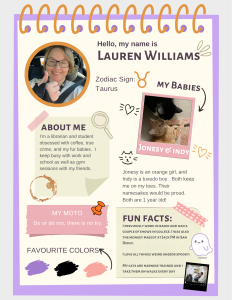
Hello, How Are You?

I’m Lauren Williams and I’m a librarian at a public library system in Southern California.  I’ve been in the library profession for almost 10 years now and I’m about halfway through my master’s degree program at SJSU.  The major reasons why I wanted to go back to school was to keep learning so I can better serve my patrons and also to feed my general curiosity.  My journey so far at SJSU has done just that.  Sometimes I’m tired at the end of the day before I start my schoolwork, but the learning and connection to others who are passionate about librarianship is a motivation to keep at it!

I’ve been interested in this specific class since the beginning of my journey because this class explores the unlimited possibilities and potentials we have as information professionals.  Sometimes the daily minutia of my tasks at work can burn me out but having a broader perspective of our field really inspires me to keep going.  The tasks I do is just a small part of the big picture and those small parts are important to keep the system going.  Currently, I’m the collection development lead at my library system.  And I’m doing my best to let those above me know that just a physical collection is not enough for where we are going as a world.  Sometimes it can be frustrating to try to convince others that libraries are beyond being a book depository. I think, at least in my system, co-workers are just starting to see that, but we have a way to go.  I definitely love collection development, and I’ve been doing it for about 5 years now.  Within those 5 years, I’ve seen a lot of changes. I’m excited to learn about the theories of the hyperlinked library and learn how institutions are making it happen.  I think I’m most excited to find inspiration.

Here’s a bit more about me.  I look forward to learning with you all!