Overwhelmed. That is the best word to describe the last year of my library career. I feel myself dangerously flirting with the burnout wall ahead of me that I no doubt will crash into soon. I’m not alone in this and I know that but going through it is so difficult. I chose librarianship because I wanted to make a difference. I know I am. But the workload I have is not helping me. I am stressed. I work hard and I somehow figure out a way to get my workload done but before I can take a breath a new “important” project is dropped onto my lap. This is how I entered our module about infinite learning. Keep reading, I promise this blog will make a turn.
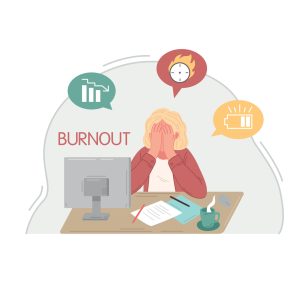
Image courtesy of Vecteezy : https://www.vecteezy.com/vector-art/19774275-professional-burnout-concept
I think library staff often forget to help themselves. This job requires us to deal with emotional labor that we don’t have the time to recover from. Oftentimes we aren’t taught how to deal with this kind of labor (Simon, 2020). This can make us exhausted and overwhelmed. On top of that, we more than likely don’t have the funding that offers us the number of staff we actually need to function properly and since librarians are superheroes…we always make it work.
I chose to adventure through professional learning experiences because I wanted to learn more about the topic especially because of where my headspace is. Of all the readings and videos available to explore, there were two things that hit me and made me realize that there may be a way to navigate away from the burnout wall I seem to be hurdling towards.
First, was a realization and an explanation. Stephens (2019) creates a formula of success to show what it takes to make a successful librarian:
Essential Skills + Mindset² x Support = Success (p.32)
I stared at this formula for a while and it clicked. In my notes, I wrote this:
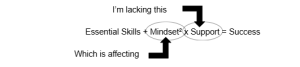
It dawned on me that within the last year, I haven’t felt support from management. That is a huge problem. One of the changes is the direction management has taken in regard to listening to employees’ issues. Instead of being free to talk about an issue, we have been told to not vent but come up with a solution using a worksheet. This is counterintuitive to me. If I’m having an issue, I want the ability to talk about it freely and not fill out a worksheet before talking to management. In Simon’s piece the emotional labor tolls are discussed, and I found it absolutely fascinating that one of the best ways to help prevent burnout is through social coping with your fellow librarians (2020). I felt vindicated reading that. That social coping mechanism has essentially been quieted by management within this last year and here I am. Don’t get me wrong, I’ve vented to co-workers about issues this last year but in secret which seems bonkers to me. So, I need support and I need to heal my mindset. So how do I go about that?
That leads me to the second thing that I took away from this module, I need to challenge myself which may improve my current state (Simon, 2020). And I have chosen to make time every week at work to learn something that will help me with my work. That could sound like I’m just adding another thing I have to do in my busy day, but I see it as a way to give myself a fun task that will give me a respite from my normal tasks that need to be completed. It’s recommended that staff should have a weekly allotted time to explore something related to their jobs in order to foster a culture of learning (Stephens, 2016). That could be attending a webinar, or going through a 23 Things program, or reading a blog about something that will help them with their jobs. I stopped at this and wrote down: “I can mandate learning time at work for me!” My plan is to put Feedly on my work computer browser to explore blogs from fellow librarians. I’ll also finally take time to read the Library Journal which I championed to have a subscription for library staff but have not made time to actually use it myself. I’ll attend a webinar. I will make time to read more about emotional labor and tools that can help with that. I will share this knowledge with coworkers who I can tell are going through a difficult time.
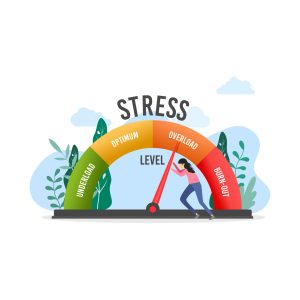
Image courtesy of Vecteezy : https://www.vecteezy.com/vector-art/9644387-stress-level-reduced-with-problem-solving-concepts-underload-optimum-overload-burn-out
I can’t control the mindsets of those above me, I can’t control the budget, but what I can do is take some time to learn every week. I went back to school to earn my MLIS because I wanted to learn more so I could be a better librarian. I’ve learned a lot, but I think I’ve learned that learning doesn’t stop with a degree or a job. Learning continues infinitely in this field. So, I’m pumping the brakes before I hit that burnout wall, and I hope you will too. We’re here for the right reasons so let’s take care of ourselves so we can make a difference out there.
References
Simon, K. (2020). Emotional labor, stressors, and librarians who work with the public. School of Information Student Research Journal, 10(1). https://doi.org/10.31979/2575-2499.100106 Retrieved from https://scholarworks.sjsu.edu/ischoolsrj/vol10/iss1/6
Stephens, M. (2016). The heart of librarianship: Attentive, positive, and purposeful change. ALA Editions.
Stephens, M. (2019). Wholehearted librarianship: Finding hope, inspiration, and balance. ALA Editions.