“What if Netflix, Pandora, iTunes, Hulu, and all the other media suppliers slowly morph into a larger, subscription-based conglomerate delivered to your digital content service? What then? ” – Dr. Michael Stephans, 2019
The ease of digital media has fascinated me and countless others. It is unmatched in its accessibility as long as you can afford it. Since Stephans pondered the impact of shifting from physical to digital media in libraries years ago, we are now living the effects. The rapid and monumental growth of conglomerates like Netflix, Hulu, and now Paramount and Warner Bros., with their impending merger, is having drastic impacts on everyday consumers and on libraries’ collection management. We see a shift in consumers’ spending and borrowing habits. For many institutions, circulation of physical media has decreased, while use of digital media, such as e-books and audiobooks, has increased (Roose, 2025). This pushed libraries to adjust their budgetary allocations, pouring funds into acquiring and maintaining digital resources, while deciding where to pull money from: physical collection, staffing, or programming, as their annual budget likely remains on par with previous years’ budgets.
Such digital content is often licensed, not owned, for a period of time. This is something we see as a frustration, not only for libraries, but for the average consumer of streaming platforms. Shows and movies are ever-changing in which platform they are available on due to contracts and negotiation deals, forcing the consumer to switch platforms or maintain multiple subscriptions. For instance, this past week Netflix announced the removal of the beloved show Gilmore Girls from its platform on June 20th. Within hours, its competitor Hulu announced the show is already available to stream on its platform.

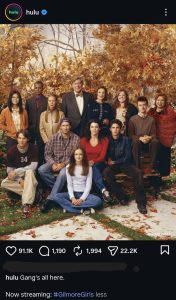
Such switches irritate viewers. Even more disheartening is when such platforms remove content they created specifically for their platforms, making it exceedingly difficult to access anywhere. For example, She-Ra: The Princess of Power has been removed from Netflix, Willow from Disney+, and Grease: Rise of the Pink Ladies from Paramount+, and are now unavailable for viewing anywhere online (legally) and unavailable for purchase via physical media. Though these shows may not have been blockbusters, they had their audiences and individuals who poured their hearts into creating them. Those creators no longer have an avenue of distribution for their body of work. How is this a sustainable framework for creators and consumers? As Matthews stated in Think Like a Startup, “Don’t get stuck following plan A; instead get to a plan that works” (2012).
“One request students made? Surprisingly (perhaps), they wanted books around them. Not just because of the information that physical books provide, but because of the atmosphere and comfort they provide.” – Saskia Leferink, 2018
It is this disappearance and inaccessibility to content that, I believe, pulls at individuals’ desire for physical media, whether it be in access to it through libraries or purchasing their own copies. Individuals are seeing the value in accessing a copy that lasts; that won’t be taken away at the drop of a hat. There is comfort physical media provides in a space, as described by Leferink when writing about renovating a library space. In creating a Library 2.0, there is much talk about how the library is more than books, which is true; however, I do not believe that means we should lose sight of the fact that many individuals rely on the library to provide access to books when access is not easy to come by.
“Collections don’t have to come at the expense of programs, meeting rooms, or vibrant community hubs, but it is important to recognize that it is only a strong print collection that attracts readers to libraries, where they can take advantage of everything else on offer (Coffman, 2025).”
A marriage of tailored collection management and all that is Library 2.0 needs to be struck to meet the expansive needs of library users.
Clare McGrane. (Host). (August 29, 2024). E-books are expensive for libraries. Some states are trying to change that [Audio podcast episode]. In NPR’s Book of the Day. NPR. https://www.npr.org/2024/08/29/nx-s1-5091277/e-books-are-expensive-for-libraries-some-states-are-trying-to-change-that
Coffman, S. (2025). Untangling the Real Cost of Ebooks to Libraries. Computers in Libraries, 45(4), 32–36.
Leferink, S. (2018, January 24). To keep people happy … keep some books. Next. https://blog.oclc.org/next/to-keep-people-happy-keep-some-books/
Matthews, B. (2012). Think Like a Startup: A white paper to inspire library entrepreneurialism. Retrieved June 17, 2026, from https://vtechworks.lib.vt.edu/server/api/core/bitstreams/77d2cb98-ddab-4543-9e47-b011819231b3/content
Roose, R. (2025, January 14). The True Cost of eBooks and Audiobooks for Libraries. Spokane Public Library. https://www.spokanelibrary.org/the-true-cost-of-ebooks-and-audiobooks-for-libraries/
Stephens, M. (2019). Past is Prologue: Crystal Visions. Wholehearted Librarianship: Finding Hope, Inspiration, and Balance (pp.16-19). American Library Association.
Hi Krystal – This is a great post! Thank you for sharing. I very much agree with you that we need a mix of digital and physical materials in our library collections, and that this tailoring needs to be done with our users in mind. We’ve been struggling with this in our video collection at the academic library I work at. Like you said, licensing can be a challenge. Our faculty rely on the library’s Kanopy subscription to make certain movies available to students. However, Kanopy’s subscription catalog seems to change often. We have had problems with critical videos getting dropped and leaving our students without access mid-semester. It takes work on the library’s part to monitor when popular videos are being discontinued and to try to negotiate with the vendor. Sometimes, the fastest way to provide access is actually good old fashioned DVDs. In one instance, local interlibrary loan partners were able to lend us multiple copies quickly to ensure all our students could view the video.
Hi Rachel,
Thanks for the insight from academic libraries. I remember having that experience when I was in my undergrad years ago, and it was frustrating for professors and students alike. I frequently recommend physical copies to patrons in the public library setting and find that new DVDs and Blu-rays are still popular in circulation in my community.
So interesting, Krystal! I was shocked when Disney+ removed the first and second seasons of The Mysterious Benedict Society less than a year after the second season had come out. I hadn’t realized that platforms would simply remove their own content to save money. So frustrating for people who want to watch something that, as you said, so many people worked hard to make.
Hi Laura,
Another great example! That is still such a popular book series for children, and I find it shocking that it would be more financially viable to remove a series they invested in than to keep it as an asset for their audiences. It really is a discredit to those who worked on the series and the audience that did enjoy it.
Hi Laura,
Great post! This topic recently came up while hanging out with a few friends, how many people are reverting to buying physical media. There are many reasons for the switch, but a few mentioned not being able to find it at their local library or online through a streaming service. The main reason has been price spikes over the last couple of years. I tend to buy pre-owned physical media, such as movies or shows I watch on repeat. But I know this isn’t an option for many people, and many rely on the library’s free services.