Reading about social infrastructure in Eric Klinenberg’s Q&A made me think of this quote from John Roedel:
“I have no patience for people who can watch the world burn and never wonder ‘How do I become rain?’”
This sentiment of “becoming rain” for a world on fire is what I feel we’re all here to do as librarians and information professionals who are dead-set on creating a safe, practical, relevant, welcoming, and supportive space for our patrons. So, how have libraries become rain for the folks who are drying out?
One thing that felt especially nourishing from this module were the Underground Flavour Group (UFG) and Kitchener Public Library (KPL) partnership and the Camden County Library System’s (CCLS) mobile kitchen. More importantly, it was the thought and care that went into these programs that moved me.
“My philosophy is, we find out what challenges a community faces and ask how can we help them,” – Linda Devlin, CCLS Director
“Libraries have become a hub for the community connect with different programs and partnering with the UFG just made sense.” – Shirley Luu, KPL
These bolded parts “we find out,” “ask how we can help,” and “[it] just made sense” felt especially relevant! I feel like as a very fresh library professional with barely a year in library services in my back pocket, there are so many things I want to try! Trying and experimenting is definitely not a bad thing, but what will actually stick with the community is doing something that “makes sense” for them! Tying it back to the John Roedel quote, I feel like it’s especially important for us to be mindful of what rain we’re bringing. A light drizzle won’t nourish a desert and a heavy storm in a place with no storm drains will drown everything out! I am reminded that beyond anything, exploring new models while being user-focused is what building a successful community is about.
I love the idea that mobile information environments don’t only need to be utilized outside of library walls. There are many ways that mobile technologies can support patrons who are inside the library as well! I’m always grateful that libraries are often staffed with socially diverse people, introverts and extroverts alike, so that patrons of all social tendencies have representation and understanding. So, when I read Karen Jenson’s (2022) article on using QR codes to help reader advisory, the introvert in me felt so seen. It reminded me that despite my over-zealous tendencies to help patrons face to face, some people are best helped when they can do it themselves! I wanted to share a few other ideas for supporting the more introverted patrons in and outside of the library:)
Utilizing outside/distanced spaces
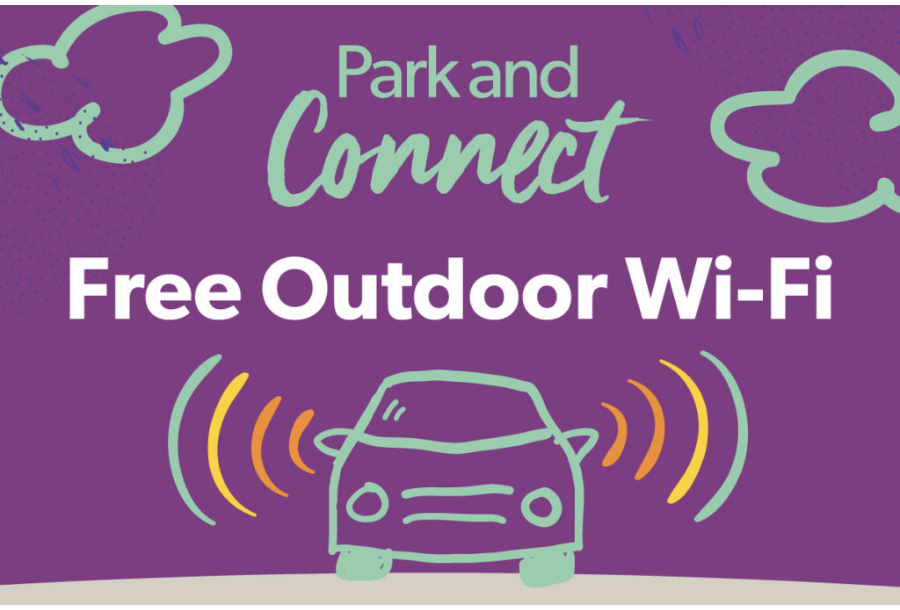
I feel like sometimes the patio areas and outside areas of libraries are detained to special events or rusty furniture. While I am all for the bubble parties and chalk zones of special event proportions, I think the introverted, more mobile patron would have a field day with a cozy and cared for outside reading/working area. Some ways to ensure the outside space is used are: 1) Make sure Wi-Fi is readily available! Nothing is more awkward than setting up shop, then debating whether or not to ask the librarian for help with the internet! 2) Make sure the outside furniture is clean and ready to use 3) Work with maintenance for an ample outlet situation! 4) Make this area available 24/7. This last one may take some convincing from the higher ups, but making outside spaces available at all times (Wi-Fi especially) gives patrons, especially introverted ones, more reason to use the library! The LA County Library boasts free unlimited access Wi-Fi, from their buildings to their parking lots! This initiative was created during COVID-19 lockdown, but stayed in order to support the community. This reddit thread is full of grateful users🙂
Signage for LA County Library’s free outdoor Wi-Fi. LA County.
Silent book clubs
The silent book clubs at my old library were a hit. We’d have a steady stream of regulars as well as newcomers just stopping by to read. Although the silent book club starts in the library, it doesn’t end there. I know that some folks have found friends via this program and take their reading (and friendship) elsewhere! A good reminder to anyone leading these is to reassure patrons that they aren’t obligated to share during post-read chat or even obligated to stay.
User-submitted displays and virtual passive programming
Now I haven’t seen this in any libraries yet, but I’m thinking of something like highlighting a “weekly question” forum on the library website, then having the answers displayed on a digital signage at the library. I’ve seen similar ideas at museums (like this Wisdom Arc at San Francisco’s Exploratorium), where there’s a display of visitor-submitted art or quotes, but I haven’t seen any that were sent in virtually! I think this would be a great way for at-home patrons to participate in library programming without needing to come in physically!
Two kids looking at the Wisdom Arc Time Machine. Wisdom Arc Project. 2014.
What I find most important from my exploration of the Mobile Information Environments articles is this bit from David Weinberger’s “Let the Future Go.” Although it was written more than ten years ago, the sentiment that the future of libraries lies in its users, and not the library itself, still holds true (2014). This is why, with the very transient, nomadic nature of many library users, the library needs to provide the environment for them to thrive, wherever and whenever that may be.
Beyond learning, exploration, and connection that kids, tweens, and teens often experience at the library, there are adult library regulars who use the space as ground for stability and sometimes sanity. I loved hearing about the innovative ways libraries connect with their patrons through specific, community-focused programs – sleepovers at the library, the healthy happy eaters club, etc – but what really struck me was the Tareq Nurul Hasan article on the library as a “sanctuary of health and wellness” (2022).
A patron enjoying the view from inside Mill Valley Public Library. 2022. @patriciamou_ on X.
Maybe this comes at a tender moment in my life, but Hasan’s emphasis on loneliness got me thinking about how dire public libraries are to those who are struggling mentally and emotionally, and for those who need solutions, but don’t know where to start. Although technology and social media connect us in ways we’ve never imagined, some people still feel disconnected from the world around them, and the judgement-free, accessible, welcoming environment of the library is one foothold that we can use to gain some stability.
I recently moved to a new state, and with it came a new library job. One of my coworkers asked me, “What do you want to do with your library degree?” I told her I wanted to focus on building up the community with fun, relevant programming and do outreach to get the (very new, very blossoming) city of Buckeye, Arizona excited about the library. But after reflecting on a particularly difficult season of my life, and recounting the stories from “Libraries Change Lives” from Public Libraries Victoria, I find that another part of my goal is making the library a place for sanctuary – a place where pondering and contemplation is not questioned, judged, or interrupted, but welcomed and fostered.
This little reflection brought me to search for looser, quieter, a little more pensive, library programs, like the meditation practices we talked about in the lecture, that I could potentially share with my new coworkers! One idea in particular was super interesting to me: meditation rooms at the library. I found that the Glendale Community College Library (just about 40 minutes from me) has a Quiet Meditation Space open for its students. According to the FAQ, “This space is intended for prayer, meditation or if someone needs a quiet space to collect themself,” and “Not intended to be used as a lounge, study room, or meeting room.”
I really love the distinction they make here – while private study rooms can most certainly serve as flex rooms for different programming, having a dedicated space for meditation/prayer/contemplation really emphasizes the importance of the practice. As Emily Mross (2018) of the Penn State-Harrisburg Library suggests, “By providing formal or informal, flexible and inclusive spaces for spiritual practices, we facilitate an environment of inclusion and affirm a sense of belonging.” While these kinds of private rooms are prevalent in academic libraries, I was able to locate Missouri libraries that offer Wellness Rooms. While their website emphasizes nursing as a use for the wellness room, I think it’s still significant that patrons are given the privacy and trust to use the room for any purpose, from nursing to meditating to just being alone for a little while.
A paper sign indicating the prayer room at Penn State-Harrisburg Library. 2018. College & Research Libraries News.
Although community is about building relationships with others (the library is definitely the place for that), I think it’s also about including those who need extra space and time for their own personal practices. And giving people a safe, judgment-free place to do that is what the library should be doing.
A few weeks ago I came across a parody story about an 89-year-old woman who secretly ran a gossip network via bookmarks hidden in books at the library. While completely fictional and exaggerated, the concept of a gossip group at the library opened my mind to all the fun, unconventional ways we can build community among adults. How can the library be a place for new ideas, stories, and exploration?
AI-generated image of an old woman in a courthouse. Pairs with a caption telling the fictional story of an old woman running a gossip network out of the library. The Dude Humor Report. (2026).
The general public commonly thinks of public libraries as a place for families and kids – the library something we grow out of, especially with every fact, story, and resource entirely available in our pockets. Adults can explore on their own. Adults don’t need to play. Adults don’t need the library anymore. The Hyperlinked Library Model tells us that this is not true. The quote from Thomas and Brown’s “A Culture of New Learning” (2011) as featured in our Module 3 lecture, “Play is the basis for cultivating imagination and innovation,” stood out to me above all other points. Michael emphasizes in the lecture plainly, “Play is important.” (Stephens, 2025).
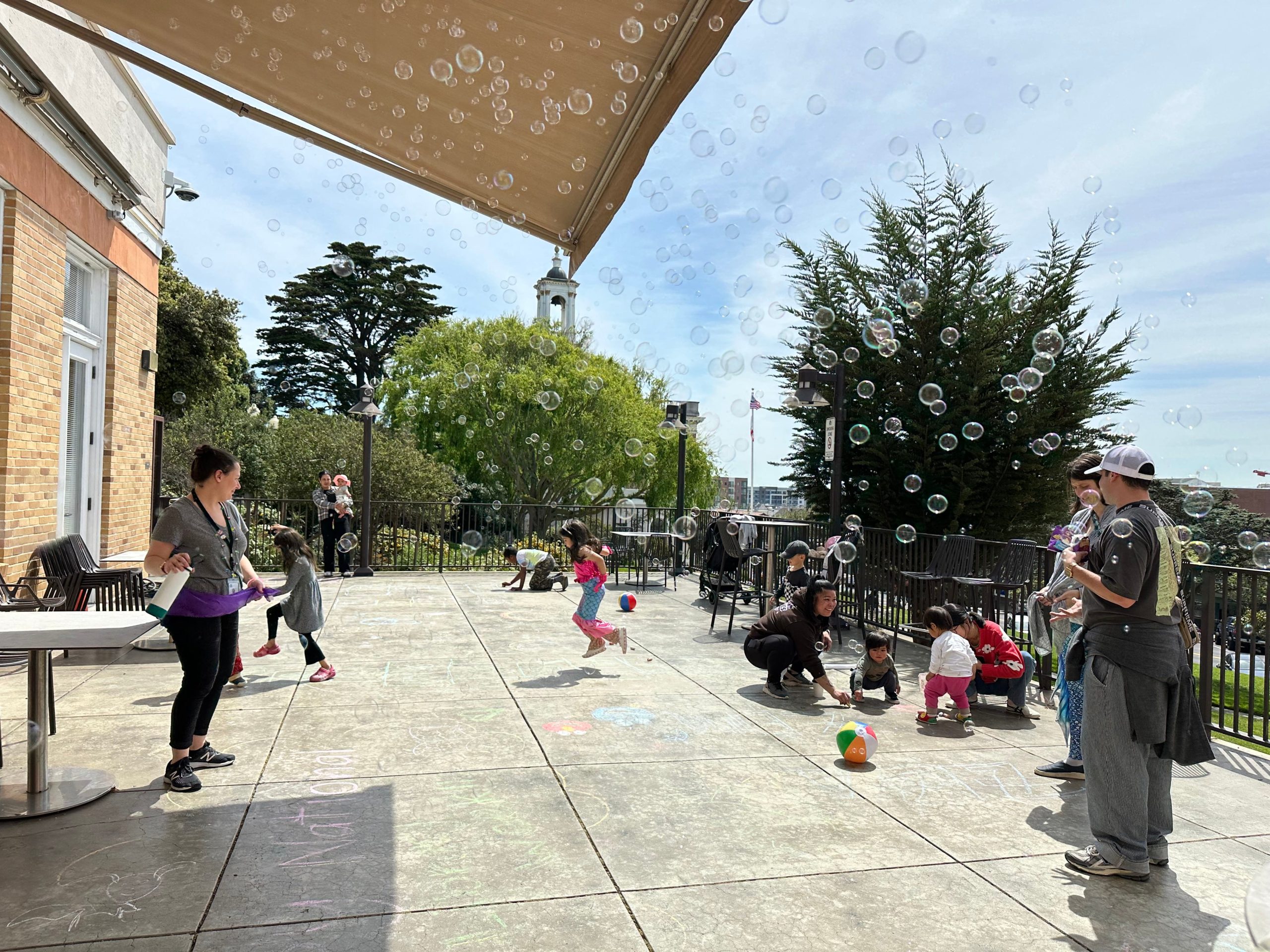
Kids and parents playing on the patio at South San Francisco Library. (2026)
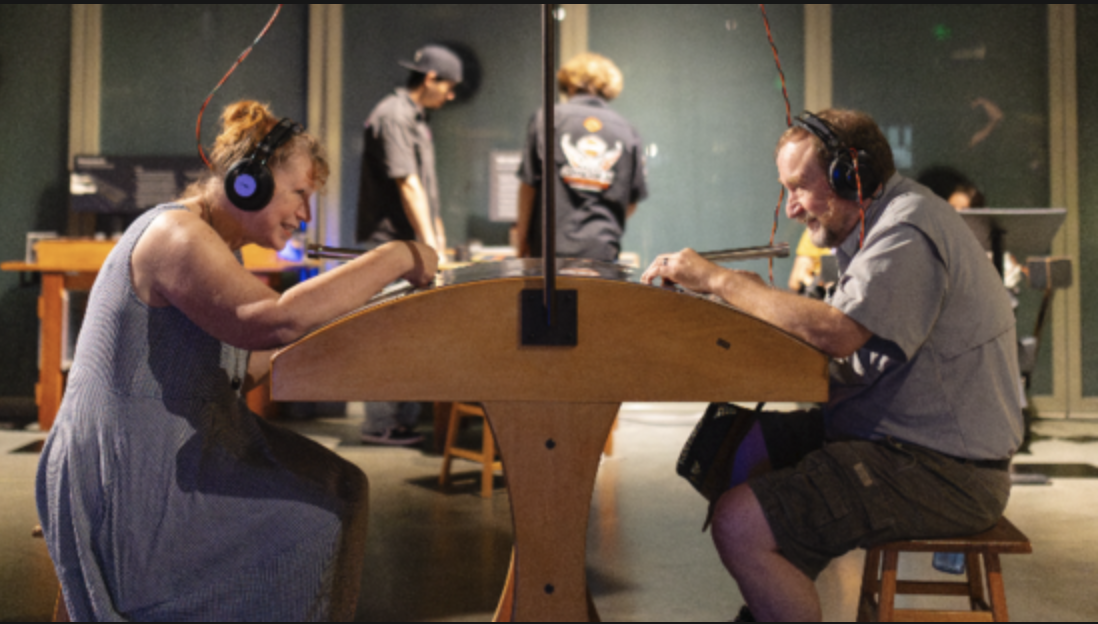
It warms my heart knowing that play isn’t gatekept by rubber balls, little hands, and chalk lines drawn in the concrete – play is just as necessary for adults for stimulation and community development as it is for kids (Lubbers et. al, 2023). Specifically in a GLAM (galleries, libraries, archives, and museums) context, play is about exploration and imagination. A study done on children’s museums and adult patrons showed that after-hours, adult-only events increased museum attendance and brought in new audiences to the museum (Kelley, 2016).
Two adults participating in the Exploratorium’s After Dark: Speakeasy event. Exploratorium. (2026).
If children’s museums can slip into more adult-focused, play-focused programming, why can’t libraries? I kept thinking about how limited our view of libraries can be sometimes and how we fall into some good, but maybe too comfortable, ruts in our ideas and programming. Even with a foundational understanding and desire for ideals, being thrown into the real world of libraries meets us with the doom and gloom of reality that change is hard to implement, and sometimes it’s hard to even gauge what people want.
Before getting too idealistic about what play in the library can look like for adults (in my mind, I’m hosting Dance Dance Revolution competitions), I am reminded that change in libraries needs to be powerful and meaningful, and not just constant and definitely not just change for the sake of change (Casey & Savastinuk, 2007). Bringing myself back to earth, I ask, then, how librarians can implement the idea of play and imagination with adults.
Following the ideas of the Hyperlinked Library, the answer to this question is clear: as much as adult patrons deserve to play, so do the library professionals! We can be imaginative in the way we meet our users or in our programming ideas – bringing the library to our users (on the patio of the library, at the park, on a book bike, online, etc), truly, the library has no barriers (Stephens, 2019). So, who’s to say we can’t start a gossip network at the library like the fictional old lady? Above all, as librarians, we need to be conductors of joy for our community, being inviting, interested, and curious about our patrons, responding to their needs (DuVerynay, 2024).
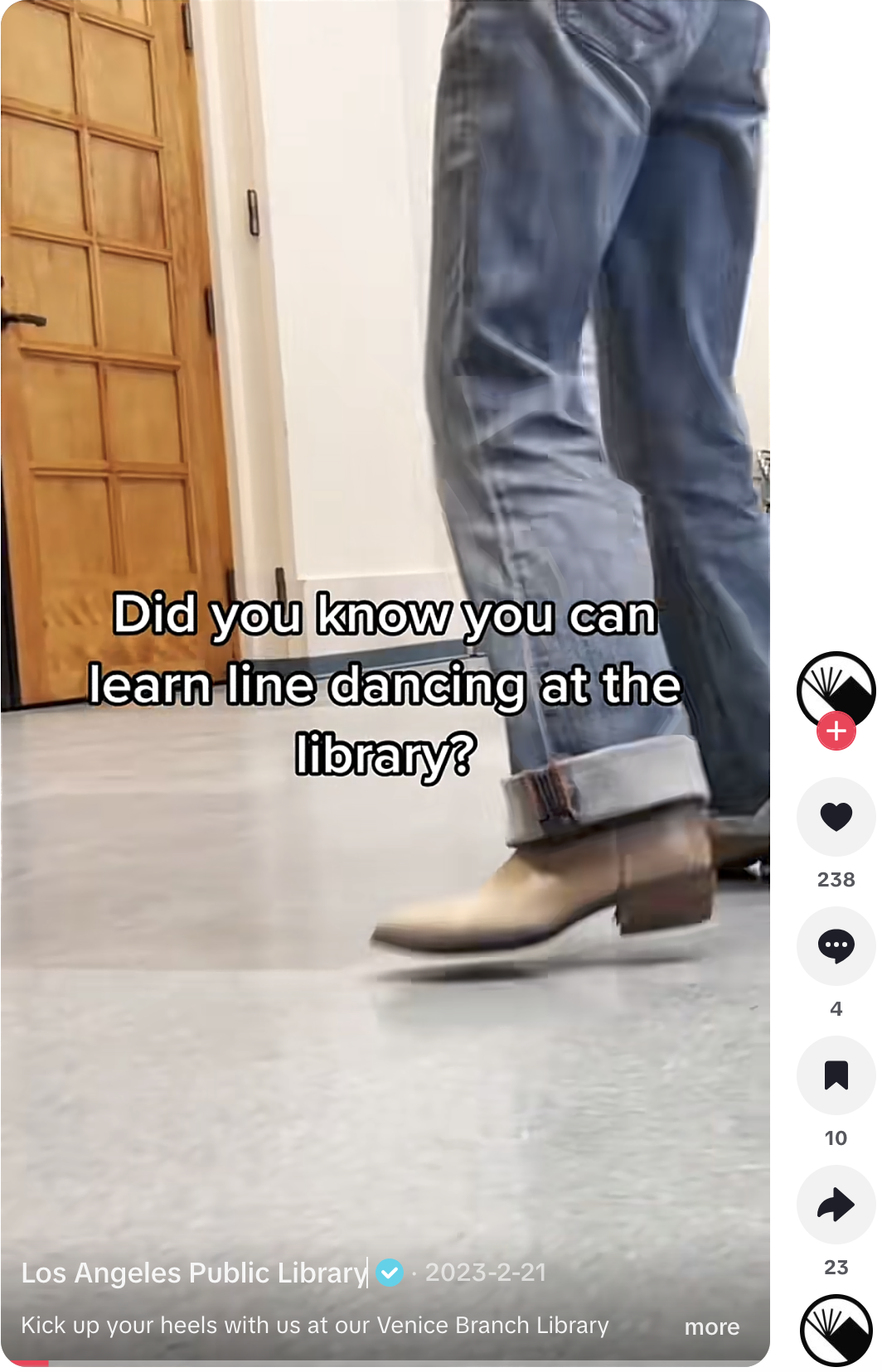
A post from Los Angeles Public Library advertising their weekly line dancing program. @lapibliclibrary (2023)
Play looks different in every community, so it’s important to be interested in what your community wants. In my professional life, I’ve seen a lot of movement from adult board game nights and mahjong afternoons. In some communities, play looks like line dancing, like at LA Public libraries! My goal for librarianship has always been to excite patrons and build community, and the framework of play is just one way to jostle adults into new ways of thinking. What is it that we’re seeking? A place to play? To explore? To exist? Whatever it is, there will always be room for it at the library.
References:
Casey, M. E., & Savastinuk, L. C. (2007). Library 2.0: A guide to participatory library service. Chapter 2: The essential Ingredients. Medford, N.J: Information Today.
DuVernay, J. (2024). There is joy for all: tips for joyous library programming. Programming Librarian. American Library Association.
Kelley, D. (2016). Play on: The importance of adult-only Play events at children’s museums. ProQuest Dissertations & Theses.
Lubbers, K., Cadwallader, J., Lin, Q., Clifford, C., & Frazier, L. D. (2023). Adult Play and Playfulness: A Qualitative Exploration of its Meanings and Importance. Journal of Play in Adulthood, 5(2). https://doi.org/10.5920/jpa.1258
Stephens, M. (2019). Wholehearted Librarianship: Finding Hope, Inspiration, and Balance. Chapter 2. American Library Association.
Stephens, M. (2025). “Historic” hyperlinked library model. https://sjsu-ischool.hosted.panopto.com/Panopto/Pages/Viewer.aspx?id=a0569381-4d66-4e0a-a7fa-aab3010a8f3e
Thomas, D., & Brown, J.S. (2011). A new culture of learning: Cultivating the imagination for a world of constant change. CreateSpace.
Hi, everyone! And hi to the hyperlinked library!:) My name is Lydia Orendain and this is my second to last semester at SJSU. I have worked as a Library Aide at Foster City Library and as a Library Assistant at South San Francisco Library. I have seen the need for connection, community, and resources at both libraries and my love for expanding access to these things is what led me to enroll in this course. I love how the library serves as a fun and educational place for people to explore their relationships with each other, uncover their place in the world, and quench their curiosity:”) I’m especially excited to see how libraries have evolved, how they are evolving now, and how we can be a part of its becoming!
My interest in the LIS world falls in public libraries and film archives. I adore the community-building that public libraries lend itself to and I love the rich, and vastly uncovered, history of film. Studying cinema in undergrad has definitely led to that passion, and my time freelancing in the entertainment industry led me to become passionate about third spaces (specifically the home-base the public library provides for numerous people groups – families, after-school-teens, remote freelancers, etc…).
Outside of work and school, I’m a big fan of pop culture, movies, and TV shows (my undergrad was in cinema, and I worked in entertainment for a while!!:)) I also love cozy video games – Stardew Valley is my absolute favorite, and I’m prolonging my Tears of the Kingdom run-through so I don’t need to say goodbye! I also love plants, gardening, and crafting:) Hope we all have a fun semester together!
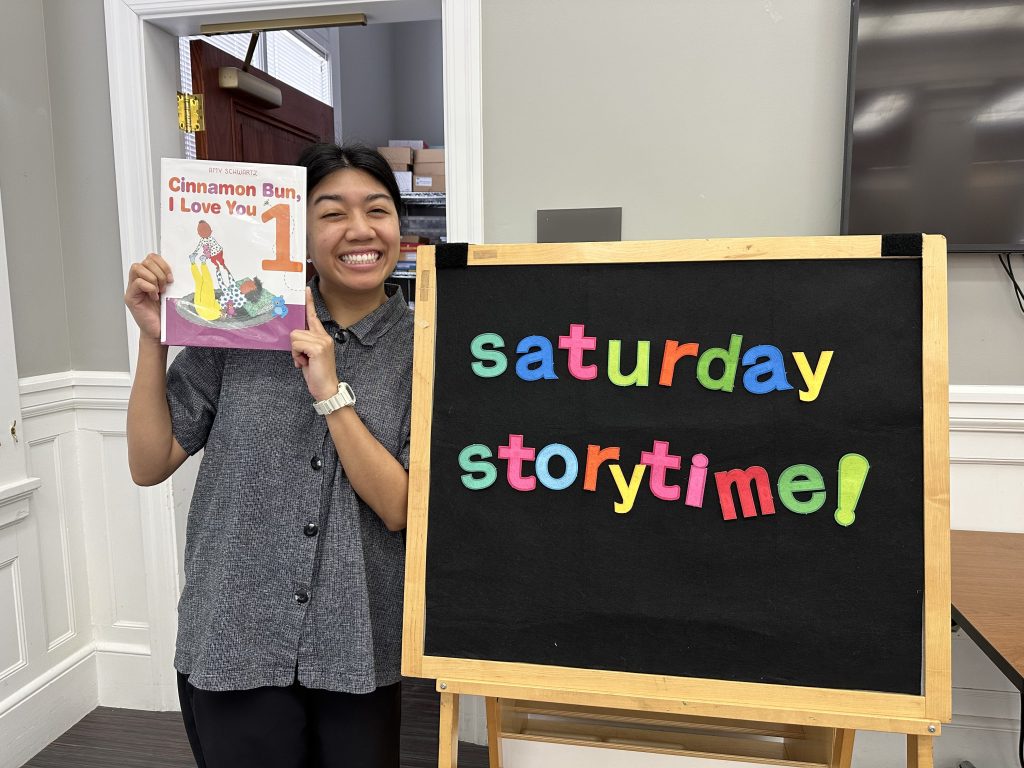
Me with a storytime book for Saturday Storytime at South San Francisco Library. March 2026.